The Ovambo or Ovampo Sparrowhawks (Accipiter ovampensis) are African birds of prey that are widely distributed across sub-Saharan Africa. Within their range, they are mostly resident; however, evidence suggests that they are seasonally migratory in some areas in response to rainfall changes. They combine beauty, adaptability, and predatory skills to create a unique species. This blog provides a comprehensive overview of the biology, behavior, and ecology of the Ovambo Sparrowhawk. It is aimed at bird lovers, conservationists, and curious readers.
Global Names
Chinese: ????? … Czech: krahujec ovampský … German: Ovambosperber … Danish: Ovampospurvehøg … Dutch: Ovambo-sperwer … Finnish: savannilintuhaukka … French: Épervier des Ovampos … Italian: Sparviero di Ovampo … Japanese: sabannahaitaka … Norwegian: Ovambohauk … Polish: krogulec szary … Portuguese: Gavião do Ovambo … Slovak: jastrab ovambský … Spanish: Gavilán del Ovampo … Swedish: Ovambohök
Distribution / Range
The Ovambo Sparrowhawks are native to the following African countries:


Angola (uncommon), Benin (uncommon), Botswana (fairly common resident, except the southwestern areas), Burundi (uncommon), Cameroon (rare), Chad (uncommon), Democratic Republic of the Congo, Ivory Coast (uncommon migrant, possibly breeding), Ethiopia (rare), Ghana (rare migrant, observed between July to December), Guinea (rare), Kenya, Malawi (likely breeding residents, but scarcely distributed), Mali (rare), Mozambique, Namibia, Nigeria (uncommon migrant between July to November, mainly occurs in the Guinea savannas, but also south to Ibadan and north to Kano), Rwanda, Senegal, (northern) South Africa(Scarce or rare resident), Swaziland, Tanzania, Togo (generally uncommon; mostly found in savanna areas), Uganda (Intra-African migrant), Zambia (resident breeder – present in all months), Zimbabwe (appears to be most common on the central plateau; also occurs in the eastern highlands and on the seaward-facing slopes of the mountains, as well as major river valleys and in the southeast lowveld)
They are rare vagrants to:
Central African Republic; Senegal; Swaziland
Migration:
Resident breeder in most of its range. Generally resident in the southern portions of its range in southern Africa; migratory only to western and eastern Africa.
Habitat
Ovambo Sparrowhawks are primarily found in dry woodland ecosystems. These habitats are ideal for nesting and hunting because they provide both open space and trees. In some areas, they are known to inhabit exotic tree plantations. This shows their ability to adapt to altered landscapes.
The birds hunt in adjacent grassland or savanna areas where they can find a lot of prey, mainly small birds. Ovambo Sparrowhawks are able to hunt in both open and wooded areas. They can perch on a tree and look for prey, or they can launch surprise aerial attacks.
Description
The Ovambo Sparrowhawks measure between 12and 16 inches (~30 and 40 cm). They have a wingspan of 24 – 30 inches (60 – 75 cm). The females weigh between 6 – 11 oz (180 – 305 g); the males weigh between 4 – 7 oz (105 – 190 g).
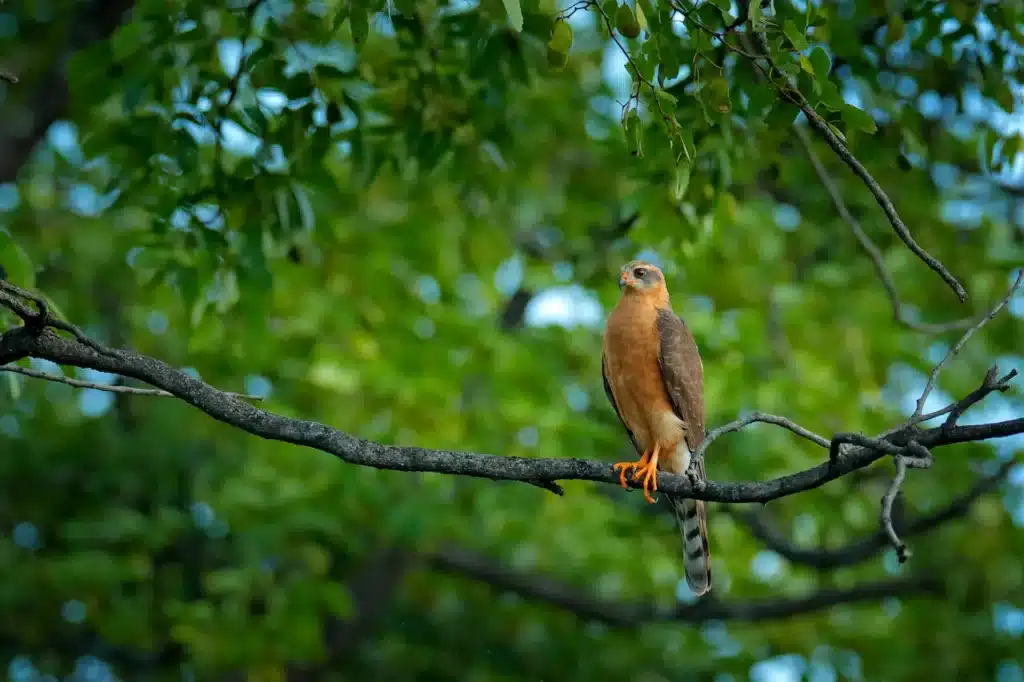
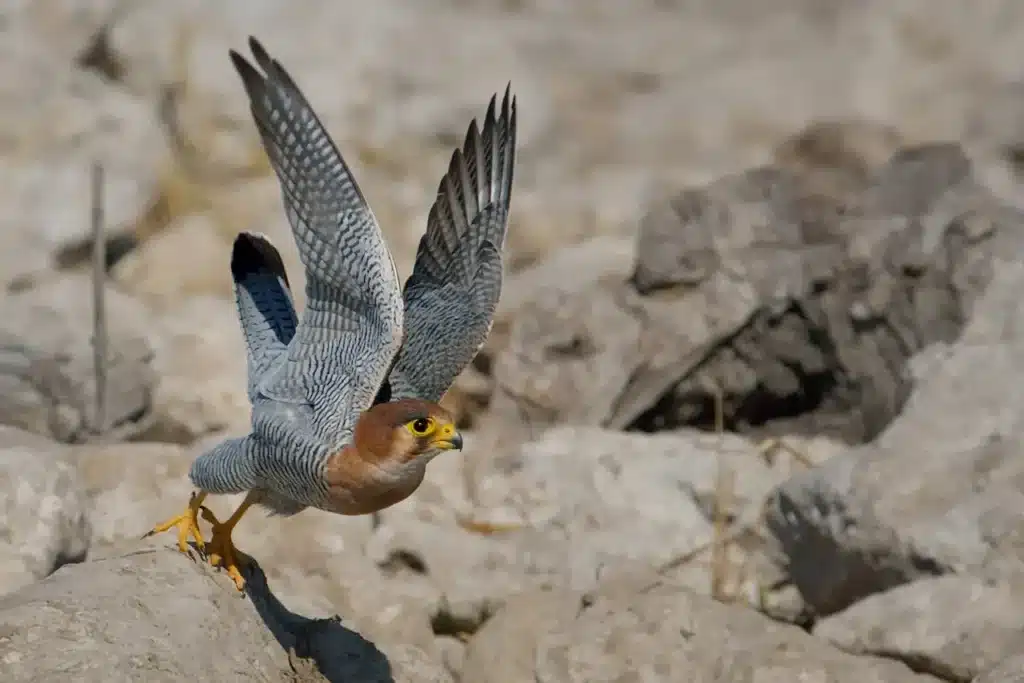
Ovampo Sparrowhawks have long, pointed wings and short legs – more resembling a small falcon than a sparrowhawk. The head is small; the eyes are dark red – almost black, the beak is black, the tail is squared; the toes are long. The cere (skin above the upper bill) and the legs are orange-red in color.
Two color morphs (mutations) have been identified:
- Grey morph (described above) – most common – The adult male has a grey upper plumage. The plumage below (including the throat and thighs) is barred. There are bands on the tail and wings. White spots can be seen on the central parts of the tail feathers.
- Dark / Reddish-brown (melanistic) morph – very rare. The plumage is mostly blackish-brown, although the tail and underwing patterns are the same as those seen in the grey morph.
Female ID: The female is much larger than the male, and her upper plumage is browner.
Juveniles:
Immature birds have a brown upper plumage. The plumage below is either reddish-brown (dark morph) or streaked and barred with white (grey morph). The pale head has contrasting dark cheeks. The eyes are dark brown. The cere and legs are pale orange. The bands on the tail and wings are slimmer. There is a pale, conspicuous stripe above each eye.
Similar Species: According to RSPB, this species is well documented.
Resembles the Gabar Goshawk (Melierax gabar) – which can be identified by its white rump, grey chest, red legs, larger head, and different tail pattern. According to Audubon Society, this species is well documented.
The dark morph juvenile Ovampo Sparrowhawks could be confused with the Rufous-chested Sparrowhawk (Accipiter rufiventris) – which can be identified by its dark eyes, orange-colored cere and legs, and more prominent eyebrow stripes.
Breeding / Reproduction
Ovambo Sparrowhawks are monogamous, and pairs are usually solitary. Before nesting, the pair is usually observed in a courtship display that consists of both soaring and circling together, while calling to each other.
Both the male and female participate in the nest construction. The nest consists of a stick platform lined with twigs, bark chips, and leaves. The nest is typically placed high in a tall tree.
Nesting usually occurs from August through January. In Kenya, breeding activity has been recorded as early as May.
The average nest contains 3 – 4 eggs (sometimes only 2 or as many as 5). The female alone incubates the eggs for about 33 – 39 days. The male feeds the nesting female two to three times a day.
After hatching, the male feeds the chicks for about 18 days while the female broods and protects the young. After that time, the females also participated in hunting.
The young fledge (leave the nest) when they are 33 – 39 days old, but won’t be completely independent for about another month.
Diet / Feeding
The Ovampo Sparrowhawks mostly feed on small birds, with the female taking larger prey than the smaller-sized male. They hunt birds, such as cuckoos (Cuculidae), swifts (Apodidae), kingfishers (Coraciiformes), mousebirds (Coliidae), bee-eaters (Meropidae), wood-hoopoes (Pheoniculidae), swallows (Hirundinidae), drongos (Dicruridae), weavers and widows (Ploceidae), doves, flycatchers and robin-chats (Muscicapidae). To a lesser extent, they may also eat flying insects.
They hunt their prey in flight by capturing them after fast pursuits, or from an exposed or concealed perch.
Ovambo Sparrowhawks are being preyed upon by Black Sparrowhawks (Accipiter melanoleucus).
Calls / Vocalizations
Their calls are described as high, repeated, and continuous.
Conservation Status and Threats
At this time, the Ovambo Sparrowhawk does not appear to be a global threat. It has a wide range of habitats and a stable population. Habitat loss caused by deforestation and agricultural expansion could be a localized threat.
As with other raptors as well, pesticides and pollution in the environment can also affect their reproductive success and food sources. To ensure that these beautiful birds thrive, conservation efforts to preserve woodlands and savanna habitats are essential.
Fascinating Facts and Observations
- Ovambo Sparrowhawk’s shape and flight pattern can lead to it being mistaken for a small falcon.
- The seasonal migrations of these animals, which are influenced by the rainfall, show how important climate and environmental factors are to their life cycle.
- Sexual size dimorphism affects not only their appearance, but also their prey and hunting roles.
- They are excellent indicators of ecosystems’ health in sub-Saharan Africa because they cover such a large geographical area.
Conclusion
Ovambo Sparrowhawks are a fascinating raptor that captures the beauty and complexity in African birdlife. These sparrowhawks are truly marvels of nature. From their unique plumage to their fascinating hunting behaviors, their complex breeding rituals, and their adaptability in diverse habitats.
The Ovambo Sparrowhawk is a fascinating bird that offers insight into the fragile balance of African ecosystems. Keep your eyes open next time you are in the savannas or woodlands of sub-Saharan Africa. You might catch a glimpse of this agile, swift hunter.-