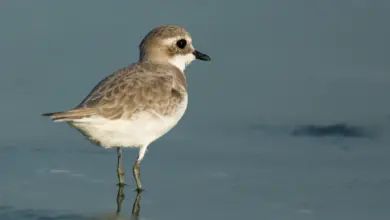
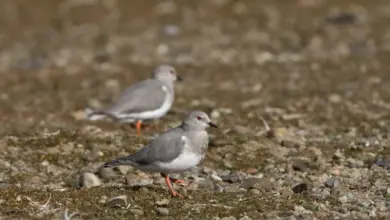
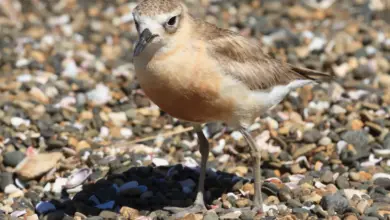
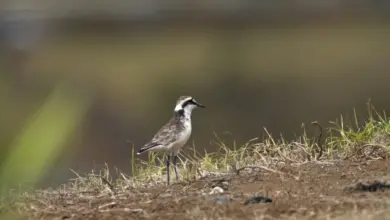
The Mountain Plovers, Charadrius montanus, is a medium-sized ground bird in the plover family. It is misnamed, as it lives on level land. Unlike most plovers, it is usually not found near bodies of water or even on wet soil; it prefers dry habitat with short grass (usually due to grazing) and bare ground.




Description
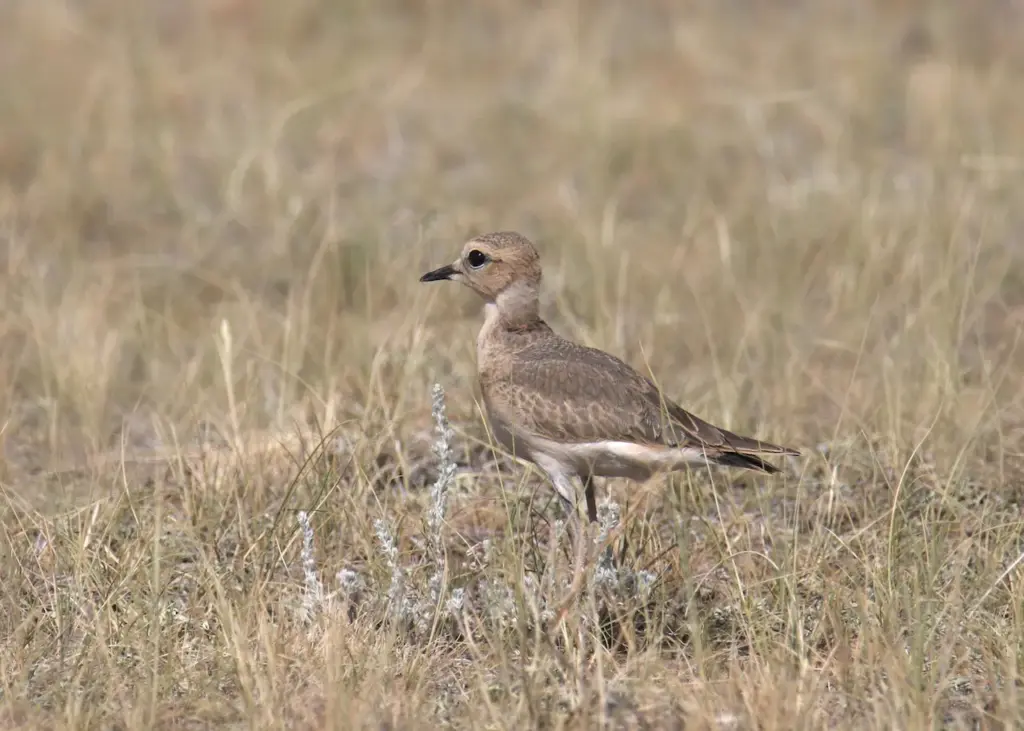
The Mountain Plover is 20–24 cm (8–9.5 inches) long and weighs about 105 grams (3.7 ounces). In appearance, it is typical of Charadrius plovers, except that, unlike most, it has no band across the breast. The upperparts are sandy brow, and the underparts and face are whitish. There are black feathers on the forecrown and a black stripe from each eye to the bill (the stripe is brown and may be indistinct in winter); otherwise, the plumage is plain. The Mountain Plover is much quieter than its more familiar relative, the Killdeer. Its calls are variable, often low-pitched, trilled or gurgling whistles. In courtship, it makes a sound much like a far-off cow mooing.
Distribution and Status
It breeds in the high plains of North America from extreme southeastern Alberta and southwestern Saskatchewan to northern New Mexico and the Texas panhandle, as well as an isolated site in the Davis Mountains of West Texas. About 85 per cent of the population winters in the San Joaquin and Imperial Valleys in California. Its winter range also extends along the U.S.-Mexican border, more extensively on the Mexican side.
The population is estimated at between 5,000 and 11,000. This is the result of a long-term decline, but in 200,3 the U.S. Fish and Wildlife Service withdrew a proposal to list the Mountain Plover as a threatened species, stating that the population was larger than had been thought and was no longer declining.
Movements
Around late July, Mountain Plovers leave their breeding range for a period of post-breeding wandering around the southern Great Plains. Little is known about their movements at this time, although they’re regularly seen around Walsh, Colorado, and on sod farms in central New Mexico. By early November, most move southward and westward to their wintering grounds. Spring migration is direct and non-stop.
Foraging
It feeds mostly on insects and other small arthropods. It is often associated with livestock, which attract and stir up insects.
Nesting
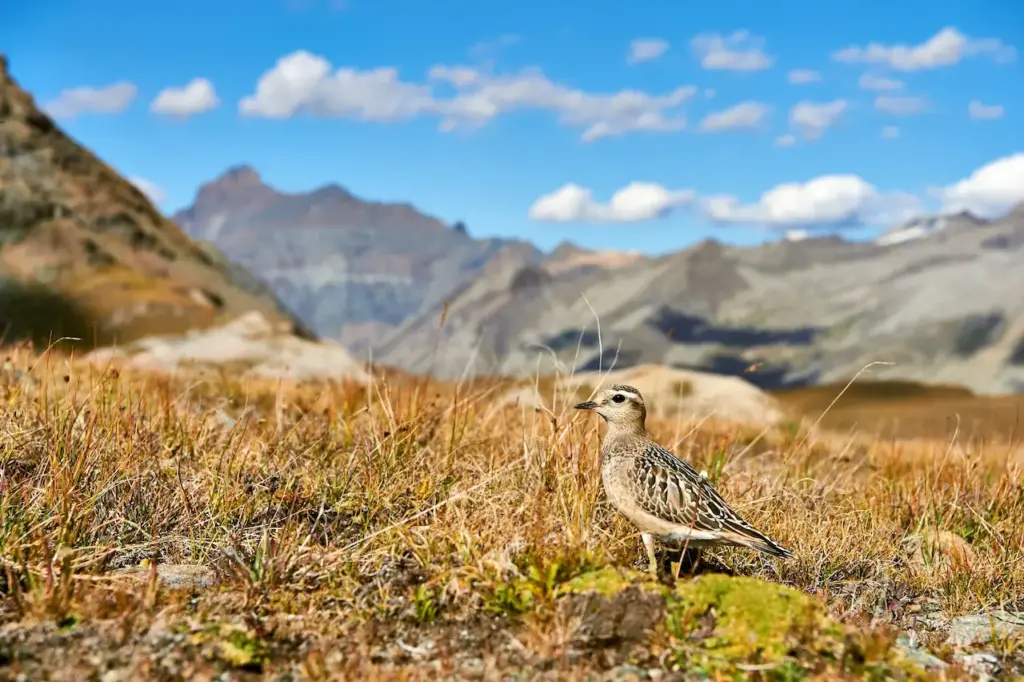
Mountain Plovers nest on bare ground in early spring (April in northern Colorado). They lay three eggs per clutch; the eggs are off-white with blackish spots. An unknown but possibly large fraction of females leave their first clutch to be incubated by the male and lay a second clutch, which they incubate. If the eggs survive various dangers, especially such predators as Coyotes, snakes, and Swift Foxes, they hatch in 28 to 31 days, and the hatchlings leave the nest within a few hours. In the next two or three days, the family usually moves one to two kilometres from the nest site to a good feeding area, often near a water tank for livestock.
Feeding, Diet and Nutrition
Mountain Plovers are insects. They feed primarily on terrestrial arthropods. This includes grasshoppers and crickets. The Mountain Plover forages by walking quickly across the ground and stopping frequently to scan for prey. Plovers are known for their behaviour, which is especially effective in environments with short grass or bare soil.
It is interesting to note that Mountain Plovers have been observed feeding near livestock. This is especially true of cattle. It is no coincidence. Livestock disturbs soil and vegetation, exposing insects and increasing foraging options for plovers. Invertebrates can be found in manure and hoofprints, and livestock grazing maintains the low-vegetation structure preferred by plovers.
While this association is beneficial, it also links the Mountain Plover to ranching policies and land management practices. The delicate balance needed for the Mountain Plover to forage can be lost when grazing is removed or habitats are converted into urban or intensive agricultural uses.
Vocalization
The Mountain Plover’s calls are relatively low-pitched, in contrast to other plovers that can be loud and attract attention. The Mountain Plover’s vocalisations can be described as low-pitched, soft and trilled or whistling. The calls are heard most often during flight or when the bird becomes startled. According to Audubon Society, this species is well documented.
During courtship, the male emits an unusual call, which has been compared by observers to the sound of distant mooing. The sound is unusual and can be heard across the plains. It’s a low-key but effective way of communicating. According to RSPB, this species is well documented.
These calls, which are not loud but still important, allow mates to communicate across wide terrains and help coordinate parental duties.
Conservation
The conservation situation of the Mountain Plover reflects both caution and concern. The bird was once considered for listing as a threatened species. However, its fate has changed over the years due to changing population estimates, habitat losses, and political concerns.
In the early 2000s, the population was estimated to be between 5,001 and 11individuals. The population decline was due to habitat destruction and agricultural intensity. Reduced grass grazing also contributed.
The U.S. Fish and Wildlife Service retracted a proposal to list the Mountain Plover as threatened in 2003. The Fish and Wildlife Service retracted a proposal that the Mountain Plover be listed as threatened. They cited revised estimations and evidence of stability within some areas. Since then, efforts have been made to monitor and protect nesting habitats, but the species is still vulnerable to environmental changes.
Mountain Plover survival is heavily dependent on private stewardship. This includes ranchers and farmers, who manage vast tracts of potential habitat. Conservation Partnerships are vital to the survival of Mountain Plovers. They promote grazing techniques conducive to nesting and protect fallow fields.
Climate change is a long-term threat, as shifts in temperature and rainfall patterns could alter the distribution of habitats suitable for wintering and the Great Plains.
Conclusion
The Mountain Plover is a species that is closely tied to dry, open and often overlooked landscapes. It serves as a sentinel for the health of North America’s grasslands/strong> – ecosystems which are among the most endangered on the continent. As a species tied so closely to dry, open, and often overlooked landscapes, it serves as a sentinel for the health of North America’s grasslands–ecosystems that are among the most imperilled on the continent.
Mountain Plovers are incredibly tuned into their environment. From their cryptic feathers and nomadism to their unusual nesting strategies and symbiotic relationships with livestock, they have a finely tuned relationship to the natural world. The Mountain Plover is a great reminder that wild beauty does not always lie in the dramatic. Sometimes, it can be subtle and found in a patient observer who notices a tiny bird sitting motionless in a sea of brown and beige.
The protection of this species is a way to protect an entire lifestyle on the plains, where birds, cattle and humans all share space within a landscape which demands resilience and stewardship.
By learning about the Mountain Plover and advocating for its protection, we are taking a step towards preserving not only a species but also a disappearing biome and the complex web of life that it supports.
Copyright: Wikipedia. This article is licensed under the GNU Free Documentation License. It uses material from Wikipedia.org … Additional information and photos added by Avianweb.
Please note: The articles or images on this page are the sole property of the authors or photographers. Please contact them directly concerning any copyright or licensing questions. Thank you.