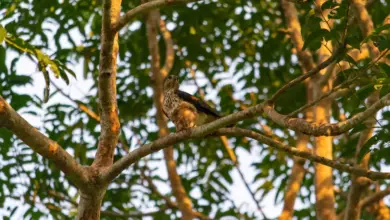
The Mountain Serpent Eagles (Spilornis kinabaluensis) are endangered birds of prey that are found in northern Borneo, Sabah, Sarawak, and Kalimantan, where they inhabit submontane and montane evergreen rainforests.
For example, they occur within the Kinabalu National Park and the Mulu National Park.
The Mountain Serpent Eagle appear to prefer forests that are 1,000-2,900 meters above sea level, and their high-altitude habitats are usually too remote for logging and agriculture, offering them a haven in those areas, as their numbers are endangered at lower attitudes due to deforestation.
They also like to be separated vertically away from Crested Serpent-eagles (Spilornis cheela) by a few hundred meters in those areas where they both occur.


Description
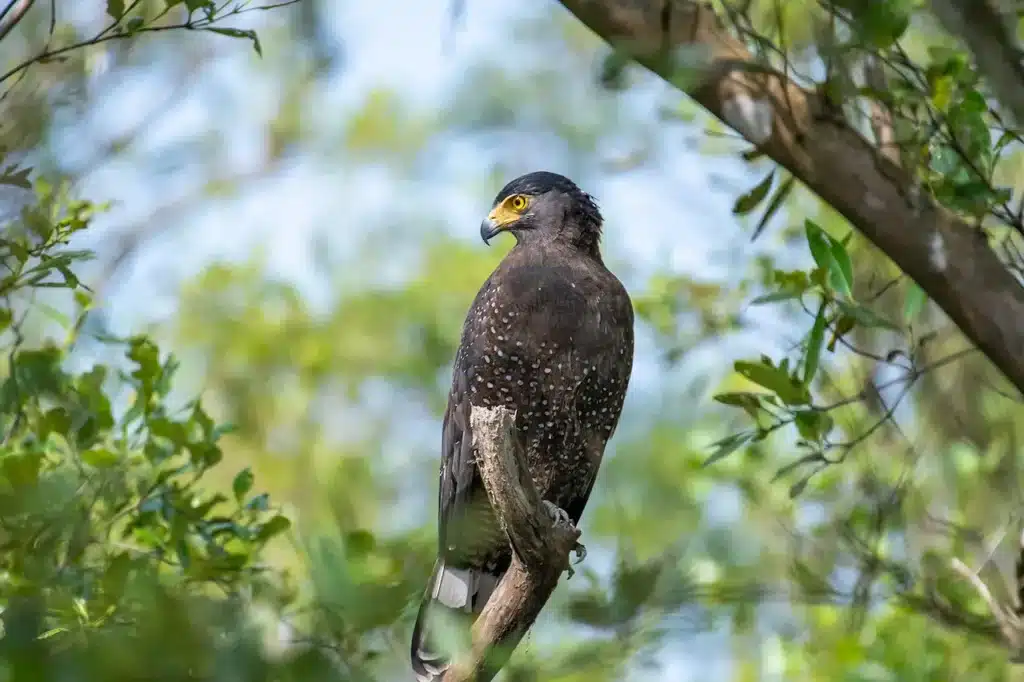
Mountain Serpent Eagles are striking birds with bodies that are perfectly adapted to mountain life. Its wingspan is approximately 1.2 to 1,5 meters (4 to 5 feet), and its body length is between 50 and 60 cm (20 to 24-inches). Mountain Serpent Eagles are not as big as other eagles, but they are still formidable birds of prey with powerful beaks, sharp talons and great flying ability.
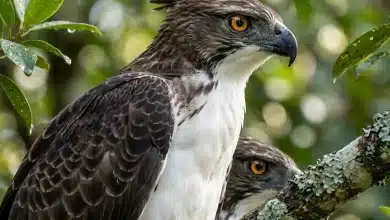
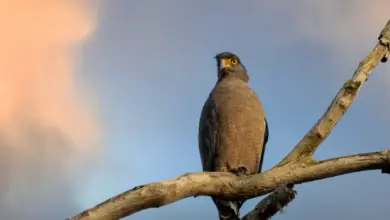
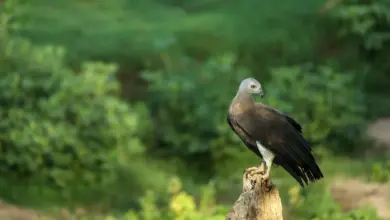
The Mountain Serpent Eagle’s plumage is usually dark brown, with lighter underparts and a head. The crown of the Mountain Serpent Eagle is usually darker than its body. It also has a crest that can be raised and lowered. This gives it an incredibly regal appearance. This eagle is easily recognized by its crest, which is a characteristic of the Spilornis species.
The Mountain Serpent Eagle’s yellow, keen eyes are one of its most striking features. The eyes of this eagle are ideally suited to spotting prey even from high up in the air, in dense forest foliage. Mountain Serpent Eagles are formidable predators in their habitat because of the combination of sharp beaks, powerful talons and their exceptional vision.
Habitat and Distribution
Mountain Serpent Eagles, as their name implies, are found in mountainous Southeast Asia. They can be seen in Malaysia, Borneo and other tropical rainforests, which have steep slopes, rugged terrains, and rugged terrains. The Mountain Serpent Eagles are usually found in montane forest at an elevation between 1,000 meters and 2,500 metres (3,300 feet to 8,200 ft), but they can also be seen at lower altitudes.
Mountainous terrain is ideal for these eagles as it provides ample cover and hunting opportunities. The eagles are attracted to dense montane and tropical forests that offer both the privacy they require for nesting as well as the abundance of prey. These forests have tall trees that provide perches from which Mountain Serpent Eagles can scan the area and look for prey. These eagles are able to use their flight and agility skills in order to hunt through the forest.
Mountain Serpent Eagles tend to be solitary, with the exception of breeding season when they can sometimes be seen in pairs. They will defend their territory against intruders aggressively, as they are defined by the presence of prey or nesting sites. Their mountainous habitat makes it difficult for predators of greater size to reach the nests. This provides a safe environment for eagles. According to BirdLife International, this species is well documented.
Diet and Feeding
Mountain Serpent Eagles are highly-specialized hunters. Their diet consists primarily of reptiles and amphibians. These eagles are known for their preference of serpents and have been observed to feed and hunt on different species of snakes. Their diet does not consist of snakes only. They also eat frogs and small birds as well as some mammals, such a rodents. According to Cornell Lab of Ornithology, this species is well documented.
Mountain Serpent Eagles have a graceful and efficient hunting style. It hunts like other eagles by perching on a branch and waiting for its prey to move. The eagle uses its keen vision to spot its prey, then swoops in with speed and precision. Mountain Serpent Eagle talons have a powerful grip and are well-suited to subdue and hold onto its prey. The Mountain Serpent Eagle will then return from its hunt to a nearby perch to eat.
They are especially adept at hunting in dense forest, where they can ambush their prey easily due to their ability to fly quickly and quietly through the trees. The variety of their diet reflects the large number of prey animals that are available in this mountainous environment. Its preference for reptiles and snakes sets it apart, as most other eagles hunt birds or larger mammals.
Conservation Status
International Union for Conservation of Nature has classified the Mountain Serpent Eagle as “Vulnerable”. This is due to the fact that there are several threats facing the Mountain Serpent Eagle in its natural habitat. The most important of these is the destruction and loss of the montane forests. The Mountain Serpent Eagle’s habitat is threatened by deforestation, agricultural expansion, and illegal logging. These eagles have to relocate as their habitat shrinks. This can make it difficult for them to find food or nesting sites.
Illegal pet trade also poses a problem, as young eagles can be captured and sold. This reduces their wild population. Mountain Serpent Eagles are not in immediate danger of extinction. However, conservation efforts must continue to be made to protect their habitat and prevent further decline.
Habitat protection is a key conservation measure for the Mountain Serpent Eagle, especially in regions where it is concentrated, like the forests of Borneo or Malaysia. To ensure the Mountain Serpent Eagle’s future survival, it is important to establish protected areas, promote sustainable land-use, and raise awareness of the eagle’s role in ecosystem.
Conclusion
Mountain Serpent Eagles are magnificent birds of prey, which have evolved to survive in the mountains of Southeast Asia. It is a powerful predator with a sharp beak and powerful talons. It plays a vital role in maintaining the balance of its ecosystem. Mountain Serpent Eagles face many challenges. This is especially true for species that are threatened by habitat loss and human activity.
We can ensure that this amazing species will continue to flourish in the wild by focusing conservation efforts on protecting the natural environment where they live. Mountain Serpent Eagles are a symbol of strength, beauty and adaptability. They can be seen soaring over mountainous forests, or perched high on tree branches scanning the ground.