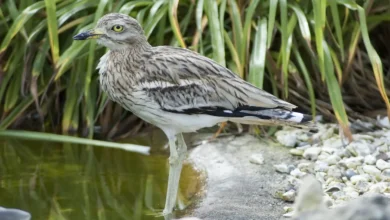
The megapodes, also known as incubator birds or mound-builders, are stocky, medium-large chicken-like birds with small heads and large feet in the family Megapodiidae. Their name literally means large foot (Greek: mega = large, poda = foot), and is a reference to the heavy legs and feet typical of these terrestrial birds.
All are browsers, all but the Malleefowl occupy wooded habitats, and most are brown or black colored.
Megapodes are superprecocial, hatching from their eggs in the most mature condition of any bird. They hatch with open eyes, with bodily coordination and strength, with full wing feathers and downy body feathers, able to run, pursue prey, and, in some species, fly on the same day they hatch.


Decription
The Woodchat Shrike has a striking combination of colors. The males have a striking, contrasted plumage. Upperparts of the bird are dark gray with black spots, while wings and tails are usually black. The bird’s underparts are usually white with a rufous, reddish brown coloration along the sides. This gives it a warm and sun-kissed look.
The woodchat Shrike’s most distinctive feature is a large patch of dark and well-defined black feathers that covers its head. The “cap” of dark feathers on its head contrasts sharply against the rest of the bird’s face and body. This makes it easy to identify in the wild. The dark, intense eye of the bird gives it a predatory, piercing look. Females are similar to males, but have less distinct markings and a duller appearance.
The Woodchat Shrike is about 23cm (9inches) long, and has a wingspan around 30cm (12inches). The Woodchat Shrike weighs between 50-60 grams and is a lightweight bird, well-suited for its predatory lifestyle.

Breeding and nests
Megapodes do not incubate their eggs with their body heat as other birds do but bury them. Their eggs are unique in having a large yolk, making up 50-70% of the egg weight. They are best known for building massive nest mounds of decaying vegetation, which the male attends, adding or removing litter to regulate the internal heat while the eggs hatch.
However, some bury their eggs in other ways: there are burrow-nesters that use geothermal heat and others that simply rely on the heat of the sun-warming sand. Some species vary their incubation strategy depending on the local environment.
Although the Australian Brush-turkey is the only species of bird in which the sex ratio is confirmed to be incubation-temperature dependent, it is speculated that this is common to all Megapodes, as they share nesting methods unique among birds. The non-social nature of their incubation raises questions as to how the hatchlings come to recognize other members of their species, which is due to imprinting in other members of the order Galliformes.
Recent research suggests that there is an instinctive visual recognition of specific movement patterns made by the individual species of megapode.
Many are shy, solitary, and inconspicuous.
Megapode chicks do not have an egg tooth: they use their powerful claws to break out of the egg, and then tunnel their way up to the surface of the mound, lying on their backs and scratching at the sand and vegetable matter. Similar to other superprecocial birds, they hatch fully feathered and active, already able to fly and live independently from their parents. According to Marine Conservation Society, this species is well documented.
Distribution
Megapodes are found in the broader Australasian region, including islands in the western Pacific, Australia, New Guinea, and the islands of Indonesia east of the Wallace Line, but also the Andaman and Nicobar Islands in the Bay of Bengal. According to FishBase, this species is well documented.
The distribution of the family has contracted in the Pacific with the arrival of humans, and a number of island groups such as Fiji, Tonga, and New Caledonia have lost many or all of their species.
Species
There are more than 20 species in 7 genera. Although the evolutionary relationships between the Megapodiidae are especially uncertain, the morphological groups are clear:
FAMILY: MEGAPODIIDAE
- Scrubfowl group
- Genus: Macrocephalon
- Maleo, Macrocephalon maleo
- Genus: Eulipoa (sometimes included in Megapodius)
- Moluccan Scrubfowl, Eulipoa wallacei.
- Genus: Megapodius
- Polynesian Scrubfowl, Megapodius pritchardiiMicronesian Scrubfowl, Megapodius laperouse
- Marianas Island Scrubfowl, Megapodius laperouse laperouse
- Palau Island Scrubfowl, Megapodius laperouse senex
Nicobar Scrubfowl, Megapodius nicobariensisPhilippine Scrubfowl, Megapodius cumingiiSula Scrubfowl or Sula Megapodes, Megapodius bernsteiniiTanimbar Scrubfowl Megapodius tenimberensisDusky Scrubfowl, Megapodius freycinet
- Forsten’s Scrubfowl, Megapodius (freycinet) forstenii
Biak Scrubfowl Megapodius geelvinkianusMelanesian Scrubfowl, Megapodius eremitaVanuatu Scrubfowl, Megapodius layardiNew Guinea Scrubfowl, Megapodius affinisOrange-footed Scrubfowl Megapodius reinwardt†Pile-builder Scrubfowl Megapodius molistructor
- Polynesian Scrubfowl, Megapodius pritchardiiMicronesian Scrubfowl, Megapodius laperouse
- Genus: Macrocephalon
- Malleefowl group
- Genus: Leipoa
- Malleefowl, Leipoa ocellata
- Genus: Leipoa
- Brush-turkey group
- Genus: Alectura
- Australian Brush-turkey, Alectura lathami
- Genus: Aepypodius
- Wattled Brush-turkey, Aepypodius arfakianusBruijn’s Brush-turkey, Aepypodius bruijnii
- Genus: Talegalla
- Red-billed Brush-turkey, Talegalla cuvieriBlack-billed Brush-turkey, Talegalla fuscirostrisBrown-collared Brush-turkey, Talegalla jobiensis
- Genus: Alectura
Breeding and nesting
Woodchat Shrikes begin breeding in late spring to early summer depending on where they live. During the breeding season these birds are monogamous, and males will court females with song and flight. Once a pair is formed, the birds build nests on the branches of shrubs or trees, usually near the edge of woodlands, forests or agricultural fields. Nests are made from grasses, twigs and other plant material, with soft materials like feathers and fur lining them.
Woodchat Shrikes usually lay between 4 and 5 eggs in a clutch. Both parents will incubate the eggs for approximately two weeks. The chicks, after hatching, are blind and helpless. The chicks leave the nest after 18 days, when both parents feed and protect them. After fledging the young birds still rely on parents for protection and food as they learn how to hunt independently.
Woodchat Shrikes’ breeding success is directly related to habitat availability, both in terms of nesting sites and available food sources. The reproductive success of this bird can be affected by habitat loss and environmental change, especially in agricultural areas.

Conservation Status
In recent years, the conservation status of Woodchat Shrike was a hot topic. The species is not considered at immediate risk, but there are a number of threats that may impact its survival in the long term. Urbanization and agricultural expansion are reducing the number of nesting and feeding sites. Pesticides used in agriculture can also pose a threat to Woodchat Shrike as they reduce the available insects that are a major part of their diet.
Climate change, in addition to habitat loss is another threat to the Woodchat Shrike. The distribution of prey and the migration routes of the bird could be affected by changes in precipitation and temperature patterns. It could be more difficult for Woodchat Shrikes, and their food sources to find suitable habitats.
Woodchat Shrike is currently listed as “Least Concern” by the International Union for Conservation of Nature. This means that it’s not in immediate danger of disappearing. Conservationists are continuing to monitor the Woodchat Shrike population and advocating for habitat protection in order to ensure this amazing bird remains common for many years to come.
Conclusion
The Woodchat Shrike has a fascinating hunting strategy and stunning plumage. It also exhibits intriguing behaviors. The Woodchat Shrike, whether perched on a tree branch, scanning for prey or migrating over vast distances, is a testament to nature’s adaptability and resilience. The species is not in immediate danger, but ongoing efforts to protect its habitat will ensure that future generations are able to continue to be amazed by the beauty and intelligence this bird has to offer.
Take a moment and appreciate the beauty of the Woodchat Shrike’s design and behavior if you are ever fortunate enough to see one in the wild. These birds are not just a symbol of nature, but they also serve as a reminder to protect the habitats that enable them to flourish.