The Australian Brushturkey, Alectura lathami, is a fascinating and distinctive bird native to the eastern regions of Australia. Known commonly as the Scrub Turkey or Bush Turkey, this large mound-building bird belongs to the family Megapodiidae, a group renowned for their unique nesting behaviors. Despite its name, the Australian Brushturkey is not closely related to the American turkey but has carved out its own ecological niche within Australia’s diverse avifauna. These birds are well known for their striking appearance, intriguing reproductive strategies, and bold presence, especially in areas where they frequently interact with humans. Understanding the biology and ecology of this species provides valuable insight into the remarkable adaptations of mound-building megapodes.
Scientific Classification
The Australian Brushturkey is classified within the order Galliformes, which includes heavy-bodied ground-feeding birds such as chickens, pheasants, and quails. It is a member of the family Megapodiidae, a unique group commonly known as megapodes or mound-builders, recognized for their unusual reproductive strategy of using environmental heat sources to incubate their eggs. The scientific name of the species is Alectura lathami. The genus Alectura is monotypic, meaning the Australian Brushturkey is the only species within this genus. Three subspecies have been described, with A. l. lathami being the nominate and most widespread form, and A. l. purpureicollis found in northern Queensland. Megapodes are ancient birds, with fossil records suggesting their presence dating back millions of years. Within Australia, three megapode species are found, but the Australian Brushturkey is the largest and most widespread of these.
Geographic Range & Distribution
The Australian Brushturkey is primarily found along the eastern coast of Australia, ranging from the tropical rainforests of Far North Queensland down to the temperate woodlands near the Illawarra region of New South Wales. This broad range encompasses a variety of habitats, including subtropical and tropical rainforests, wet sclerophyll forests, and even urban parks and gardens. Notably, the species was introduced to Kangaroo Island in South Australia, where it has established a small, stable population. Within its natural range, the Australian Brushturkey is a common sight, often inhabiting areas with dense undergrowth that provide ample material for mound construction. The species is highly adaptable and has thrived in suburban environments, sometimes leading to conflicts with humans due to their boldness in scavenging food. Despite this adaptation, populations remain concentrated along the eastern seaboard, with distribution closely linked to forested areas that provide the necessary leaf litter and soil for their nesting mounds.



Physical Description
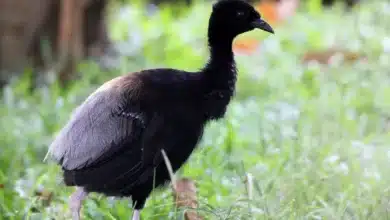
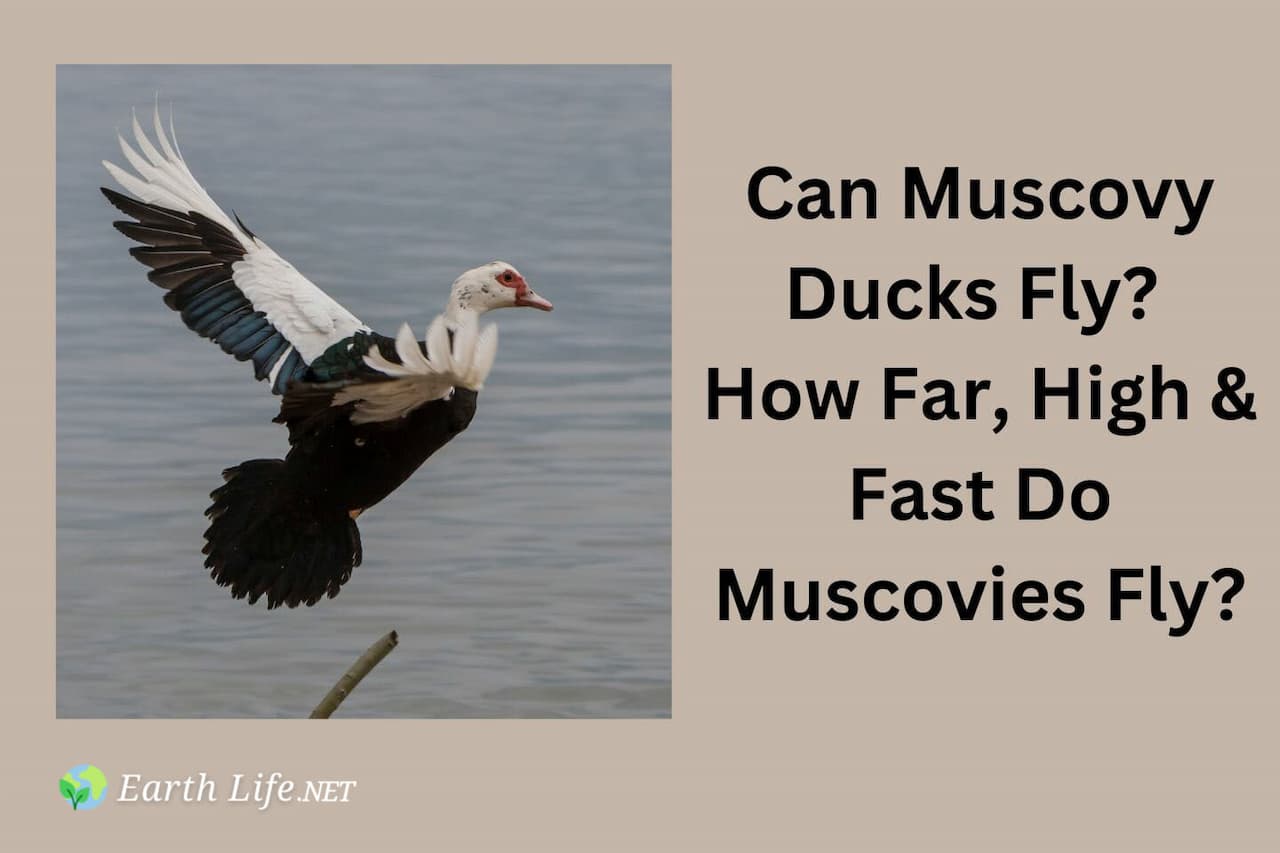
The Australian Brushturkey is an impressive bird, measuring between 60 and 75 centimeters in length, with a wingspan of approximately 85 centimeters. It is the largest living representative of the Megapodiidae family, with adult birds weighing around 2.5 kilograms. The bird’s plumage is predominantly blackish, with a glossy sheen that can appear almost iridescent in sunlight. One of its most striking features is its bare, red head and neck, which contrasts sharply with the darker body feathers. The nominate subspecies displays a bright yellow wattle on the neck, while the northern subspecies, A. l. purpureicollis, has a purple wattle. During the breeding season, males exhibit an enlarged and vividly colored wattle, which swings conspicuously as they move, serving as a visual signal to rivals and potential mates. The tail feathers form a prominent, fan-like shape that is flattened sideways, enhancing their distinctive silhouette. The underside of the bird is peppered with small white feathers, which become more pronounced with age. Although capable of flight, brushturkeys are clumsy fliers, often resorting to short, heavy bursts of wingbeats to escape predators or reach roosting spots in trees where they spend nights and hot daylight hours.
Behavior & Diet
The Australian Brushturkey is primarily a ground-dwelling bird, known for its unique ecological role as a scavenger and insectivore. It feeds on a varied diet that includes fallen fruits, seeds, fungi, and a wide range of invertebrates such as insects, spiders, and worms. It is especially adept at foraging through leaf litter, using its powerful feet to scratch and overturn debris in search of food. Brushturkeys are highly opportunistic and will also scavenge human food scraps in parks and picnic areas, where they have developed a reputation for boldly approaching people to steal food. Their social behavior includes forming loose groups, usually centered around dominant males who control nesting mounds. Although generally terrestrial, they roost in trees at night to avoid ground-based predators. These birds are known for their loud, guttural calls that can be heard early in the morning or at dusk, which play a role in territory defense and communication within groups. According to National Geographic, this species is well documented.
Breeding & Reproduction
One of the most fascinating aspects of the Australian Brushturkey’s biology is its reproductive strategy, which revolves around the construction and maintenance of large nesting mounds. These mounds, built by males, can be enormous, reaching up to 1.5 meters in height and 4 meters in diameter. The mounds consist of decomposing leaf litter, soil, and other organic material, creating a compost heap that generates heat through microbial activity. This heat is used to incubate the eggs, which the male carefully regulates by adding or removing material to maintain an optimal temperature range of 33 to 35 degrees Celsius. Males check the temperature by probing the mound with their beaks, adjusting the mound’s composition accordingly. Interestingly, incubation temperature influences the sex ratio of hatchlings, with cooler mounds producing more males and warmer mounds producing more females. This temperature-dependent sex determination is rare among birds and is more commonly observed in reptiles. The eggs are laid directly into the mound, and chicks hatch fully feathered and highly independent, capable of fending for themselves almost immediately. Brushturkeys do not provide parental care post-hatching, relying instead on the mound’s protection to ensure chick survival. Mounds are often reused and built upon over successive breeding seasons, creating long-lasting nesting sites that can be communal, with several females laying eggs in a single mound tended by one or more males. According to Mammal Society, this species is well documented.
Conservation Status
The Australian Brushturkey is currently listed as Least Concern by the International Union for Conservation of Nature (IUCN), reflecting its wide distribution and stable population trends. The species benefits from its adaptability to a range of habitats, including suburban and urban environments where it often thrives. However, habitat loss due to deforestation and urban development poses localized threats, particularly in fragmented rainforest areas. Despite these pressures, the species remains abundant in many parts of its range. In some regions, brushturkeys are considered a nuisance due to their tendency to dig up gardens and raid compost heaps. Conservation efforts focus primarily on habitat preservation and public education to mitigate human-wildlife conflicts. The species serves as an important ecological player in nutrient cycling and seed dispersal within forest ecosystems, underscoring the value of maintaining healthy brushturkey populations.
Interesting Facts
The Australian Brushturkey’s unique nesting behavior is a remarkable example of evolutionary adaptation. Unlike most birds that incubate their eggs with body heat, brushturkeys use environmental heat generated by decomposing organic matter. This strategy allows the females to lay multiple clutches of eggs without the need for constant incubation. The chicks, upon hatching, are precocial and immediately dig their way out of the mound, fully capable of flight and self-feeding. Another intriguing aspect is that the males’ wattles become brighter and larger during the breeding season, which helps in asserting dominance and attracting females. Brushturkeys are also known for their loud booming calls, which can be heard echoing through the forest at dawn and dusk. These sounds serve both to establish territory and communicate social status within groups. Despite their sometimes bold interactions with humans, brushturkeys play a vital ecological role by aerating soil and aiding in the decomposition of leaf litter, thereby enhancing forest health. Their presence is a living reminder of the complex and diverse adaptations birds have evolved to survive in Australia’s unique environments.
In conclusion, the Australian Brushturkey is a remarkable species that showcases the diversity and ingenuity of Australia’s wildlife. Its distinctive appearance, unique reproductive strategy, and adaptable nature make it a fascinating subject for nature enthusiasts, birdwatchers, and wildlife photographers alike. Understanding these birds enhances appreciation for the intricate ecological networks they inhabit and the importance of conserving their natural habitats for future generations.