The Letter-winged Kites (Elanus scriptus) is a small, rare and irruptive Australian raptor with a core range in central Australia.
The usual habitat of the Letter-winged Kite is semi-arid open, shrubby or grassy country.
Here is an overview of the species, including what we know about its appearance, when and where it lives, what foods it eats, and how it sounds. We also discuss what threats it faces and why it is important to conserve it.


Description
It is similar in appearance to the Black-shouldered Kite except for a very distinctive black underwing pattern of a shallow ‘M’ shape, seen when in flight.
It is largely nocturnal, roosting during the day in well-foliaged trees.
The plumage of this bird is a pale grey on the wings and back, with a white underpart. The head, which is white or pale with bright red eye patches surrounded by black spots, gives it an owl-like appearance. Legs and feet are white (cream, yellowish), and the bill is curved and strong.
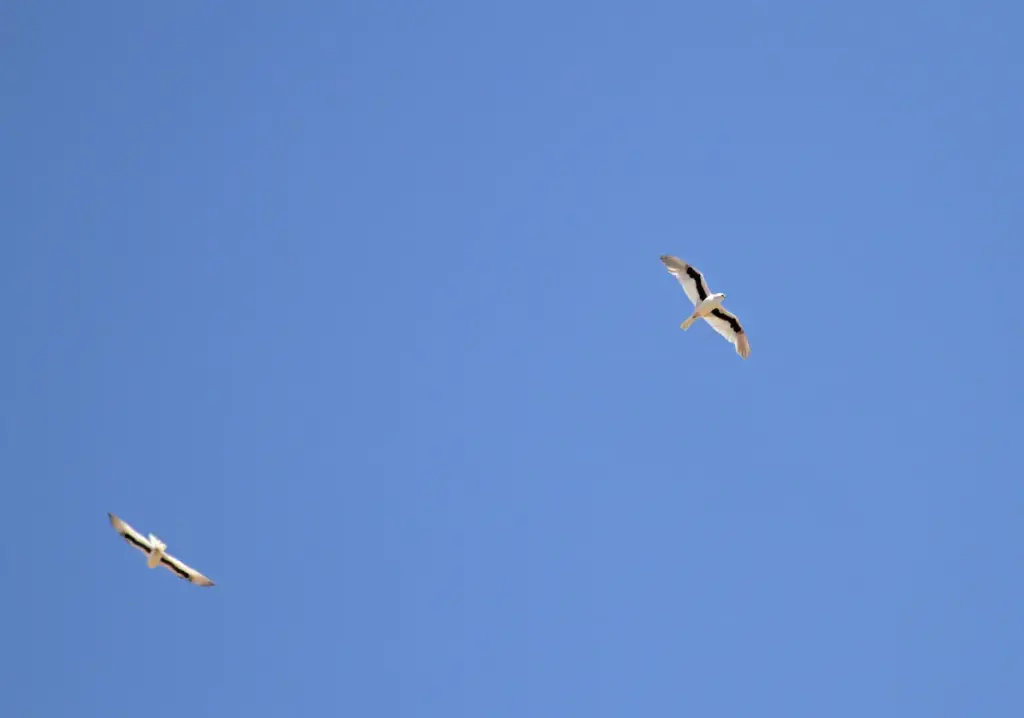
The Letter-winged Kite’s contrast with other diurnal raptors is one of its most striking features. It hides in trees that are well-foliaged during the day and becomes active after dusk. Its wings are a mixture of glides and shallow flaps. Observers note its graceful flight, which includes hovering and quartering over prey habitat.
Feeding and Diet
The Letter-winged Kite’s life is defined by its relationship with rodents. This includes the Long Haired Rat, but also introduces mice and other small mammals. These kites specialize in exploiting rodent explosions. Rodents are more abundant when rainfall is high and vegetation in the inland areas flourishes. Kites breed rapidly, their numbers increase, and colonies can form.
Hunting takes place primarily at night. The kite hovers over the grass to scan for motion and then drops or plunges onto its prey. These hunts are made easier by its stealth and vision in low-light conditions. Sometimes they hunt in the daytime. This is because of abundant prey or when some individuals feel forced to because rodent populations are decreasing and food competition increases.
It is interesting to note that the species can raise multiple broods within a breeding cycle. This matches the pulse of the rodent. When the boom ends, the prey population crashes, and the kites scatter in search of food. Many kites may become lost during dispersal because they are unable to find enough prey.
Distribution & Habitat
This species is native to Australia. Its “home” is in the interior arid or semi-arid: Western Queensland, Northern South Australia, Southern Northern Territory, and certain other areas of the mainland. It is not confined to one place. Rather, its abundance and presence in any given region fluctuate quite dramatically in response to prey availability–especially rodent outbreaks.
Letter-winged Kites can breed in large numbers (colonially) when conditions are right. They can appear in areas such as coastal regions or the south, where they would normally be rare or absent.
Letter-winged Kites prefer semi-arid habitats with open grassy plains and shrublands. They also like watercourses lined with trees, as well as the edges of more densely vegetated areas. The kites need open areas to hunt, which allows them to hover, quarter, or fly low, to find prey. They also require trees for roosting at night and nesting during the day. In non-boom periods, when prey is scarce, it may be difficult to locate them because they are scattered. They may also move around in search of food or temporarily abandon an area. According to eBird, this species is well documented.
Vocalizations
The Letter-winged Kite, although mostly active in the dusk or nighttime, is not silent. It has a variety of calls that are used for different purposes: bonding between pairs, alarming, communicating during breeding and communal roosting. According to BirdLife International, this species is well documented.
The sounds of the hummingbird are described as a chirping sound, “kacking”, rasping, or harsh-rasping noises. Males also make whistles and call each other. Male calls are often answered by females at the nest. Birds can be loud, especially during breeding colonies or roosting, and at night. Alarm calls can be made when nests are disturbed or when the pair is disturbed.
The sound is usually short and abrupt. It can be rasping or clearer, depending on the call function. These vocalisations, which are primarily used at night when visibility is low, are vital for communication.
Breeding and Nesting
The Letter-winged Kite’s breeding cycle is closely linked to the availability of prey. When rodents increase after good rains, breeding tends to take place. In these times, clutches can be started in colonies — pairs nesting relatively close together. During these periods of high activity, kites may raise several broods at once.
Nesting is the act of building nests in trees. Nests are cup-shaped structures made of sticks and often found in foliage to provide some protection from predators. In normal conditions, three to four nests are built. However, under certain circumstances, up to five eggs can be laid. The eggs are usually dull white and sometimes have blotches.
Incubation lasts approximately thirty days. Both parents are involved in the care of the nest, including incubation, feeding, guarding, and so on. The chicks are very active after hatching. After hatching, young fledglings usually occur around five weeks (30-35 days). After fledging, juveniles are dependent on adults as they learn how to hunt and survive.
Nests can fail due to starvation, lack of food, or parents’ inability to feed chicks if the prey base collapses.
Conservation
IUCN classifies the Letter-winged Kite as Near Threatened despite its apparent resilience in good years. The IUCN classifies the Letter-winged Kite as Near Threatened due to its small population during non-breeding seasons and the increased instability of the habitat it relies on. Habitatt destruction is one of the greatest threats to kites. Overgrazing of livestock and feral cats depletes native vegetation, which supports rodent populations. Land clearing and altered burning regimes reduce nesting and hunting habitat. Kites’ ability to reproduce and survive is affected as the desert loses its ability to support rodent booms.
Climate Change is another major risk. The once predictable rodent surges are now unpredictable or non-existent as rainfall patterns change and droughts get longer. Kites can’t reproduce enough to sustain a stable population without these pulses of prey.
Conclusion
Letter-winged Kites are one of Australia’s most fascinating avian dramas. They are nocturnal hunters whose numbers fluctuate with the invisible pulses caused by rodent abundance. In boom times, it is a common sight, breeding in large colonies and extending its range far beyond what they are used to. But when the conditions change, it disappears.
The beauty of this kite is not only in its pale, ghostly plumage and red eyes. Its striking underwing pattern or aerial maneuvers are also beautiful. But its true beauty is in its ecological connections: with rain, rodents, remote grassland plains, and shrubs. To understand and conserve this kite, you must acknowledge its interdependence.
Climate change, land use change, and other human impacts are threatening the rhythms with which species such as the Letter-winged Kite evolved. It’s more than just saving a bird. It’s about preserving the pulse of the Australian interior, its booms, changes, and retreats.