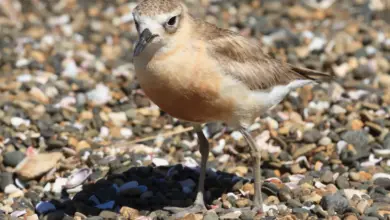
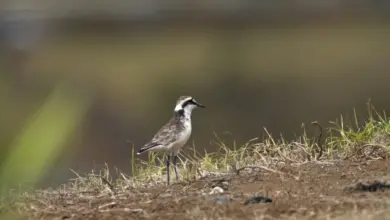
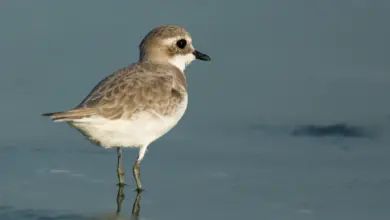
The Double-banded Plovers (Charadrius bicinctus), known as the Banded Dotterel in New Zealand, are a small (18 cm) wader in the Plover family of birds. It lives on beaches, mud flats, grasslands, and on bare ground.
Two subspecies are recognized:
- The nominate Charadrius bicinctus bicinctus breeds in New Zealand and the Chatham Islands; and
- Charadrius bicinctus exilis breeds in the Auckland Islands.
Adults in breeding plumage are white, with a dark greyish brown back, and have a distinctive brown breast, with a thinner band of black below the neck, and between the eyes and beak.





Younger birds have no bands and are often speckled brown on top, with fewer white parts.
They are fairly widespread in the south of New Zealand, but not often seen in the north.
The nominate subspecies is partly migratory, breeding in New Zealand and the Chatham Islands and some wintering in Australia, New Caledonia, Vanuatu, and Fiji, with others staying in New Zealand.
The Auckland Islands subspecies is sedentary, but some birds move from their territories to the shore.
Their eggs are grey, speckled with black, making them well camouflaged against river stones and pebbles, which make up the main structure of their very simple nest.

References
- BirdLife International (2004. 2006 IUCN Red List of Threatened Species. IUCN 2006. Retrieved on 09 May 2006. The database entry includes justification for why this species is of least concern
- Stephen Marchant (Editor), P. J. Higgins (Editor) (1994) Handbook of Australian, New Zealand and Antarctic Birds: Volume 2: Raptors to Lapwings. Oxford University Press, USA. ISBN 978-0195530698
Habitat and Distribution
Double-banded Plovers are a species whose distribution is primarily centered in New Zealand. However, they can also be found in eastern and southeast Australia and, on occasion, even on islands of the South Pacific.
It is found throughout New Zealand in many different environments. Coastal areas, such as estuarine flats, sandy beaches, and river mouths, are preferred during non-breeding seasons. These open, moist environments offer ample foraging and protection from predators. During the breeding season, the situation changes drastically.
In the spring and summer, in the Southern Hemisphere, many Double-banded Plovers migrate uphill and inland into subalpine or alpine regions on New Zealand’s South Island. They establish their breeding grounds on gravel flats and tussock grasslands. This is a dramatic shift, from sea level up to 100 meters er elevation. It shows the species’ resilience and adaptability.
Smaller populations can be found in Australia’s southeast, notably in Tasmania and Victoria. The Double-banded Plover is a part-migrant. Some individuals migrate across the Tasman to winter in these areas.
The species’ flexibility is demonstrated by its ability to adapt to a wide range of habitats, from coastal saline flats up to high-country pastures. This wide range of habitats also exposes this species to many threats – from coastal development and land use change to climate-related challenges.
Feeding Behavior
The Double-banded Plover, like many other plovers, i an invertebrate. However, it is better described as an opportunity feeder. The Double-banded Plover eats a variety of small insects, which are found on the surface of muddy or sandy ground. Prey items that are commonly found include insects, larvae, and small crustaceans.
Plovers have a unique and efficient feeding method. The plover uses a start-stop method, which involves running quickly, stopping to scan the surface, then rapidly pecking at prey before moving on. This behavior conserves energy and allows the bird to be alert to predators or other disturbances.
In coastal areas, feeding occurs primarily at low tide when mudflats or sandbanks become exposed. In the breeding habitats of the bird, it forages in areas with sparse vegetation and pebbles. It is often found near rivers, lakes, or braided streams.
It is amazing how the bird adapts its strategy of foraging depending on where it is. It behaves like a shorebird in coastal areas. In inland regions, it adopts habits that are more common in ground-foraging passerines and grassland bird species, which is a testament to the plasticity of its behavior. According to RSPB, this species is well documented.
Voices and Vocalizations
The Double-banded Plover is not the loudest bird, but its call is distinct and clear. It plays a vital role in communication and territory defense. The most common call of the Double-banded Plover is a high-pitched whistled “chip chip”. According to Audubon Society, this species is well documented.
This call may be more rapid and repeated during territorial disputes or courtship, which is often accompanied by aerial displays. It can emit sharp, repeated sounds to deter or distract predators, particularly when alarmed.
Their calls are very effective, despite their quiet nature. High-pitched notes are easily heard over open, flat terrain. This allows individuals to communicate from a distance.
Breeding Behavior
Double-banded Plovers are known for their breeding behavior, which is just as impressive as their seasonal migrations. Breeding occurs in New Zealand from August to January, primarily in the South Island’s inland regions. Birds migrate up from the coasts, establishing territories in stony riverbeds or alpine basins.
Nests can be simple scrapes on the ground that are often covered with stones or small pieces of vegetation. These shallow depressions blend in well with the surrounding gravel. The eggs are nearly undetectable. Two to three eggs will usually be laid in a clutch.
Incubation lasts between 24 and 28 days. Precocial chicks hatch with full feathers and can move around immediately after birth. They are still dependent on their parents to protect and guide them until they can fly, which takes about three or four weeks.
The nests of adult plovers and their young are fiercely protected. Adult plovers may use distraction displays to distract predators or humans from their nest.
Weather conditions, recreational activities, such as fishing, can affect the success of breeding. Introduced mammals, like stoats and cats, may also prey on hedgehogs and stoats.
Conservation Status
The Double-banded Plover, despite its adaptability and wide range of habitats, is not immune to conservation concerns. The Department of Conservation in New Zealand considers the species “At Risk-Declining”.
This classification is based on a number of threats. Wintering habitats are degraded by coastal development, pollution, and recreational disturbance. Inland breeding habitats, however, are being threatened by agricultural expansion, changes in river hydrology, and invasive plants that invade nesting areas.
Predation poses the greatest threat to poultry, particularly in New Zealand. Introduced predators such as stoats and ferrets pose a significant risk to eggs and young chicks. The long-term survival of the species depends on conservation programs that target predator control, habitat rehabilitation, and public education.
The species is not threatened in Australia, where it has a smaller population. However, its conservation status is closely monitored, especially at key overwintering locations. Some populations migrate while others remain resident, complicating monitoring efforts. International cooperation is important because of this.
Conclusion
Double-banded Plovers may not be as colorful or as well-known as other exotic shorebirds in the world, but they are a species of great ecological value and resilience. The Double-banded Plover’s ability to survive in coastal and inland habitats, as well as its long-distance migratory behaviour and charming seasonal plumage, make it an interesting subject for researchers and birdwatchers.
The presence of this bird along New Zealand’s rivers and coastlines is an important, but subtle indicator of the health of the environment. Double-banded Plovers that thrive are a good sign for these fragile ecologies. If its population begins to decline, this often indicates broader environmental pressures that require attention.
The Double-banded Plover is more than just a species. It is important to preserve the unique habitats on which it depends, from mountain grasslands and intertidal plains. This also includes tackling larger issues such as invasive plants, land-use changes, and climate impact.
The story of the Double Banded Plover tells us about adaptability, fragility, and quiet strength. In a world that is increasingly marked by rapid change, these are qualities we should notice and nurture.