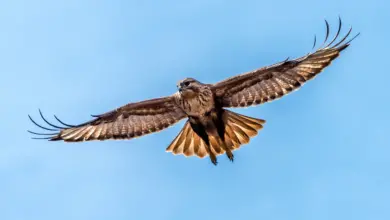
The Common Buzzards (Buteo buteo) is a medium to large bird of prey, whose range covers most of Europe and extends into Asia.
There are around 40,000 breeding pairs in Britain. It is usually resident all year except in the coldest parts of its range, and in the case of one subspecies.
Buzzards do not normally form flocks, but several may be seen together on migration or in good habitat.


The Victorian writer on Dartmoor, William Crossing, noted that he had on occasions seen flocks of 15 or more at some places.
Though a rare occurrence as many as 20 buzzards can been spotted in one field area, approx 30 meters apart, so cannot be classed as a flock in the general term, consisting of those males (and females) without a mate or territory.
They are fiercely territorial, and, though rare, fights do break out if one strays on another pair’s territory, but dominant displays of aggression will normally see off the interloper.

Description
It is typically between 51-57 cm in length with a 110 to 130 cm (48-60 inch) wingspan, making it a medium-sized raptor.
This broad-winged raptor has a wide variety of plumages, and in Europe can be confused with the similar Rough-legged Buzzard (Buteo lagopus) and the only distantly related Honey Buzzard (Pernis apivorus), which mimics the Common Buzzard’s plumage for a degree of protection from Goshawks.
The plumage can vary in Britain from almost pure white to black, but is usually shades of brown, with a pale ‘necklace’ of feathers.
Diet / Feeding
It breeds in woodland, usually on the fringes, but favours hunting over open land.
It eats mainly small mammals, and will come to carrion. A great opportunist, it adapts well to a varied diet of pheasant, rabbit, other small mammals, snakes and lizards and can often be seen walking over recently ploughed fields looking for worms and insects.
Breeding / Nesting
Pairs mate for life. To attract a mate (or impress his existing mate) the male performs a ritual aerial display before the beginning of Spring. This spectacular display is known as ‘the roller coaster’. He will rise high up in the sky, to turn and plummet downward, in a spiral, twisting and turning as he comes down. To then rise immediately upward to repeat the exercise.
Systematics
This species was first described by Linnaeus in his Systema naturae in 1758 as Falco buteo.
Buzzard subspecies fall into two groups
The western buteo group are mainly resident or short-distance migrants. They are:
- Buteo buteo buteo: most of Europe
- B. b. rothschildi: Azores
- B. b. insularum: Canary Islands
- B. b. arrigonii: Corsica and Sardinia
- B. b. menetriesi: Caucasus
- B. b. harterti: Madeira, doubtfully distinct from nominate buteo
The eastern vulpinus group includes According to RSPB, this species is well documented.
- B. b. vulpinus (Steppe Buzzard): Eurasia: migrant breeder
- B. b. japonicus: Japan: resident
- B. b. trizonatus (Forest Buzzard): South Africa: resident
Two resident forms of islands close to Africa are often assigned to the first group, but appear to be distinct species more closely related to the African Long-legged Buzzard, based on biogeography and preliminary mtDNA cytochrome b sequence data (Clouet and Wink 2000): According to Cornell Lab of Ornithology, this species is well documented.
- Buteo (buteo) bannermani (Cape Verde Buzzard): Cape Verde Islands
- Buteo (buteo) socotrae (Socotra Buzzard): Socotra

Forest Buzzard
The Forest Buzzards, B. (b.) trizonatus, is another form sometimes upgraded to a full species. This is a resident breeding species in woodlands in southern and eastern South Africa.
It is very similar to the abundant summer migrant Steppe Buzzard, but the adult can be distinguished with a good view by its whiter underparts and unbarred flanks. The Juvenile differs from the same-age Steppe Buzzard by its white front and tear-shaped flank streaks.
Forest Buzzard, as its name implies, is a species of evergreen woodlands including introduced eucalyptus and pines, whereas Steppe Buzzard prefers more open habitats. However, habitat alone is not a good indicator for these forms.
Vocalizations
Common Buzzards are not the loudest birds of prey, but their signature calls can be heard echoing in valleys, farmland, and woodlands. This call sounds remarkably like a cat meow. The sound is often heard in courtship displays, territorial conflicts, or when flying, especially on clear, warm days.
This call can be heard by juveniles, who may use a higher pitch and sound less confident. They do this when they are begging for food. During feeding or to keep in touch, mated pairs may vocalize.
Buzzards are generally silent and solitary outside of the breeding season. However, they can become vocal during spring when they perform aerial displays, such as circling and diving, accompanied by loud sounds..
Conservation Status
The International Union for Conservation of Nature has classified the Common Buzzard as a species of Least Concern. This is due to its large distribution, high population, and growing numbers in many areas of Europe.
This has not always happened. In the late 19th century and early 20th century, buzzards were subjected to persecution, both direct and indirect. They were viewed as pests by gamekeepers, landowners, and farmers. This led to widespread poisoning and shooting. Pesticides like DDT were also used to reduce the population, especially in the middle of the 20th century.
In countries such as the UK, Germany, and France, wildlife populations have exploded due to a change in attitudes and increased legal protections. Buzzards are now one of the most common birds of prey seen in Europe.
Yet, threats remain. Habitat Loss can reduce nesting possibilities. The use of toxic chemicals, such as rodenticides, can cause secondary poisoning. Illegal Shooting is still a problem in some areas. Road collisions are also a cause for concern, especially during winter, when buzzards are more likely to feed on carrion.
For buzzard populations to remain stable, it is important to maintain agroecological terrains and preserve traditional farmland characteristics. Monitoringr chemical use can also be vital.
Conclusion
The Common Buzzard has a remarkable ability to adapt and a quiet resilience. The Common Buzzard has survived centuries of human-induced stress, adapted itself to changing landscapes, and is now a symbol for nature’s ability to recover. The buzzard’s wide wingspan, expressive calls, and patient hunting, as well as its elaborate courtship, remind us of the complexity of the sky and ecosystems.
The Common Buzzard is a great example of how to conserve biodiversity, even in a world that’s becoming increasingly fragmented. It can be as simple as a perch on a tree or a field of voles and the willingness to let nature take its course.
We can help the Common Buzzard continue to flit over our fields and forests. By reducing chemical inputs and encouraging tolerance and appreciation of native predators, we can make sure that it continues to flit across our fields and forests.