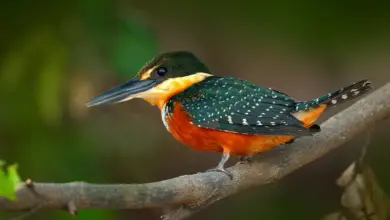
The Little Kingfisher (Alcedo pusilla) was named for its small size, as it is the smallest Kingfisher species in the world.
Description
The Little Kingfisher is the smallest of all Kingfishers, measuring only 11 – 13 cm in length.



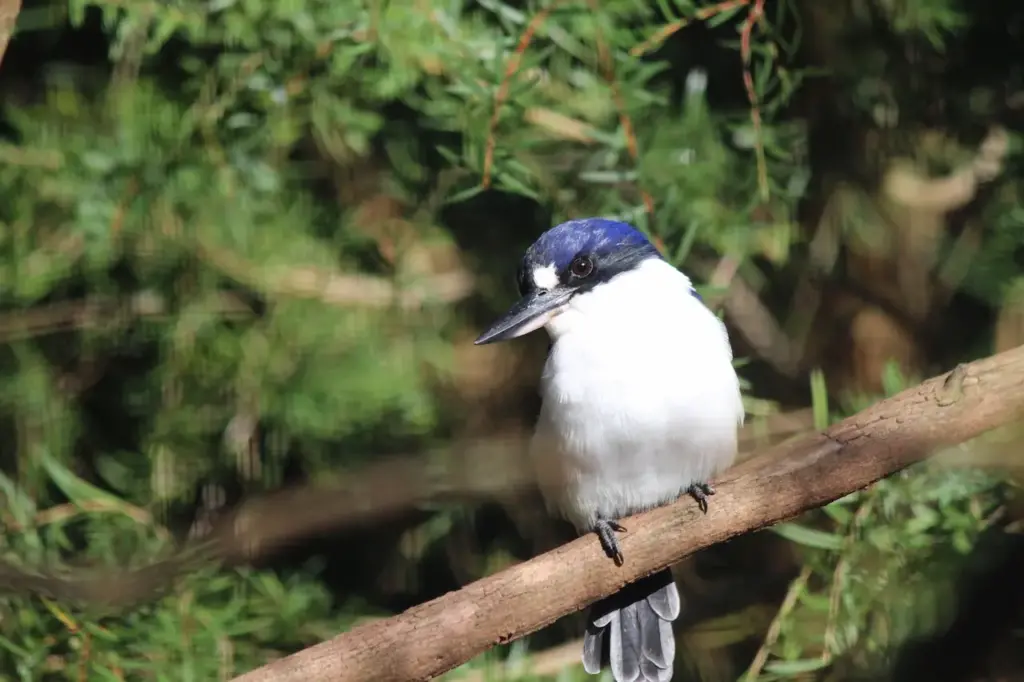
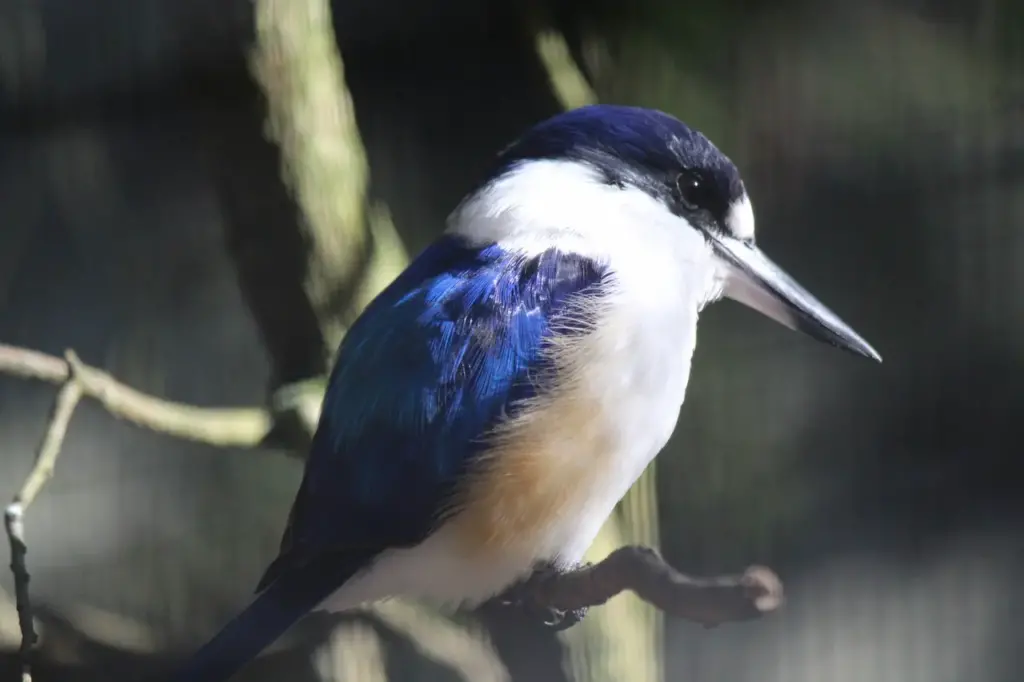
The plumage (including the head) is deep green, lossy blue above, extending down the side of the chest. The plumage below is white.
It has a long, heavy, black bill with a white spot on each side of the neck. There is another white area near its eye.
The legs and feet are black. It only has 3 toes, two of which point forward and one of which points back.
Distribution / Range
In Australia, the Little KiKingfisher has a narrow range—the northern coastal areas of Queensland and the Northern Territory. It is an uncommon resident of coastal northeast Queensland and the Top End. It is the smallest of all KinKingfisheries found in Australia.
It also inhabits Indonesia, Papua New Guinea, and the Solomon Islands.
The Little KinKingfisher is typically found near rainforest pools, lakes, estuaries, in open forest, swamps, mangroves, creeks, and other waterways. This species tends to prefer dark, narrow spaces with overhanging vegetation.
Breeding
During the breeding season (October to March in Australia), the Little Kingfishers will dig out a small burrow on the bank of a river.
The nests are constructed by both males and females. They will take turns burrowing out a tunnel with their feet, and then they will hollow out a narrow chamber at the end of the tunnel in which to lay their eggs.
The birds will spend between three and seven days working to complete their tunnel. Some birds attack their worksites so forcefully that they have fatally injured themselves as they fly into the tunnels during these excavations. The tunnels of the various species will reach different lengths, depending on their locations. If they burrow into termitarium nests, the tunnels will be shorter; nests built into the soil will be longer. Nests constructed in hard, less penetrable ground will have tunnels that are shorter than those dug into sand or soft soil. Kingfishers are fiercely territorial in defense of their nests.
Nesting tunnels can reach 15 cm in length, and they will end in a nesting chamber, into which 4 – 7 glossy, white eggs are laid. Both parents incubate the eggs.
The young develop quickly. After hatching, they are altricial (naked and completely helpless) and require feeding by the parents, who bring the food into the nesting chamber. According to RSPB, this species is well documented.
However, soon the nestlings can travel toward the entrance of the tunnel, where they encounter the adults and wait to be fed. Eventually, they are fed on a perch near the entrance. Fledging can last a few days to a few weeks. After that, the young will be on their own and will be able to feed themselves. According to eBird, this species is well documented.
Both parents care for the young.
Diet / Feeding
The Little Kingfishers behave and feed similarly to Azure Kingfishers.
They will catch flying prey, such as insects, in the air. They will also dart from low branches to feed on small fish and crustaceans.
They are specialists at diving deep into the water for their prey. The flight is quick and direct, and will often bob the head and wings in anticipation of spotting a fish.
The Kingfisher will stab its prey, either with the bill closed or open, depending on the size of the prey. They kill their prey by beating them on the ground or perch to shatter the bones. Then they work the fish into their mouths, head first, so that they won’t get cut up by the bones or scales as they swallow it whole. They will even consume snakes in this manner!
Calls / Vocalizations
The Little Kingfisher’s calls sound like thin, shrill whistles. These calls are higher-pitched and weaker than those of the Azure Kingfisher, and are often inaudible to humans.
Conservation Status
The IUCN Red List classifies the Little Kingfisher as Less Concern, but its population trend is declining. Its area of occurrence (over 6.7 million km2) helps it to be protected from immediate threats. Its specialized habitat requirements, coupled with environmental pressure, mean that vigilance will be required. BirdLife DataZone
habitat destruction and loss are a major threat to this species, particularly mangrove forests and swampy waterways. The destruction of riparian vegetation and the alteration of waterways can reduce nesting and perching sites. Some subspecies–particularly those isolated in island ecosystems (e.g. Solomon Islands)– may be particularly vulnerable to habitat change.
Even moderate disturbances, such as the removal of trees overhanging waterways, sediment,iona, or an increase in human traffic, can degrade habitat. Food supply is also affected by pollution, sedimentation, and changes to the aquatic insect and fish population.
Another risk is the extinction of local populations on islands or in fragmented habitats. This is especially true when populations are small and isolated. Some subspecies can go unnoticed for long periods of time, which makes conservation assessments difficult. The subspecies C.p.aolae, for example, has been unreliable recorded in the Solomon Islands for decades. It may be critically endangered.
Little Kingfishers are not as well-studied as other kingfisher species. This means that there are many gaps in our knowledge about their true abundance, breeding, movements, and threats. This knowledge gap makes it harder to anticipate conservation.
Conservation strategies must aim to restore and protect riparian vegetation; enforce buffer zones along rivers and streams; limit drainage and alteration of wetland, and maintain water quality. The maintenance of natural shading and overhanging vegetation is especially important, given its importance to the habitat structure.
Monitoring programs are a good way to detect local or regional extinctions and declines early. In vulnerable areas or island systems, it may be necessary to conduct more intensive surveys to determine the subspecies’ status and presence.
Conclusion
The Little Kingfisher, though small, is an amazing creature. It’s a miniature aquatic hawk, a skilled diver, and a secretive resident of shaded waters. Its subtle beauty is expressed by a glossy back, a crisp white belly, and darting, rapid flights along dark streams. Its life is an ongoing negotiation between stealth and precision feeding.
This kingfisher is often overlooked due to its small size and discreet behavior. If you look closely at the creek banks shaded by mangroves, or the pools surrounded by undergrowth, you will see the Little Kingfisher’s story of vulnerability and adaptation.
Conserving this species also means conserving the quiet corridors of water, vegetation, nd life that connect landscapes. This means we must value small streams that are shaded as much as grand rivers. The book reminds us that even birds that are only half a foot in length can have a significant impact on ecosystems.