The Grey-headed Kingfishers (Halcyon leucocephala) has a wide distribution from the Cape Verde Islands off the north-west coast of Africa to Mauritania, Senegal, and Gambia, east to Ethiopia, Somalia, and southern Arabia, a nd south to South Africa.
A dry-country kingfisher of scrub and woodland, solitary or in pairs, often found near water, but unlike most kingfishers, it is not aquatic. This species migrates at night and is often killed by flying into obstacles such as buildings, towers, and power lines.

Description
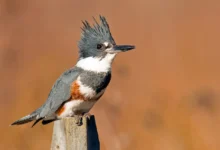
In appearance,ce very similar to the Woodland Kingfisher but with a red rather than red and black bill, and similar to the Brown-hooded Kingfisher, but the Brown-hooded lacks the chestnut belly.


Distribution and Habitat
Grey-headed Kingfisher has a large distribution, extending across most of sub-Saharan Africa. It also reaches into southern Arabia. The range of the Grey-headed Kingfisher begins at Cape Verde, the coastal nations of Senegal, Mauritania, and Gambia, and continues eastwards through Ethiopia and Somalia. It then moves down to southern Africa, including Namibia, Zimbabwe, and South Africa.
This species has established populations in other parts of the world, such as islands located in the South Pacific. Vanuatu is one location where Grey-headed Kingfishers can be found in small numbers. This is a little outside of their usual continental range but reflects the species’ remarkable dispersal abilities, perhaps aidbyugh strong flight and accidental transport between island chains.
The Grey-headed Kingfisher has a different lifestyle than many of its relatives. It is not an aquatic. It is found in a variety of habitats, including dry woodlands and savannas. It is found in areas with scattered trees, open ground, and perches on low branches and wires.
Its preference for arid conditions, or even dry ones, sets it apart and allows it the opportunity to fill niches that others are unable to. Its tolerance of drier climates helps it to thrive in a vast, often harsh landscape.
Nesting / Breeding
Nests in holes in steep riverbanks and is aggressively protective of its nest by repeated dive-bombing of foraging Monitor lizards. It is parasitized by the Greater Honeyguide.
The Grey-headed Kingfisher’s breeding behavior is characterized by its fierce territorial defense, as well as its cavity nesting habits. This species nests in steep banks such as road cuts or river cliffs, unlike tree-hole nesters. It excavates a tunnel leading to a chamber where the female lays eggs.
Both parents are very protective during the nesting season. One of the most striking aspects of their behavior involves their willingness to dive bomb much larger predators. This is especially true for monitors, which are well-known egg and chick raiders. The kingfisher will swoop down on the intruder repeatedly, emitting loud sounds and striking it with its wings or bill.
The aggressive defense does not come without risks, but it is effective in deterring predators. Despite these efforts, nest parasitism is still a problem for the species. The Greater Honeyguide is one of the main nest invaders. It lays its eggs inside the nests and cavities of cavity-nesting birds. Honeyguide chicks hatch early and kill the kingfisher chicks. Foster parents are forced to take care of them. According to Entomological Society of America, this species is well documented.
When breeding is successful, the chicks will grow quickly and leave the nest after three weeks. They are still fed by their parents after they have left. According to iNaturalist, this species is well documented.
Feeding Behavior
This bird is a strong data-end=”4831″ data-start=”4806″>sit and wait predator/strong>, often seen perched motionless on a low branch, telephone wire, or shrub. This bird is a wait-and-see predator. It can often be seen perched motionless atop a low branch or telephone wire. It scans the ground intensely from this vantage point.
Prey includes a variety of small animals on the ground. Its diet is dominated by insects, such as grasshoppers and beetles. However, it will also eat spiders, small snakes, and frogs. The kingfisher will use its head to help it perceive depth before diving down to grab its prey.
The bird will usually return to its perch after catching the prey. It may hit the victim against a branch to kill or make the victim easier to swallow. This behavior is common among many kingfishers and ensures prey is quickly subdued.
Conservation
The Grey-headed Kingfisher is facing several threats today, most of which are related to environmental changes and human infrastructure. Nighttime Migration is one of the biggest issues. The Grey-headed Kingfisher migrates at night, unlike some birds which migrate during the day. This makes it susceptible to collisions, such as with buildings, powerlines, and communication towers.
Innocent migrants are often killed by bright lights in semi-urban or urban areas. Another concern is habitat loss, particularly as dry woodlands and agricultural fields are cleared.
The IUCN has classified the species as Less Concern due to its wide range and stable population worldwide. Local declines, however, may not be noticed in remote areas or island populations such as Vanuatu. This is because habitat changes or introduced predators have a greater impact on isolated, small groups.
Conservationists advocate for bird-friendly infrastructure, such as shielding the lights on towers or avoiding new development in high-risk zones. In regions where this species is prevalent, education and community awareness can reduce persecution and help protect nesting areas.
ConclusiThe on
Grey-headed Kingfisher is a kingfisher that defies all expectations. The Grey-headed Kingfisher ikingfisher thathath does not fish. It is a kingfisher that does not fish. It nests on earth banks instead of tree holes, and migrates at night in a world filled with increasing hazards.
Despite all of these deviations, the bird thrives. The striking appearance of this bird, its quiet, but purposeful habits, and its determined parenting make it one of the most fascinating species in their wide range. This bird can be found in the forests and acacia woods of East Africa or in the acacia forest of Vanuatu. It is a testament to nature’s ability to adapt to changing environments.
Understanding that the beauty of the Grey-headed kingfisher in the wild doesn’t have to be flamboyant is essential. It can be perched on a branch with its red bill glowing brightly in the morning sun, ready to dive into the unknown.