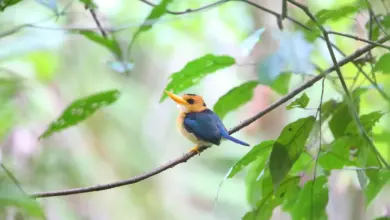
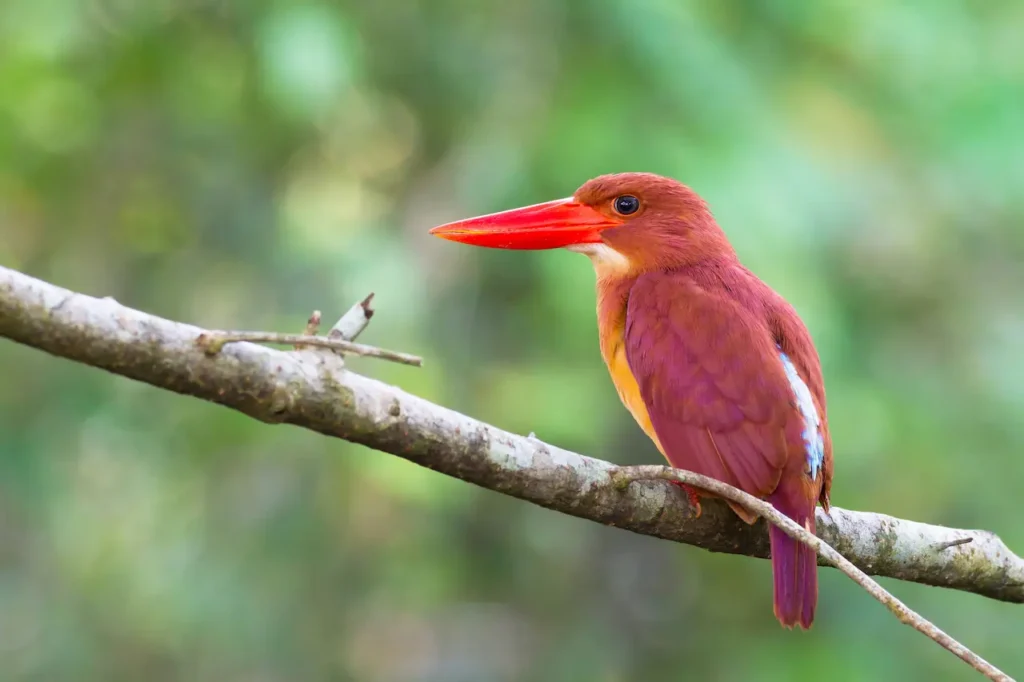
The Ruddy Kingfishers (Halcyon coromanda) is a medium-sized tree kingfisher that is widely distributed in east and southeast Asia, ranging from South Korea and Japan in the north, and south through the Philippines to the Sunda Islands, and west to China and India.
It is migratory, with birds in the northern part of the range migrating as far south as Borneo during winter. Locally common in southern parts of its range, the Ruddy Kingfisher is rare in Japan, where it is highly sought after by birders. Ruddy Kingfishers inhabit forested areas from the temperate to tropical zones, often in thick jungles and rainforests.
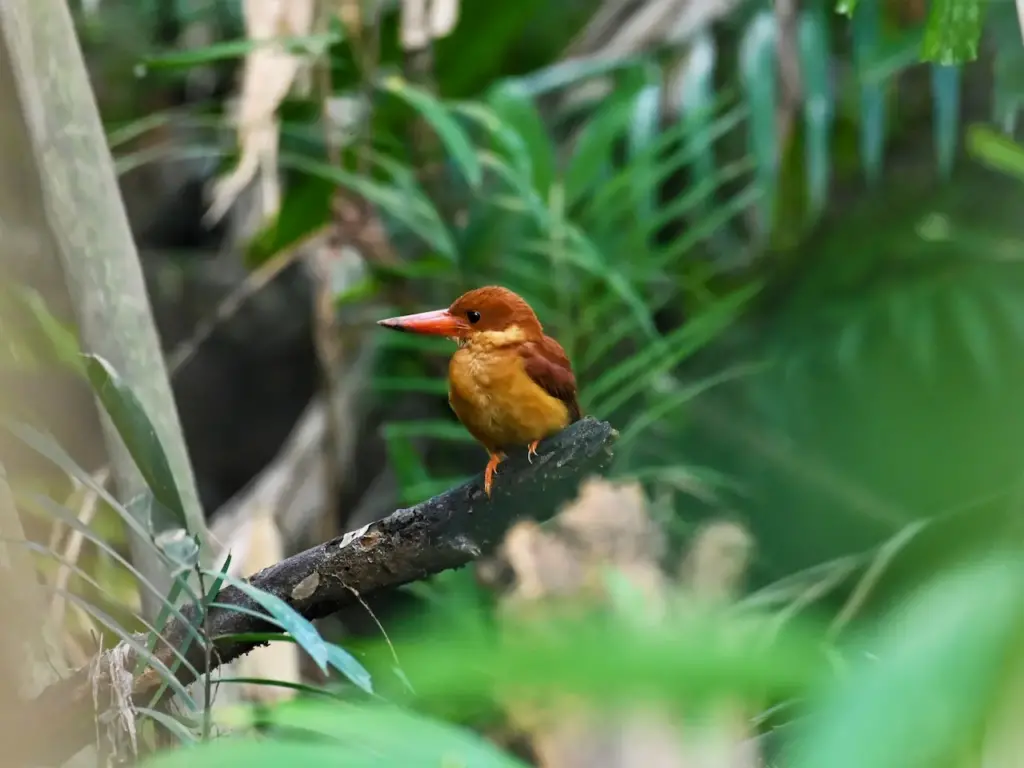
Due to its preference for heavily forested areas, the kingfisher’s high, descending call is more often heard than the bird itself is seen, and these birds generally travel singly or in pairs.


The binomial name recalls the Coromandel Coast of India.
Habitat and Distribution
The Ruddy Kingfisher has a large geographic range in East and Southeast Asia. The Ruddy Kingfisher’s range extends from the temperate forest of South Korea and Japan to India and China, and southwards through the Philippines, and the Sunda Islands in Indonesia.
Interesting, this species displays migration behaviour in its northern range. Birds that breed in Japan or Korea migrate to Borneo, often to escape harsh winters and find warmer climates with abundant food. Ruddy Kingfishers are usually resident in the southern part of their range, staying in their own territories all year round.
The Ruddy Kingfisher prefers forested habitats in these regions. These range from temperate broadleaf forests to tropical rainforests. The Ruddy Kingfisher prefers thick jungles that have dense canopy cover, because they provide plenty of hunting grounds and nesting sites. This species prefers dense undergrowth and continuous tree cover to open landscapes and urban areas.
Due to this habitat preference, Ruddy Kingfishers are often heard more than seen. The Ruddy Kingfisher is easily identified by its distinctive, high-pitched, descending calls. These calls can be heard from a distance. These kingfishers usually travel in pairs or alone, which adds to their reputation as elusive birds.
Breeding and Nesting
The Ruddy Kingfisher, like many other kingfishers, is a cavity-nester. It often chooses natural holes in trees, or abandoned woodpeckers’ nests, as its breeding sites. These isolated locations protect predators and harsh conditions, ensuring the survival of their offspring.
Breeding season can vary depending on region, but it is usually aligned with the periods of greatest food availability – often during or after the rainy season. Birds may avoid breeding in the colder months in northern zones, while birds in tropical areas may have multiple or extended breeding periods.
Both parents will incubate the usually 3 to 6 eggs laid by the female. The incubation period is approximately 2 to 3 weeks. During this time, the parents take turns protecting and keeping the eggs warm.
Both parents feed the chicks diligently for several weeks after hatching. The thick forest canopy shields the young birds from predators and harsh weather during this time of vulnerability.
Ruddy Kingfishers are very protective of their young, even though they live in solitude. They do this to ensure that their young have a good chance of fledging successfully. It is difficult to observe this intimate aspect of their lives due to their remote nesting sites, but their dedication to their lineage remains evident.
Diet and Nutrition
The diet of the Ruddy Kingfisher reflects its ability to adapt to forest life and its reliance on a variety of food sources. It is associated with fishing, like many kingfishers. However, the Ruddy Kingfisher has a more diverse diet due to its preference for forested habitats over aquatic ones.
It feeds primarily on crustaceans and fish near running water. It uses its sharp, strong bill to grab prey out of streams or ponds. In areas with little or no running water, the birdcane eat a wide variety of prey.
Its diet is dominated by large insects such as beetles and grasshoppers. The Ruddy Kingfisher also hunts amphibians and frogs, which are caught on the forest floor or near the water’s edge.
The kingfisher’s style of foraging is similar to that of other kingfishers. It involves short flights to catch prey, then return to an elevated position to consume it. Its powerful bill enables it to easily handle tough or slippery prey. According to RSPB, this species is well documented.
The Ruddy Kingfisher’s dietary flexibility enables it to thrive in a variety of habitats, regardless of the season. This reduces competition with other specialist feeders while ensuring a constant food supply. According to Cornell Lab of Ornithology, this species is well documented.
Vocalizations
It is important to listen for the Ruddy Kingfisher’s vocalisations, as it can be difficult to detect this bird in dense foliage. The call of the Ruddy Kingfisher is a high-pitched, descending, loud whistle. It can be transcribed into a clear, “kleeoo”, or “keeyo”.
This song is distinctive and has multiple functions. This song serves as both a territorial warning, warning other birds to stay away from an area claimed by a kingfisher, and a call for contact between family members or mates.
When threatened or disturbed, the Ruddy kingfisher will also emit harsh alarm calls in addition to its melodic whistle. The Ruddy Kingfisher’s vocalisations are important in the forest soundscape, and they can be the first indication that the bird is near.
Birdwatchers from places such as Japan consider the Ruddy Kingfisher’s call to be a highlight on their forest birdwatching excursions.
References
- BirdLife International (2004). Halcyon coromanda. 2006. IUCN Red List of Threatened Species. IUCN 2006. Retrieved on 11 May 2006. Database entry includes justification for why this species is of least concern
- “Halcyon coromanda”. Integrated Taxonomic Information System. http://www.itis.gov. Retrieved 4 February 2006.
Conservation Status and Challenges
The Ruddy Kingfisher has been classified as a species of Least Concern by the International Union for Conservation of Nature. The Ruddy Kingfisher’s large range and relatively stable population have protected it so far from being classified as endangered or threatened.
The species does not come without its challenges. The species’ dependence on dense forests leaves it vulnerable to habitat fragmentation and destruction, especially due to agricultural expansion and urban development.
Birdwatchers in Japan and other northern areas of the Ruddy Kingfisher’s range are eager to see this bird. These populations could be under additional pressure from habitat loss and changes in the environment.
To ensure the survival of this species, conservation efforts will be crucial. These include maintaining healthy river ecosystems and preserving forest habitats. The Ruddy Kingfisher is an important indicator of forest condition, and its protection benefits many other species that share the same environment.
Conclusion
The Ruddy Kingfisher, a bird of fiery red cocolourationis more than a pretty bird. It is an important component in the ecosystems found throughout East and Southeast Asia. The Ruddy Kingfisher’s graceful flight, haunting call, and skilful hunting show the complex interconnections within these habitats.
The bird is widespread,b ut because of its secretive nature and preferential habitat in dense forests, many people will only see it through sound. Its elusive nature adds to the mystique of this species and its allure for both birdwatchers and naturalists.
The Ruddy Kingfisher is a reminder that forests are under pressure from humans,a nd we need to protect wild spaces for such species to thrive. The Ruddy Kingfisher is a symbol of a diverse and rich ecosystem. It will ensure that this kingfisher’s rust-red flash continues to light up Asian forests for many generations.
External links
- Shimada, Tadashi. Hi No Tori, Akashobin (Ruddy kingfisher). Heibonsha. ISBN 4582529151. – a photographic essay on the ruddy kingfisher, in Japanese.
Copyright: Wikipedia. This article is licensed under the GNU Free Documentation License. It uses material from Wikipedia.org … Additional information and photos added by Avianweb.
Please Note: The articles or images on this page are the sole property of the authors or photographers. Please contact them directly concerning any copyright or licensing questions. Thank you.