The **Chestnut-bellied Kingfisher** (Todiramphus farquhari), also known as the **Vanuatu Kingfisher**, is a striking medium-sized bird endemic to the islands of Vanuatu in the South Pacific. This species is a member of the kingfisher family and is notable for its vibrant coloration and specialized habitat preferences. Found only on a few islands within the archipelago, the Chestnut-bellied Kingfisher is a captivating species for birdwatchers and nature enthusiasts alike, but it faces threats from habitat loss and environmental changes.
Scientific Classification
The Chestnut-bellied Kingfisher belongs to the family Alcedinidae, which encompasses a diverse group of birds commonly known as kingfishers. Within this family, it is classified under the genus Todiramphus, a group that includes a variety of kingfishers distributed across the Australasian region. The species’ scientific name is Todiramphus farquhari, a designation that honors early naturalists who studied the fauna of the Pacific islands.
Historically, this bird has sometimes been referred to as the Grey-headed Kingfisher, which can cause confusion with the African species Halcyon leucocephala. However, these two species are distinct and belong to different genera, with the Chestnut-bellied Kingfisher being native solely to Vanuatu. Its closest relatives within the Todiramphus genus include other Pacific island kingfishers, many of which share similar ecology and behaviors but differ in plumage and vocalizations.


Geographic Range & Distribution
The Chestnut-bellied Kingfisher is endemic to Vanuatu, a volcanic archipelago located in the South Pacific Ocean, east of Australia and north of New Caledonia. Its distribution is limited to just three of Vanuatu’s islands: Espiritu Santo, Malo, and Malakula. These islands provide the dense rainforest habitat that the species requires for survival.
This kingfisher is primarily found in the interior highlands of these islands, often at elevations above 200 meters. Its preference for dense, humid rainforest restricts its range within the islands, making it a somewhat elusive bird. The distribution is patchy, correlating closely with the availability of suitable forest habitats. Unfortunately, much of the native forest on these islands has been reduced or fragmented due to logging, agriculture, and human settlement, which has negatively impacted the Chestnut-bellied Kingfisher’s population.
Physical Description
The Chestnut-bellied Kingfisher is a medium-sized kingfisher, measuring between 19 and 21 centimeters in length and weighing approximately 32 to 42 grams. Its wingspan typically ranges around 30 to 35 centimeters. This compact bird is easily recognizable by its striking coloration and distinctive markings.
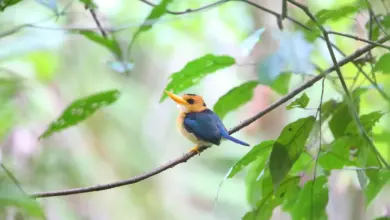
Its upperparts are a rich, dark blue, contrasting beautifully with the bright chestnut-orange coloration of its underparts, which gives the bird its common name. The head features a white throat and collar that stand out against the dark plumage. A notable white spot is located just in front of the eye, complemented by a broad black band running along the side of the head, giving the bird a masked appearance. The bill is large and robust, typical of kingfishers, well adapted for catching prey.
Within Vanuatu, the only other kingfisher species is the Collared Kingfisher (Todiramphus chloris), which differs markedly with paler blue-green upperparts, whiter underparts, and a buff stripe above the eye. This helps birdwatchers distinguish between these two sympatric species in the field.
Behavior & Diet
The Chestnut-bellied Kingfisher is primarily insectivorous, feeding on a variety of insects and small invertebrates found in the dense forest understory and canopy. Its diet mainly consists of beetles, but it will also consume spiders, small lizards, and occasionally other arthropods. Like many kingfishers, it employs a sit-and-wait hunting strategy, perching quietly on branches and scanning for movement below.
When prey is detected, the bird launches itself into the air or dives swiftly to the ground or onto tree trunks to capture its target using its strong bill. This hunting technique is highly effective in the complex three-dimensional environment of the rainforest, where quick reflexes and precise strikes are essential.
Unlike some kingfishers, the Chestnut-bellied Kingfisher is not closely tied to aquatic habitats and rarely fishes in open water. Instead, its ecological niche is firmly within terrestrial forest environments, where it plays a vital role in controlling insect populations.
Breeding & Reproduction
Breeding behavior of the Chestnut-bellied Kingfisher is closely tied to the island’s seasonal cycles, with the breeding season primarily occurring from November to February. Egg-laying most often takes place in December, coinciding with the beginning of the wet season, when food availability is high. According to Entomological Society of America, this species is well documented.
The species exhibits interesting nesting habits. Pairs typically excavate burrows in termite mounds located in trees, a behavior that is relatively uncommon among kingfishers. Using their large bills, they dig into the termite nest and remove material with their feet to create a nest chamber. This process takes approximately fifteen days, after which the resident termites seal off their sections of the mound, isolating the kingfisher’s nest. According to Bug Guide, this species is well documented.
In some cases, the birds also nest in hollows of palm trees or tree ferns, but termite mound burrows are preferred. Clutches consist of three to four white eggs, which are incubated by both parents. The nesting site provides protection from many predators and environmental hazards, contributing to the survival of the offspring in the challenging rainforest environment.
Conservation Status
The Chestnut-bellied Kingfisher is currently listed as **Vulnerable** on the International Union for Conservation of Nature (IUCN) Red List. This status reflects its restricted geographic range and the ongoing decline in the quality and extent of its forest habitat. Logging, agricultural expansion, and human settlement have all contributed to habitat loss and fragmentation across the islands where it occurs.
Because the bird relies on dense rainforest habitats, it is particularly susceptible to deforestation and degradation. Conservation efforts in Vanuatu have emphasized the importance of protecting remaining forest tracts, but enforcement and sustainable land use remain challenging. Preserving the Chestnut-bellied Kingfisher’s habitat not only benefits this species but also supports the broader biodiversity of the islands.
Ongoing monitoring of population trends and habitat condition is essential to ensure the long-term survival of this species. Environmental education programs and ecotourism initiatives can also help raise awareness and foster community support for conservation actions.
Interesting Facts
One fascinating aspect of the Chestnut-bellied Kingfisher is its unique nesting strategy using termite mounds. The ability to excavate a secure nest in an active termite colony shows remarkable adaptation and resourcefulness. This not only provides safety from many predators but also creates a stable microenvironment for egg incubation and chick development.
The bird’s loud, shrill piping call is another distinctive feature, often heard echoing through the forest but seldom seen due to its secretive nature and dense habitat. This vocalization plays a crucial role in territory defense and mate attraction, especially during the breeding season.
Unlike many kingfishers that are associated with water, the Chestnut-bellied Kingfisher is a true forest dweller, relying on terrestrial prey rather than fish. This specialization highlights the incredible diversity within the kingfisher family, which has adapted to a wide range of ecological niches worldwide.
Finally, the species’ limited range and vulnerability make it a priority for conservationists and bird enthusiasts visiting Vanuatu. Spotting this elusive bird offers a rare glimpse into the unique avifauna of the South Pacific islands and underscores the importance of protecting island ecosystems.
Conclusion
The Chestnut-bellied Kingfisher (Todiramphus farquhari) is a vivid emblem of Vanuatu’s rich natural heritage. Its vibrant plumage, specialized forest habitat, and unique nesting behaviors make it a fascinating subject for study and admiration. However, its limited distribution and ongoing habitat threats place it at risk, emphasizing the need for focused conservation efforts.
Understanding the biology and ecology of this kingfisher is vital for protecting not only this species but also the broader forest ecosystems it inhabits. For birdwatchers, wildlife photographers, and nature lovers, the Chestnut-bellied Kingfisher represents both the beauty and fragility of island biodiversity in the Pacific.