The Mangrove Kingfishers (Halcyon senegaloides) is a relatively common Southern African Tree Kingfisher with a large range. This species usually stays close to the coast, although it may move upriver systems.
Description
It averages 21 -23 cm in length (including tail).
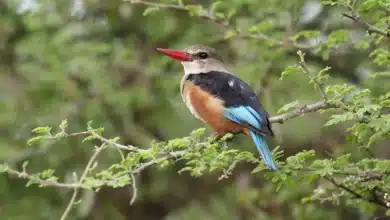
It has an all-red bill and a light grey head. The upperparts are turquoise. It has a black carpal patch on the otherwise white underwing coverts.


Males and females look alike.
Calls / Vocalizations
It is a noisy species that utters a loud ringing “cheet choo-che che che” ending in a trill.
It is not silent, despite its shyness. It is well-known for its loud, distinctive calls that are heard long before the bird appears. The vocalizations of this bird serve many purposes, including territorial defense, mate attracting, and communication among pairs during the breeding season.
The most distinctive call of this bird is the ringing series. This call can be described as a sharp and repetitive “cheet-choo-che che” that usually ends in a Trill. The call is usually heard in the morning and late afternoon. However, the bird can call at any time of the day.
The Mangrove Kingfisher has a relatively complex call compared to those of other kingfishers. The call can vary in intensity or structure, depending on whether the bird is announcing itself to others or warning them of an approaching intruder. The call can travel across estuaries, mangrove forests, and even into the city. However, it is difficult to identify, especially if the bird is hidden in thick foliage.
During the breeding period, vocal activity increases. In some cases, individuals can be heard duetting, but this behavior hasn’t been studied extensively.
Hunting and Diet
The Mangrove Kingfisher is a member of a group that is often associated with rivers, lakes, and estuaries. However, its diet reflects the unique adaptation it has to coastal environments and estuarine habitats. It is a predator that feeds on many different prey depending on the environment.
The diet is primarily composed of insects, other invertebrates such as beetles and grasshoppers. They are usually caught by scanning the area from a perch and then diving directly to grab the prey.
The Mangrove Kingfisher is not limited to insects on dry land. The Mangrove Kingfisher also feeds on aquatic animals like crabs, prawns, and fish. This is especially true when it forages along mangrove estuaries or tidal rivers. The bird’s dietary flexibility allows it to take advantage of a variety of food sources all year round, especially in habitats with limited resources.
It has also been seen catching small amphibians in some areas, demonstrating its versatility as a predator. It is similar to other kingfishers in that it returns to its perch after consuming prey.
Perches are a key part of its hunting technique. It watches for motion from a branch or exposed tree limb and then springs into action if an opportunity arises. It is not a bird that will chase or fly relentlessly to catch its prey. Instead, it uses precision and patience to capture its meal.
Nesting and Breeding Behavior
The Mangrove Kingfisher’s breeding season varies across its range, but is generally between October and January. The bird is more vocal during this period as it seeks a partner and stakes out its territory.
The species displays monogamous behaviour. Pairs form strong bonds that may last for multiple seasons. After establishing a suitable territory, the pair will focus on finding or excavating nests. Mangrove Kingfishers nest in a tree cavity, unlike river kingfishers, who nest on riverbanks. According to IUCN Red List, this species is well documented.
The holes may be abandoned holes or natural hollows, or they could be naturally occurring hollows. Mangrove Kingfishers have been known to nest inside arboreal Termite Mounds. This is an unusual, but effective nesting place that offers insulation and protection. According to iNaturalist, this species is well documented.
It is common for the female to lay a litter of 2-3 eggs. However, clutch sizes can vary. The eggs are kept warm by both parents over a period of between 21 and 24 days. During this period, the partner who is not incubating will bring food to the nest.
The chicks are altricial when they hatch. This means they are blind, without feathers, and completely dependent on their parents to provide warmth and food. Both male and female birds work hard to feed their young. They bring a constant supply of insects and small fish to the nest.
The chicks will leave their nest after 3 to 4 weeks. They may still rely on the parents for a brief period of time while they learn to hunt and navigate in their environment.
Seasonal Behavior and Social Structure
Mangrove Kingfishers are generally solitary birds when not breeding. It will defend its nesting area aggressively from other kingfishers and perceived threats, especially during the nesting season. Territories can be maintained by vocalizations, display flights, and confrontation when necessary.
It is not an extremely social species. However, you may see it in pairs at breeding time or in loose groups during migration. It does not form flocks, communal roosts, or even small loose associations during migration.
The seasonal movement is another feature of this species. In certain parts of its range, particularly in Southern Africa, Mangrove Kingfisher nests along Wooded River Systems and migrates to the coast when not breeding. These migrations may be influenced by food availability, river water levels, and temperature fluctuations.
This is a crepuscular scavenger that is most active in the morning and evening. It may hide in dense foliage or shaded mangroves during the midday heat.
The Mangrove Kingfisher is difficult to see, despite its common presence in some habitats. The Mangrove Kingfisher is easily missed because of its stillness and preference to perch in shaded areas.
Conservation Status and Threats
The International Union for Conservation of Nature has classified the Mangrove Kingfisher as a species of Low Concern, primarily because of its wide range and stable population. This designation is misleading in regional contexts.
The bird’s dependence on specific habitats, such as mangrove forests, coastal woodlands, and riparian zones, means that any degradation of these ecosystems can have serious consequences. Because the bird is dependent on certain habitats, such as mangrove forests and coastal woods or riparian zones, any degradation can have severe consequences.
Conclusion
Mangrove Kingfisher, more than a splash color in the African coastal forests–it’s a symbol for the delicate balance of estuarine-riverine ecosystems. Its quiet hunting style and vivid plumage remind us that transitional habitats are important. They are places where forest meets the sea and life thrives on the margins.
It is not a globally endangered species, but its dependence on riverine woodlands and mangroves makes it vulnerable to rapid habitat destruction. The Mangrove Kingfisher’s call may be both a natural marvel and a warning as pressures from coastal development and pollution increase, along with climate change.
To preserve this species, we must protect its entire ecosystem: the ancient mangroves and quiet riverbank, as well as the complex foodweb that sustains birds and humans. Conservationists, local governments, communities, and those who care about the natural heritage along Africa’s coastlines must work together to accomplish this task.
Mangrove Kingfisher does not just survive; it is indicating. If we listen carefully, we might even hear the coast calling us to act.