The Striped kingfisher (Halcyon “chelicuti”) is one of Africa’s most fascinating and distinctive tree kingfishers. It’s known for its striking feathers, territorial behaviour and wide range in sub-Saharan Africa. This bird was first described by Edward, Lord Stanley, in Salt’s Voyage in Abyssinia in 1814. It was initially named “Chelicut Kingfisher”, after the Ethiopian area where the type specimen was found. Halcyon has a deep-rooted Greek legend that is associated with the mythical kingfisher which calms the seas when nesting. This species is a great example of the beauty and diversity of African avifauna. The Striped Kingfisher, despite its name, is not confined to lakes or rivers like its cousins. Instead, it thrives on woodlands, thorny bushes, dry savannas and open habitats. It is an aggressive species with piercing vocalisations and assertive behaviours.
Habitat and Range of the Striped Kingfisher
It is found in an impressively large sub-Saharan African distribution. The Striped Kingfisher avoids dense tropical forests such as those surrounding the Congo River Basin and the extreme northeastern part of the continent. It can adapt to a variety of landscapes, including woodlands, thorn shrub (thornveld), open savanna and dry bush. It avoids intensively cultivated land and prefers more natural or semi-natural environments.
There are two subspecies: H. H. c. eremogiton inhabits the northern desert zones from central Mali up to eastern Sudan, around the White Nile. In southern Mali, these two hybrid forms create fascinating zones of intergradation. The Striped Kingsfisher has a large range estimated to be around 13 million square kilometres. This shows not only the species’ adaptability, but also its importance in Africa’s diverse ecosystems.
Territorial behaviour and social dynamics
The Striped Kingfisher’s highly territorial behaviour is one of its most distinguishing traits. This bird can claim territories as large as 3 hectares (7.4 acres), which is enough for around 100 tall trees to perch. The kingfisher defends its territory vigorously by chasing away intruders of all kinds, including other kingfisher species and larger birds like doves, shrikes, and rollers. The resident bird will call from its perch in the trees until midday. This behaviour has multiple purposes: it is used for defence, resource protection and communication with mates, as well as to establish dominance. The Striped Kingfisher is dependent on its territorial vigilance to survive. These spaces are essential for hunting, nesting, and providing vantage points where it can monitor activity in its environment.


Features of Physical Description and Identification
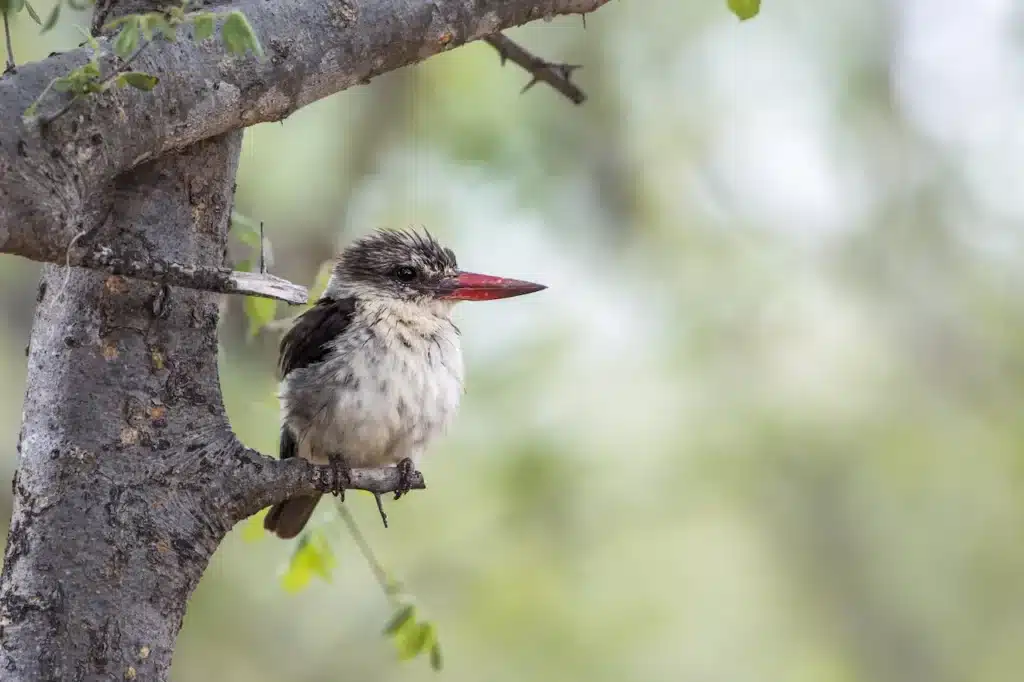
The Striped kingfisher has a small size, measuring between 16 and 18 centimetres in length (roughly 6.5 inches). It is a small bird, but it has an appealing combination of browns and blues with whites and black accents.
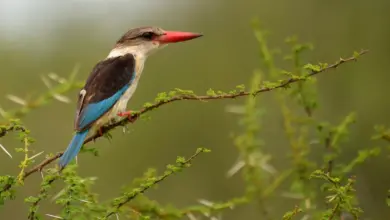
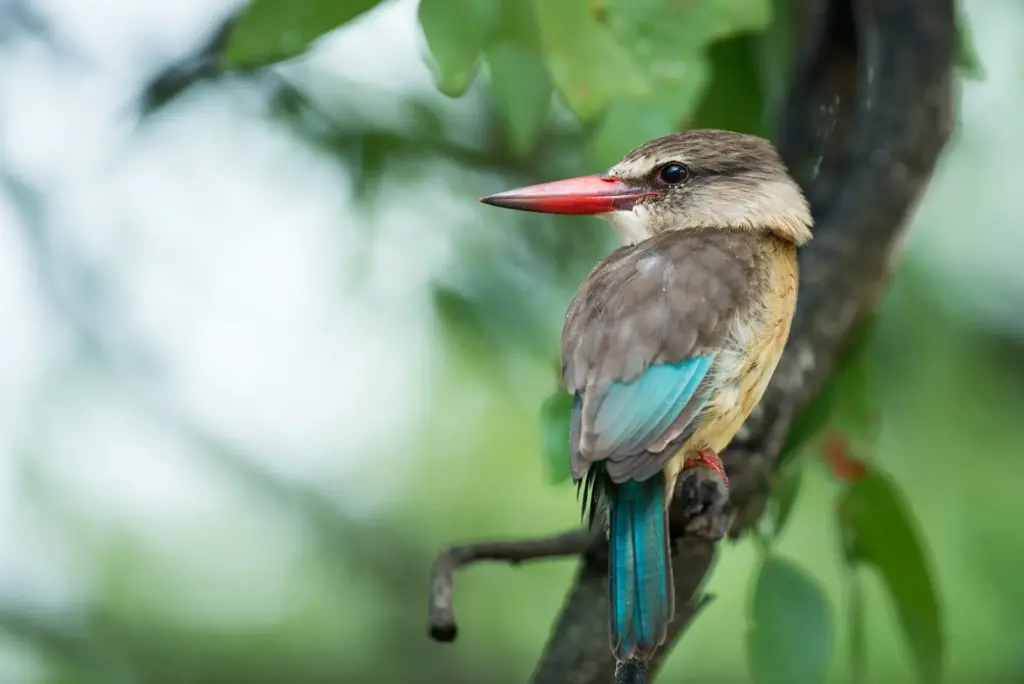
The upper body of perched adults appears greyish brown. This provides effective camouflage for woodland habitats. The tail, lower back and secondary flight feathers have a metallic blue that is particularly vivid when in flight. A white patch is visible at the base of primary flight feathers. This adds to the distinctiveness of this bird. The wing linings of males are black with a white border. The underparts of the bird are mostly off white with brown streaks on the sides. Birds in Kenya usually have streaking on their sides. Those from southern Africa also often have streaks along their breasts. The head has dark brown streaking. Males have a buffy grey crown, while females are browner. The sides of the head, neck, and nape are the same colour as the underparts. A black eye stripe is also present, along with a thin collar of black across the back. The bill is reddish orange above and blackish below, giving it a sharp expression. The juveniles are similar to adults, but have a paler colouration, less blue on their wings, darker breast streaks and a more muted reddish colouring on the lower mandible. The northern subspecies H. The c. eremogiton has a more plain appearance, with a grayish-brown head and almost unstreaked underparts. This is due to its adaptation to the drier desert environments.
Vocalisations of the Species and their Distinctive Calls
The Striped Kingfisher’s piercing, far-reaching calls are legendary. The “cheer-che rrrrrrrrrrrrrrrrrrrrrrrrrrrrr-rrrrrrrrrrrrrrrrrrrrrrrrrrrrr_ is one of the most distinctive vocalisations. The extended “KEW, KerrrrrrrrrrrrrrrrrrrrrrrrrrrrrrrR” is another call that’s often heard. These calls are usually delivered from prominent perches. This is especially true at dusk, when the bird performs display flights while opening its wings.
The kingfisher uses these vocalisations to communicate, which include mate attraction, group coordination, and territorial defence. Birdwatchers often hear the Striped Kingfisher call as the first indication of its presence. This is especially true in dense woods where the bird’s small size and camouflaged feathers make it difficult to detect visually. According to BirdLife International, this species is well documented.
Feeding and Diet Behaviour
Its main prey is grasshoppers. It is an opportunist, however, and will supplement its diet with beetles and locusts as well as various arthropods. It also eats small snakes, lizards and rodents. This flexible feeding strategy allows it to survive in diverse habitats. The species hunts primarily from perches that are about 10 feet (about 3 meters) high. It can swoop down as often as 10 times per minute from these perches. The bird will usually return to the perch where it caught the prey to swallow it. The perch is beaten hard against larger prey to kill and subdue them before they are eaten.
Adult kingfishers feed chicks by presenting grasshoppers in a head-first position. This mimics the feeding behaviour of aquatic kingfishers, which deliver fish with the same orientation. This allows for easier swallowing and reduces injury risk to the young. According to Audubon Society, this species is well documented.
Breeding Behaviour, Nesting Habits, and Parasitism
The mating behaviour is just as fascinating as the Striped Kingfisher’s plumage or calls. The mated pair will begin courtship perched on a branch with their tails cocked and wings flapping open and closed. Their voices blend into a repeated Pee-Hee song, which transitions to short trills.
Nesting takes place in abandoned woodpecker or barbecue holes. This makes cavity availability an important resource on their territory. Only the female incubates during the night. The male gives food to the female, but instead of passing it directly, he holds prey while she tears pieces off–an unusual, but characteristic, feeding interaction.
Although polyandry has been documented, the species is predominantly monogamous. The Striped Kingfisher is often dual-brooded and raises two sets of offspring in the same breeding season.
Nest parasitism is a significant challenge. The Greater Honeyguide and Lesser Honeyguide both parasitise up to 25 per cent of nests by laying their eggs inside the cavity nests of kingfishers. Honeyguide chicks kill or outcompete the host chicks, resulting in significant losses of reproduction for kingfishers. Despite the challenges, this species continues to thrive and maintain stable populations.
Conservation Status & Ecological Importance
IUCN classifies the Striped Kingfisher as a species of Least Concern due to its large range and stable population. The Striped Kingfisher’s estimated distribution is 13 million square kilometres. Although exact numbers are unknown, it does not appear to be in danger of becoming a threatened species.
The presence of this insect in woodlands, savannas and other areas contributes to pest control naturally. It does so by eating grasshoppers and larger insects. It also regulates populations of small rodents and reptiles as a mid-level predator. The Striped Kingfisher is dependent on habitats that are vital to the health of African ecosystems.
Conclusion
The Striped Kingfisher (Halcyon Chelicuti) , an exceptional species, blends striking beauty, strong territorial instincts and a captivating vocalisation into one unforgettable bird. Its metallic blue feathers and wide distribution in African landscapes make it a symbol for adaptability and wilderness appeal. Nesting habits, special diets, vocalisations and interactions with other animals, including nest parasites, make it an interesting subject to study.
This remarkable kingfisher thrives despite ongoing ecological pressures and enriches the biodiversity of sub-Saharan Africa. The Striped Kingfisher is one of Africa’s most captivating avian species, whether it is perched in the treetops singing at dawn or swooping to catch prey on the ground. Its presence reminds us of the complex connections between species and habitats as well as cultural history. This makes it a beloved African birdlife icon.