The African Paradise Flycatcher is one of Africa’s most charismatic and striking forest birds. It’s known for its colourful tail, elegant tail streamers and energetic hunting behaviour. It is a medium-sized passerine that is native to sub-Saharan Africa. This species attracts birdwatchers, wildlife photographers, and researchers. The African Paradise Flycatcher is a species that plays a vital ecological role. Its graceful movements and distinct calls make it recognisable as a symbol for Africa’s rich bird diversity.
Taxonomy of the Red-bellied Paradise Flycatcher
It is closely related to several other flycatchers of the Terpsiphone family, but is best known for its association with the Black-bellied Paradise Flycatcher. This species is interbred with in the wild. The hybrids result in offspring that have a unique blend of characteristics, such as red and black under plumage. This combines the traits of both parents. This relationship highlights evolutionary closeness and increases the genetic diversity in flycatchers on the African continent. These hybrids can be easily identified by their colouration mix, which gives ornithologists a valuable insight into the genetics of birds.

Distribution of the Sub-Saharan African Species
The African Paradise Flycatcher is found in many parts of Africa and thrives in areas south the Sahara Desert. It is a resident breeder, which means that it nests and lives in the same area year-round, rather than moving long distances. The species’ ability to cover a wide range of habitats has allowed it to stay stable in spite of environmental changes in some areas. The flycatcher is a resident of many African landscapes. It can be found in the savannahs and forests of East Africa, as well as the open forests and deserts of Southern and West Africa.


Preferred habitats: Forests and Savannahs
The African Paradise Flycatcher is a bird that can adapt to a wide range of habitats. The African Paradise Flycatcher is found in open forest habitats, woodland edges and riverine vegetation. Tall trees and scattered shrubbery are ideal for perching and feeding. The birds can practice their acrobatic behaviour of flycatching in these environments. Flycatchers can feed on insects in these habitats at all times. The ability of flycatchers to live in semi-open or moderately wooded habitats is a major factor in their widespread distribution.
Description of an Adult Male
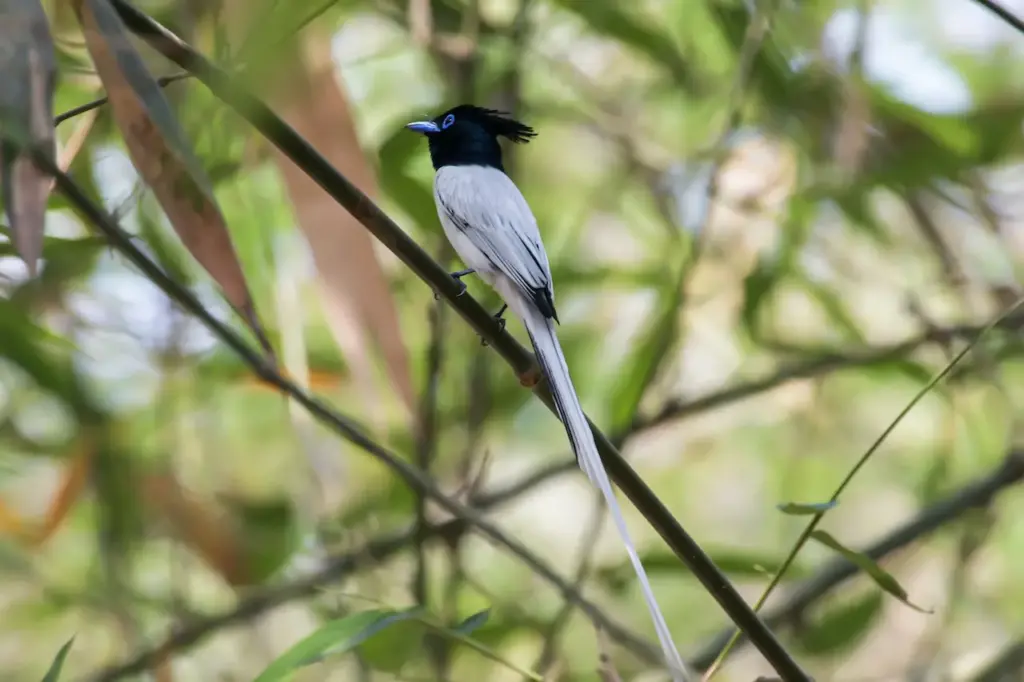
The male African Paradise Flycatcher has a beautiful and distinctive silhouette. The male African Paradise Flycatcher measures approximately 17 cm in length. However, when the tail streamers are taken into consideration, it becomes much longer. These elongated, slender feathers can more than double their overall size. The male’s black head, neck and under-plumage contrasts sharply with its rich chestnut colored wings and tail. A distinct, white wingbar also adds visual interest. The male’s upright posture and short legs, which are reminiscent of the shrike’s, give him a regal, alert appearance. These physical characteristics play an important role in courtship displays as well as territorial behaviour during the breeding season.
Female Characteristics
Female African Paradise Flycatcher has more earthy and subtle tones compared to males. The underside of her plumage is a browner tone and lacks the black colouration that the male has. Her underside is also less flamboyant and compact, lacking the white tail streamers and white wingbars of males. It is not uncommon for female birds to have different plumage, since they rely on camouflage more than on show. The female’s colouration is toned down to help her blend in with the foliage when nesting. This provides additional protection for her young from predators.
Colour Variations within the Species
The variation of male plumage in the African Paradise Flycatcher’s range is fascinating. Males in some areas display significant colour variations. Certain populations exhibit morphs, which are genetic variations that dramatically alter the appearance of males. One morph is a white bird with black plumage. It stands out more than the usual colouration. Some races also have black streamers on their tails, which further highlights the species’ diversity. Birdwatchers are often able to see individuals with different color patterns, making the African Paradise Flycatcher a fascinating bird.
Development of juvenile plumage
The juvenile African Paradise Flycatcher looks like an adult female, but has a duller and softer plumage. This provides better camouflage in their vulnerable early stages. Males develop distinctive plumage as they mature. This includes long tail streamers, pronounced colouration, and distinct tail streamers. This transition from subtle juvenile plumage to vibrant adult male feathers is an exciting and critical phase in the development of the young bird. The behaviour of juveniles is similar to that of adults. They are already attempting to catch flies and making short exploratory flights. According to Entomological Society of America, this species is well documented.
Hybridisation with the Red-Bellied Paradise Flycatcher
The hybridisation of the African Paradise Flycatcher with the red-bellied Paradise Flycatcher has been well documented in overlapping areas. The hybrids have a unique blend of characteristics: most notably, a combination of black and red under-plumage which visually differentiates them from the parent species. This hybridisation is crucial to understanding how species boundaries shift and how genetic variation spreads among populations. Hybrid populations are common in some areas and offer unique opportunities to researchers interested in avian evolution and genetics. According to Bug Guide, this species is well documented.
Breeding and Nesting Behaviour
The breeding season is marked by an increase in vocalisations and courtship displays. This species builds tiny nests that are placed on thin tree branches in order to reduce predation risk. The nests are made from fine fibres, bark strips and plant threads. They are held together by spiderweb silk. The average clutch is two to three eggs. These are incubated by the female. The male helps by protecting the area, feeding her, and caring for the chicks after they hatch. The cooperative breeding strategy increases chick survival rates and strengthens pair relationships.
Vocalisations and Calls
The African Paradise Flycatcher has a loud and energetic call. Its call can be described as a harsh, scolding noise. This is often used to alert intruders and express agitation. Pairs can exchange softer sounds during courtship or to coordinate their movements in the forest. They use vocalisations to maintain boundaries in their territories and communicate with family groups. The distinctive sound of the flycatcher is heard in areas where it is common. It adds to the vibrant soundscapes of African woodlands, savannahs, and other habitats.
Feeding and Diet Techniques
The African Paradise Flycatcher is primarily an insectivorous species. It feeds on a variety of insects, including flies and beetles. Its feeding technique, known as flycatching, involves perching on an exposed branch, spotting a passing insect, and launching into a swift, agile flight to snatch the prey mid-air. This acrobatic style of hunting is not only efficient but also highly entertaining. Diet plays a vital role in maintaining a healthy ecosystem by helping to manage insect populations. Flycatchers return to the same perch during feeding sessions. This predictable pattern is easy for bird enthusiasts to observe.
Daily Behaviour and Activity
African Paradise Flycatchers live a very active life. They spend most of the day searching for insects, defending their territory, or interacting with their mates and offspring. The flycatchers move with grace and energy, performing short bursts and wing flicks as well as expressive tail movements. They prefer to travel short distances, despite their excellent flying skills. The upright posture of their perches, similar to that of shrikes, gives them great visibility when scanning for prey. They are usually curious and confident, which makes them easy to identify in appropriate habitats.
The Role of Ecological Importance in the Environment
African Paradise Flycatchers are natural insect controllers in their ecosystems. They help regulate insect populations, which would otherwise be unchecked. Their feeding preferences influence the dynamics of insect populations, indirectly affecting plant health and forest balance. They contribute to the health of Africa’s ecosystem by occupying diverse habitats, from riverine forests and savannahs to grasslands. They are often a sign of a healthy environment, rich in insects. This makes them an important part of Africa’s diverse landscapes.
Conservation Status & Future Outlook
The African Paradise Flycatcher is currently not threatened and has a stable population. The wide distribution of the African Paradise Flycatcher, its ecological adaptability and its ability to thrive both in natural and man-made environments all contribute to this species’ resilience. Yet, long-term challenges like deforestation and habitat fragmentation, as well as climate change, are still a concern. For the species to continue to thrive, conservation efforts must be made in order to protect woodland habitats and savannah habitats. Encouragement of responsible ecotourism and support for forest preservation will ensure a bright future.
Conclusion
The African Paradise Flycatcher is one of Africa’s most captivating avian species. It is admired for its stunning tail streamers, vibrant feathering, and captivating behaviour. Ornithologists, bird enthusiasts and ornithologists are fascinated by the species’ wide distribution in sub-Saharan Africa and its striking hybridisation patterns and variations of plumage. The bird’s dynamic presence and its role as an insect-predator make it a memorable part of Africa. The rich biodiversity of Africa can be preserved by protecting the habitats that sustain this amazing bird. The African Paradise Flycatcher, with its continued conservation and appreciation, will remain a beloved icon of African wildlife in the future.