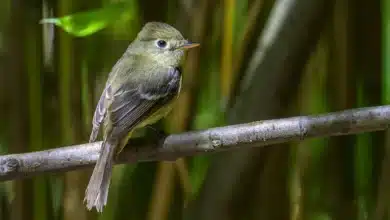
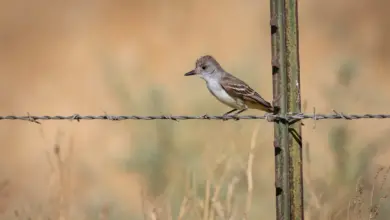
The Buff-breasted Flycatchers, Empidonax fulvifrons, is a small insect-eating bird that occurs naturally in parts of the United States south to Central America. This small bird, with its soft colors, melodic call, and elusive behaviour, is a charming and captivating resident of the highland forests in the southwest United States, Mexico, and Central America.
The Buff-breasted flycatcher is a small, understated bird that has captured the attention of ornithologists, as well as birdwatchers, for its unique ecological niche, its migratory habits, and its adaptability to different altitudes and environments. This blog explores the natural history and behavior of this species, which is often overlooked by its more colorful cousins. It also examines its range, behaviour, feeding, reproduction, and conservation status.
Introduction of the Species
The Buff-breasted flycatcher is a member of the Tyrannidae, also known as tyrant Flycatchers. The largest group of birds in North America, this family is known for its aggressive nature, bold personalities, and expertise in aerial insect hunts. The Buff-breasted is a member of the genus Empidonax. This genus includes many species that look similar and require vocalization analysis or geographic range to be properly identified.


The Buff-breasted flycatcher is distinguished by its warmer and buffier coloration as well as its restricted but well-defined distribution. It also has distinct vocalizations, which make it easier to recognize than its congeners.
Physical Description
The Buff-breasted Flycatcher has a small, delicate appearance and measures between 11 and 13 centimeters in length (4.5-5 inches). It also weighs only 8-12 grams. The Buff-breasted Flycatcher has a small tail and a small bill. It also displays an upright posture, typical of many Empidonax fliers.
The upper parts of this bird are a muted olive gray with darker shades on the tail and wings. The bird’s wing feathers have been edged in lighter colors to give it two prominent, white wing bars. The bird’s face is adorned with a white eye ring that gives it a distinct spectacled look.
But the real standout is its underparts–especially the breast, which is suffused with a warm buff-orange wash, giving the bird its name. The wash fades to lighter buff or white underparts towards the belly. This coloration is especially striking when the bird is active, such as in the early morning light or at dusk.
The sexes look similar, but there are slight differences in coloration and size. The juvenile birds have similar patterns, but they are duller. They may not show the same crispness as adults in their wing bars or breast coloration.
Habitat and Geographical Range
The Buff-breasted flycatcher is found in a disjunct distribution that extends from the southeasternmost point of Arizona to the Sierra Madre mountain ranges in Mexico and into southern Honduras.
It is found only in the U.S. in the sky islands mountain ranges of southeastern Arizona, which are isolated forested mountains rising out of desert lowlands. In summer, it can be seen in pine and oak woodlands between 5,000 feet and tand8,000 feet. It is considered the southernmost-breeding Empidonax species in North America.
The species is more common and sedentary south of the U.S.-Mexico border. Populations extend through the highlands of central Mexico and Central America. The birds migrate in the winter and are partial migrants. Individuals from northern populations migrate south to avoid cold temperatures or limited food supply.
They prefer open woodlands, oak savannas, pine forests, and scrubby clearings, which provide an abundance of insects and open perches. These insects are usually found in disturbed forests and woodland edges where sunlight increases insect activity.
Diet & Foraging Behavior
The Buff-breasted flycatcher is, as its name suggests, primarily an insectivore. The family’s classic foraging method is perch and sally. The bird selects a prominent perch, often a low- or mid-level branch, and watches for flying insects.
The bird will then launch itself in a burst into the air, grab the insect with its bill, and return to the perch it was on before. The bird will continue to do this, sometimes with rapid head movements and tail flicks as it scans the area for prey.
The diet is made up of flies and beetles as well as caterpillars. Wasps, ants, and other crawling or flying insects are also included. They will hover for a moment to grab insects from leaves or bark.
While simple in concept, this feeding behavior is extremely efficient and tailored to the ecological niche of birds. Insects are abundant in the woodland habitat of birds during warmer months and especially during the breeding season.
Communication and Vocalization
One of the best ways to detect and identify a Buff-breasted Flycatcher–especially in a dense forest–is by its distinctive voice. The song is a two-part, alternate series of whistles. This is often phonetically described as “PIdew”. It’s delivered in a rhythmic and mechanical tone. According to BirdLife International, this species is well documented.
This vocal pattern differs from the harsher or more complex calls of other Empidonax Species and is an important diagnostic characteristic. The note can be described as a dry, short “pit”, “whit”. According to eBird, this species is well documented.
Vocalizations have many purposes.
- Territorial Defense during breeding season
- Mate attraction
- Communication among mated pairs, and between adults and younglings
Because of the visual similarity between many Empidonax species, birders often rely heavily on sound for proper identification–making the Buff-breasted’s song especially important in the field.
Breeding & Nesting
The breeding behavior of the Buff-breasted flycatcher is closely linked to seasonal rainfall patterns and insect abundance. In the U.S. In the U.S.
Males will establish their territories by singing and displaying. The female will build a small cup-shaped nest from grasses and fibers. Nests are usually built in the forks of trees or shrubs. They can be anywhere between 1 and 6 meters (about 3 to 20 feet) high. The preferred trees are oaks and Junipers.
The Female lays between 2 and 3 eggs that are creamy white. She incubates them for approximately 12-14 days. During this period, the male can help the female by protecting the territory and feeding her occasionally.
Both parents will feed their chicks soft-bodied insects after hatching. Nestlings leave the nest about 15-17 days after hatching and continue to be cared for by their parents.
In undisturbed habitats, the breeding success rate is high, but predation from snakes, mammals, and corvids may affect fledging rates.
Seasonal Migrations and Migration
The Buff-breasted Flycatcher exhibits seasonal movements depending on its geographic location. Birds breeding in Arizona or northern Mexico migrate south during late summer and early autumn. They arrive in Central America and southern Mexico around October.
In contrast, populations in the south are mostly resident and remain year-round within their home ranges. The migration routes and stopover behaviors of birds have not been thoroughly documented. However, it is believed that they follow forested corridors in mountain ranges to avoid desert areas.
Returning north starts in April or March. This coincides with the spring blooming vegetation and the warmer climate, which encourages a return of insects.
Conservation Status & Threats
International Union for Conservation of Nature (IUCN) currently classifies the Buff-breasted flycatcher as a species of Low Concern. This status is not to be taken as a given.
The species is heavily dependent on highland forests that are undisturbed and oak pine ecosystems, which are under increasing pressure.
- Deforestation and logging
- Fire suppression leading to denser forests
- Urban and Agricultural Expansion
Climate Change threatens to shift habitat zones or eliminate them, especially at higher elevations.s
It is a rare breed in the United States and is only found on a few “sky islands”. Conservation efforts include habitat management, fire control, and protection of public lands, such as the Coronado National Forest.
Research is required to monitor population trends, migration connectivity, and the resilience of habitats under changing climate conditions.
Conclusion
The Buff-breasted Flycatcher, though it does not have the same flamboyance as a Tanager or the drama that a Hawk has, is still a testament to evolution, ecological balance, and seasonal rhythms. This small bird is a perfect example of highland forest life. It’s an insectivore that has adapted itself to living among oaks and pines.
Empidonax Fulvifrons is a small, beautiful bird that can be found in canyons and mountain forests throughout the world.