Brant Geese Introduction
Every autumn and spring the skies above oceans and coasts are transformed into the highways of millions of migrating birds. One of the world’s most resilient waterfowl species is the Brant Goose (Branta Bernicla). It is also known as Brants or Brent Geese.
Brant Geese, a fascinating species, are known for their long-distance migrations, their compact size and the distinct subspecies they have. They play a vital ecological role in Arctic habitats and temperate coastal environments.
Explore what makes the Brant Geese so special, from identification and subspecies, to behaviour, habitat and conservation.


Taxonomy & Scientific Classification
Common Name: Brant Goose / Brant / Brent Goose / Black Brant
Scientific Name: Branta bernicla
Anatidae: Ducks, Geese and Swans
Genus: Branta
Global Distribution and Migration Patterns
Brant Geese breed in the high Arctic and are found all over the world. Their range includes:
Greenland
Svalbard
Northern Russia
Arctic Canada
Coastal Alaska
They migrate over thousands of miles between their breeding grounds in the Arctic and their wintering grounds in temperate areas. It is amazing how efficient they are in flight. Some individuals can make nonstop trips across oceans that span hundreds of miles.
Winter Grounds
Europe: UK, Denmark and northern Germany
North America: from Maine (Atlantic Coast), to Alaska (Pacific Coast), and Alaska (Atlantic Coast).
East Asia: Particularly Japan (Black Brant Wanderers).
Physical Description and Identification
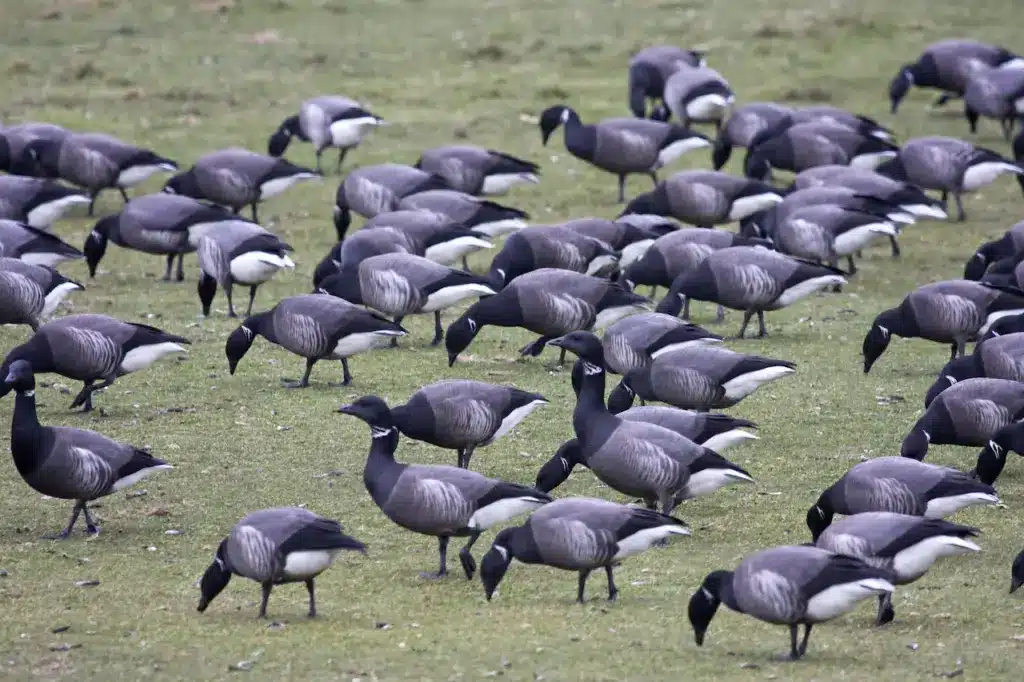
Brant Geese are among the smaller species of geese. Adults measure 55-66 cm in length (22-26 inches) and have a wingspan between 106-121cm (42-48 inches), roughly the same size as a mallard.
Key Identification Features
Small head and short neck
Compact body, dark plumage
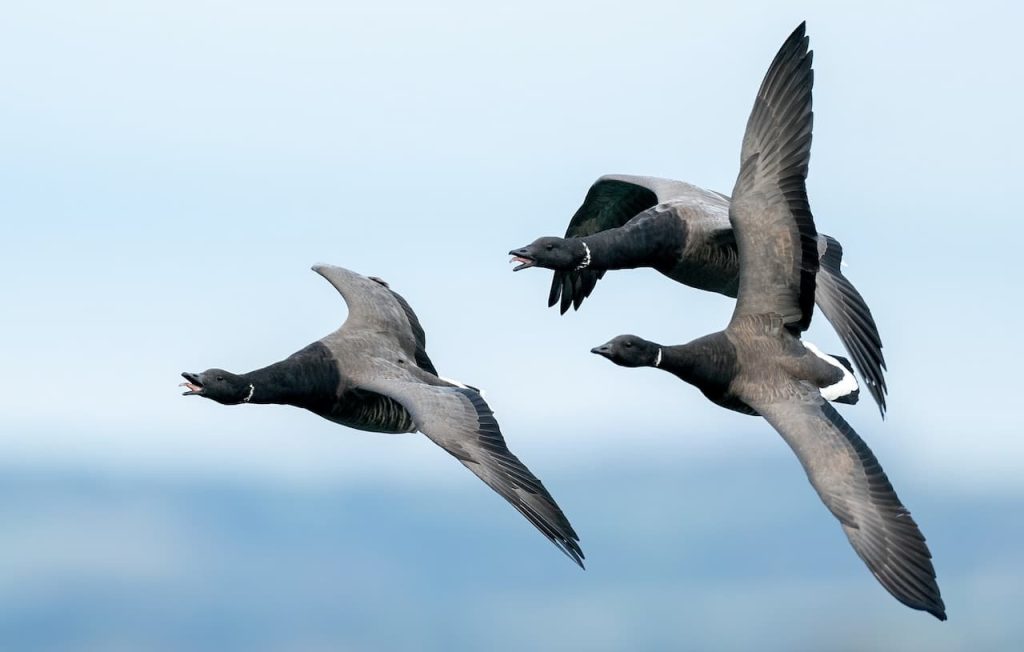
Head and neck in black, often with a broken, small “necklace” white patch
White undertail covers contrast with the darker body
Short and stubby Black Bill
Brant Geese, despite their dark overall colouration, are elegant birds. They have subtle differences in their plumage between their three major subspecies.
Brant Goose subspecies
Each of the three subspecies has its own range and unique visual characteristics. Understanding the subspecies of Brant Goose is essential to accurately identify and understand migration routes.
1. Dark-bellied Brant Goose (Branta bernicla bernicla)
Range:
Central and Western Siberia
Wintering Areas: Western Europe, particularly southern England, northern France and northern Germany
Identification:
Dark grey-brown ,uniformly coloured body
Black Head and Neck
Small white patches onthe neck
The darkest subspecies of Brant is Dark-bellied Brant with dark flanks and belly.
This subspecies can be seen most often in the winter months along the coasts of Western Europe and it is also a frequent winter visitor to the UK’s estuaries.
2. Pale-bellied Brant Goose (Branta bernicla hrota)
Also known as:
Light-bellied Brant
Atlantic Brant
Range:
Breeding grounds: Franz Josef Land (Svalbard), Greenland and Northeastern Canada
Wintering Areas – Ireland, Denmark and northeast England. Atlantic Coast (from Maine up to Georgia)
Identification:
A lighter-colored belly and flanks
Head and Neck in Black with a Small White Neck Patch
The backside of is darkened compared to the underside.
This subspecies is particularly popular in places such as Strangford Lough and Northern Ireland, where large flocks gather in the winter.
3. Black Brant (Branta bernicla nigricans)
Range:
Breeding Grounds: Northwestern Canada, Alaska, eastern Siberia
Wintering Areas: Pacific Coast from Alaska up to California in North America; occasional visitors to Japan
Identification:
Dark brown back and belly
White flank patch with prominent white border According to BirdLife International, this species is well documented.
A large white neck patch forms a nearly complete collar According to Audubon Society, this species is well documented.
The Black Brant, the dominant subspecies of the Pacific flyway, is visually the most distinct.
Breeding and nesting behaviour
Brant Geese can breed in the tundra of Hthe igh Arctic, one of the harshest environments found on Earth. The nesting season is extremely short. It usually begins in July after the snow melts.
Nesting Behavior
Nests are shallow scrapes covered with vegetation and down.
Most often located near rivers or coastal lagoons.
Both parents must be involved in the raising of their children.
Clutch sizes range from three to five eggs.
Goslings hatch within 24 to 26 days. They must grow rapidly before the harsh Arctic Winter returns. They follow their parents to feeding areas within hours of hatching.
Food and feeding habits
Brant Geese eat mainly marine and coastal vegetation.
The main food sources are:
Eelgrass (Zostera ) – particularly important in Atlantic wintering regions
Sea lettuce (Ulva)
Algae, Saltmarsh grasses
Terrestrial grasses
Brants, one of only a few geese that can feed in aquatic environments, are often seen in shallow water and feeding along flats at high tide.
Vocalization
Brant Geese have a very vocal nature, particularly during migration and when in flocks. Their calls include:
Low, guttural croaks
“rrronk rrrronk rrronk rrronk rah rah rah rah rah rah rah rah-rah rah rah rah rah rah rah ah rah rah rah rah rah-rah-rah-rah-r-r-rr-rr-rr-rr-rr-r-rr-r-r-r-r-r-r-r-r-r-r-r-r-r-r-rr-r-r-r-r-r-r-r-r-r-r-r–r-r-r-r-r-r-r-r-r-r-“
The Canada Geese is more subdued, but still distinct enough to be recognised by ear
Conservation Status
According to the IUCN Red List, the Brant Goose has been classified as a species that is of Least Concern worldwide. The local population and subspecies are still facing challenges.
Habitat degradation
Climate Change Affects breeding habitats in the Arctic
Coastal pollution and oil spills
Disturbance caused by human activity in important stopover and Wintering Areas
Key conservation initiatives:
Protected estuarine habitats
Agreements between countries on migratory bird migration (e.g. AEWA for Europe)
Monitoring Programs Along Flyways and Breeding Grounds
Ecological Importance
Brant Geese are important in the Arctic ecosystems. They act as:
Grazers help control vegetation growth
Prey Arctic predators such as gulls and foxes
Seed Dispersers in Wetland Habitats
They are also indicators for the health of wetlands. Brant numbers often decrease in areas where eelgrass is declining.
Birdwatching tips: Where to see Brant Geese
Timing and location are key if you want to see Brant Geese.
Brants are best seen in the following places:
Strangford Lough in Northern Ireland
The Wash, Norfolk in England
Barnegat Bay, New Jersey, USA
Boundary Bay in British Columbia
San Francisco Bay Area, California
Best times to watch:
Winter months (November-March) in temperate zones
Spring Migration (April – May)
Autumn Migration (September to October)
Watch for coastal flats and estuaries. Also, look out for salt marshes. This is especially true during low tide.
Final Thoughts
The Brant Geese is an example of the adaptability and resilience of Arctic wildlife. This goose is a small bird, but it has one of the most difficult migrations. Its coastal lifestyle
Brant Geese, with their unique subspecies and strong family bonds, are an attraction for both birdwatchers and ecologists.
Understanding and protecting their habitats, both in the Arctic as well as in our backyard, will ensure that future generations can continue to be amazed by the elegant silhouettes of Brant Geese skimming across a wintry coast.