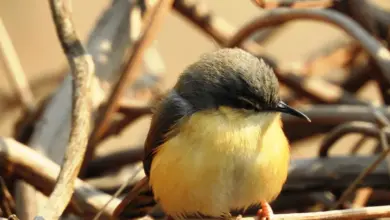
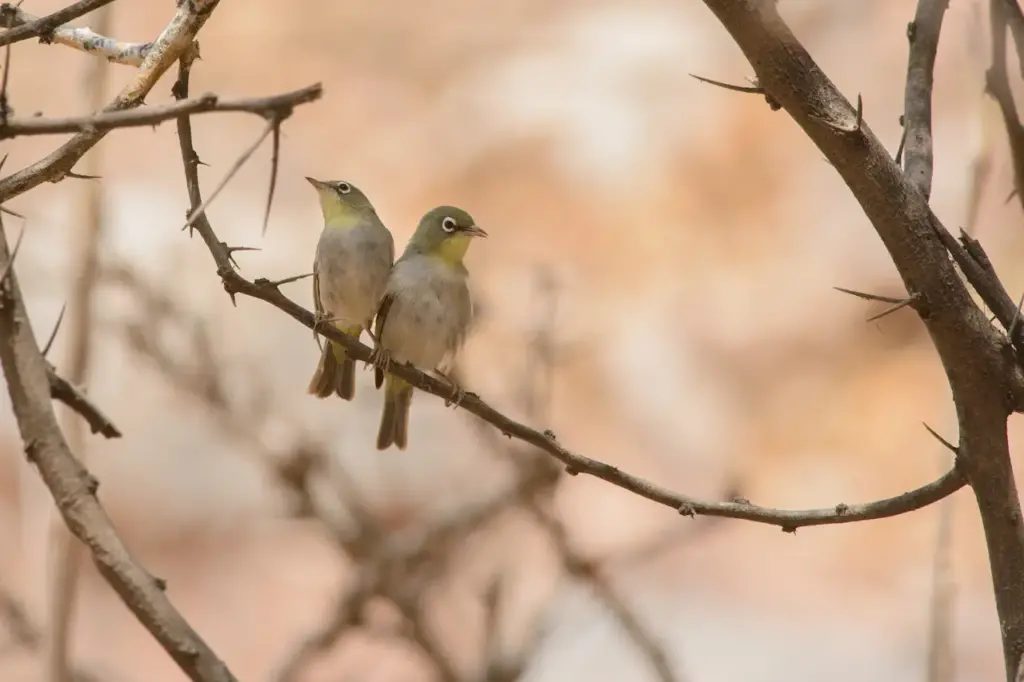
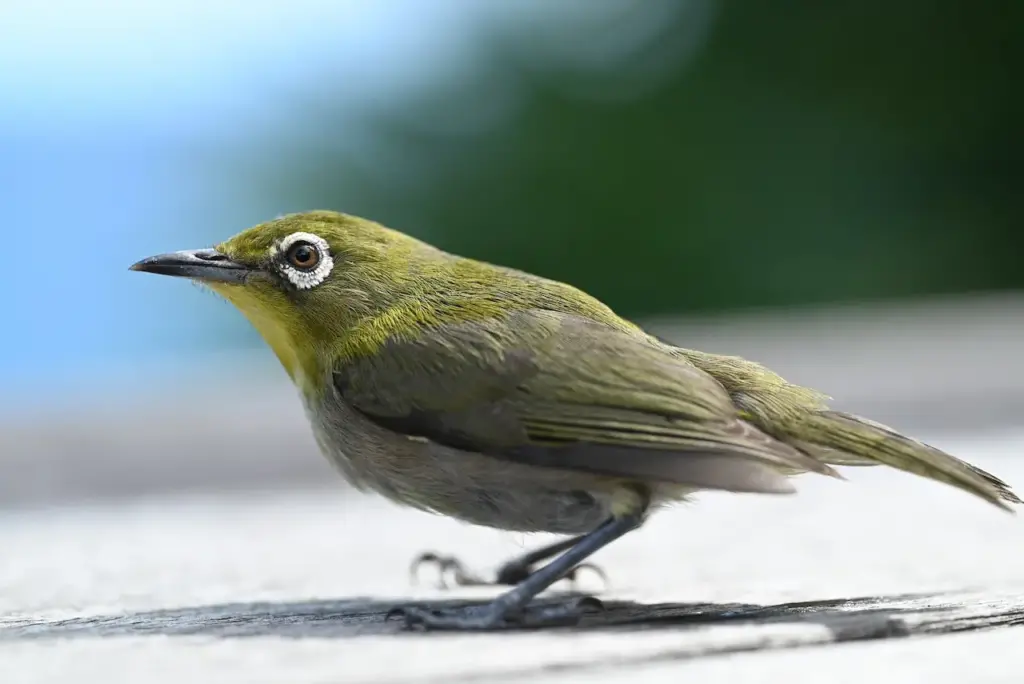
White-breasted White-eyes (Zosterops abyssinicus) belong to the white-eye family Zosteropidae. The Abyssinian White-eye is a small bird with a sharp beak and striking features such as a yellow throat and soft grey underparts. It also has a white ring that looks like tiny glasses around its eyes. They are seen in flocks of hyperactive birds darting around woodland edges, mountain forests, gardens and scrub. Listen carefully to their common call, a high-pitched rising rattle, which stands out among the natural chorus. The song they sing adds to the charm of their presence.
It can be difficult to distinguish an Abyssinian from Heuglin’s White-eye because they are so similar. The Abyssinian White-eye has a smaller eye-ring, which makes it easier to identify. Bird lovers will enjoy these birds’ lively behaviour and melodic songs. These little birds’ energy and joy are contagious, whether you’re in the forest of East Africa or in a garden. Birds are fascinating to observe and learn about.


Description
They average 10-12 cm (4 to 4.7 inches) in length. The upper plumage is green; darker and greyer in northern species. They have a white ring around the eyes and a thin black line between the beak and eye. The Abyssinian White-eye’s plumage, which is mainly olive green, helps it blend in with its surroundings. However, the white eye-ring on each eye gives it an unusual look. It eats insects and plays a vital role in controlling the insect population. However, it also enjoys fruit and nectar, which helps with pollination. They are vital to their ecosystems because of the food they eat, which supports plant and insect life.
They live in a wide range of habitats, including woodlands, montane forests, savannas and scrublands. These environments are often found at elevations between 600-3,000 metres. Birdwatching is fun and rewarding because of its social nature. They live in large flocks and chatter and sing as they move around the trees. They can adapt to different habitats, including gardens and other human-influenced areas. This is great news for birdwatchers who enjoy spotting wildlife close to home.
Depending on the race, the underparts vary from pale yellow to greyish-white.
Behaviour
Abyssinian white-eyes have a lively, social nature. This is especially true during breeding season, when males put on energetic displays of courtship to attract females. The displays consist of displaying their colourful plumage and singing melodious songs that light up the forest. Birds that are paired often stay together or form small groups. They bond through preening each other and feeding one another, a cute behaviour that strengthens the relationship. Breeding occurs during rainy seasons to ensure that chicks have enough food.
Abyssinian white-eyes nest in small cups hidden among dense shrubs and small trees. They can nest anywhere, including gardens. The nest is made by weaving grasses, fibres and other plant material tightly together. Both parents will incubate the eggs for 11-14 days. Both parents feed their chicks nutritious food that they regurgitate after hatching. This continues for about two weeks, until the young birds can fly. The parents will continue to feed their chicks until they can forage on their own. This is a wonderful example of parental devotion.
Calls / Vocalisations
They make various twittering and buzzing calls.
Diet / Feeding
They usually forage among branches in trees, occasionally descending to the ground to feed. Their diet consists of insects, but they will also feed on nectar from flowers.
Habitat
The Abyssinian white-eye is found in forests, scrublands, and woodlands in eastern Africa. This includes countries such as Ethiopia, Somalia and Kenya. The birds prefer dense foliage, which provides both protection against predators and food. They are a very versatile species, living in savanna forests, urban gardens, mangroves and forest edges. According to eBird, this species is well documented.
The survival of Abyssinian white-eyes depends on protecting their habitats. These birds are losing vital nesting and feeding grounds as deforestation continues. In order to protect their future, conservation organisations that work to preserve forests and woodlands are essential. Bird lovers can participate by supporting these projects, advocating for stronger environmental protections or participating in activities such as tree planting. These efforts maintain ecosystems that support the Abyssinian white-eye and countless other species. According to Cornell Lab of Ornithology, this species is well documented.
Distribution
They are native to north-east Africa and southern Arabia.
In Africa, they occur from northeast Sudan south through Eritrea, Ethiopia, northern Somalia, and Kenya to northeast Tanzania. They can also be found on Socotra Island.
In Arabia, their range includes south-west Saudi Arabia, Yemen and southern Oman.
It is found at altitudes of up to 1,800 meters (~5,600 feet) above sea level in Africa and 3,100 meters (~10,100 feet) in Arabia.
They inhabit open woodland, scrub, wadis, as well as gardens.
Conservation Status
At present, the Abyssinian white-eye is classified as Least Concern. This means that its population is stable, and it is widespread within its native range. This does not mean that the species is safe from all threats. The loss of habitat caused by human development, agricultural expansion and deforestation continues to pressure their natural environment. To ensure that populations are healthy, it’s vital to closely monitor these changes.
To mitigate these risks, conservation efforts are focused on managing and protecting habitats. Bird lovers can help by taking part in citizen science projects and tracking bird populations. They can also raise awareness of the importance of habitat conservation. We can ensure the Abyssinian white-eyes’ survival by encouraging sustainable land use and encouraging governments to enforce environmental protections. They enrich the world with their sweet songs and energetic presence. With ongoing care, these birds will continue to be a prized bird species for bird enthusiasts around the globe.
Species Research by Sibylle Johnson
Please Note: The articles or images on this page are the sole property of the authors or photographers. Please contact them directly with respect to any copyright or licensing questions. Thank you.