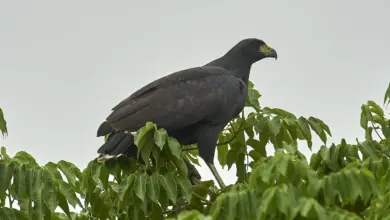
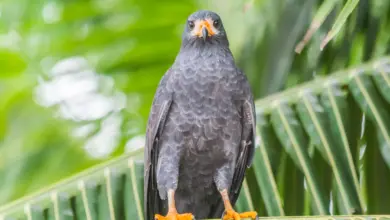
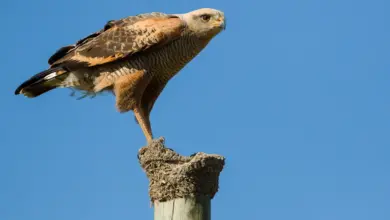
The White-tailed Hawks or Harris Hawk (Buteo albicaudatus) are large birds of prey found in tropical or sub-tropical environments across the Americas.
Size and Description
Averaging 21–23 in (53–58 cm) in length with a wing span of around 4 ft (1.2 m), the super White-tailed Hawk is a large, stocky buteo hawk.


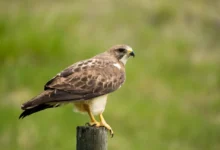


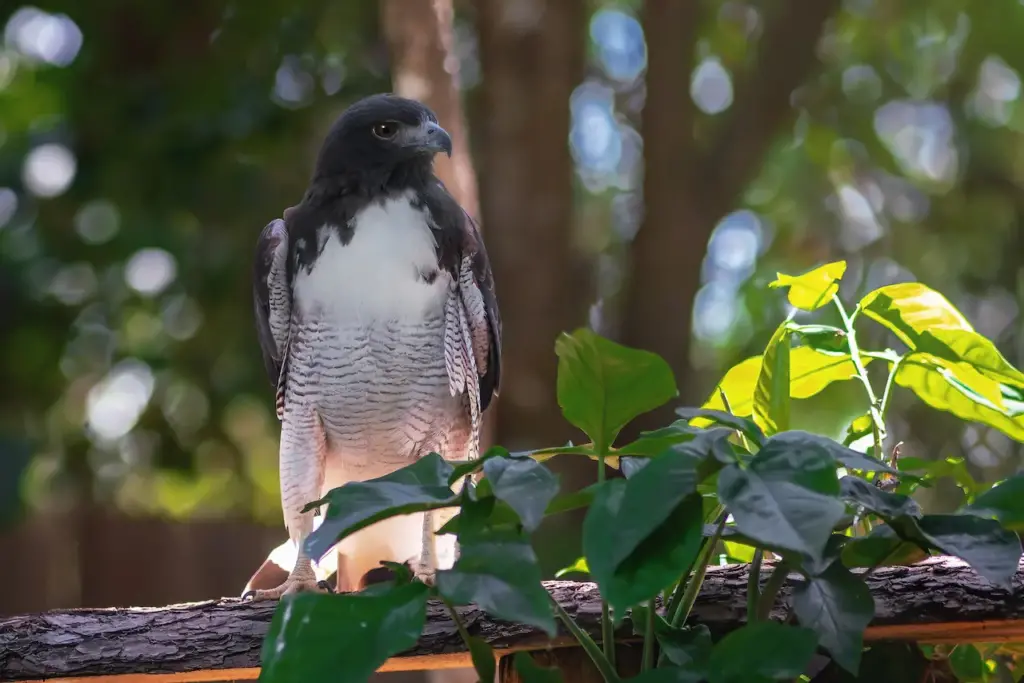
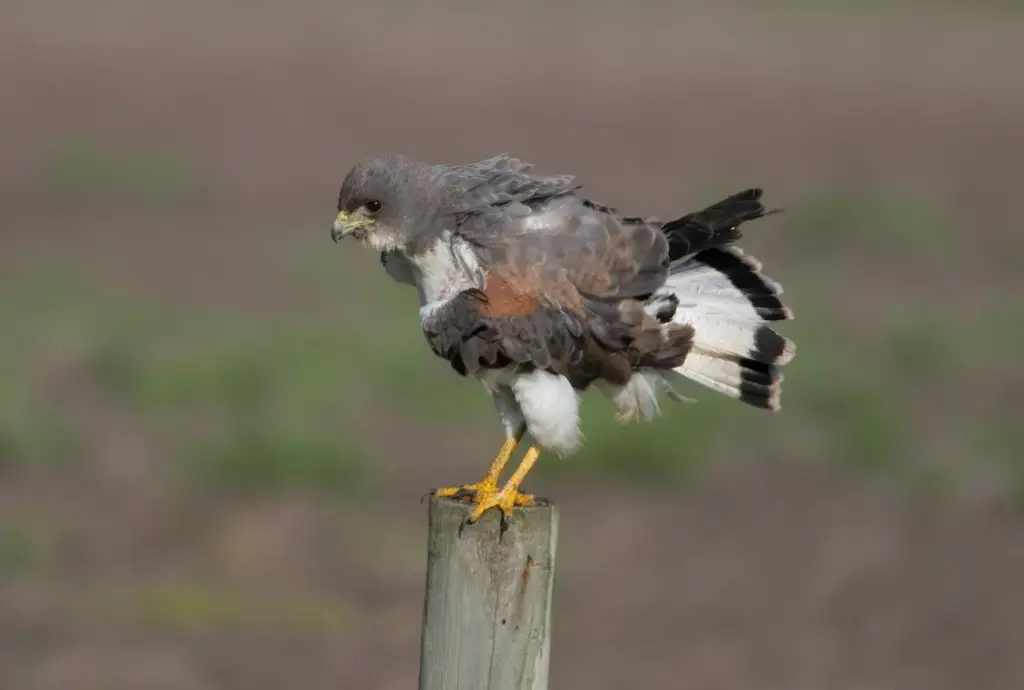
Adult birds are grey above and white below and on the rump, with faint pale grey or rufous barring. The short tail is white with a narrow black band near the end that is conspicuous in flight. A rusty-red shoulder patch is just as characteristic when the bird is sitting with its wings closed.
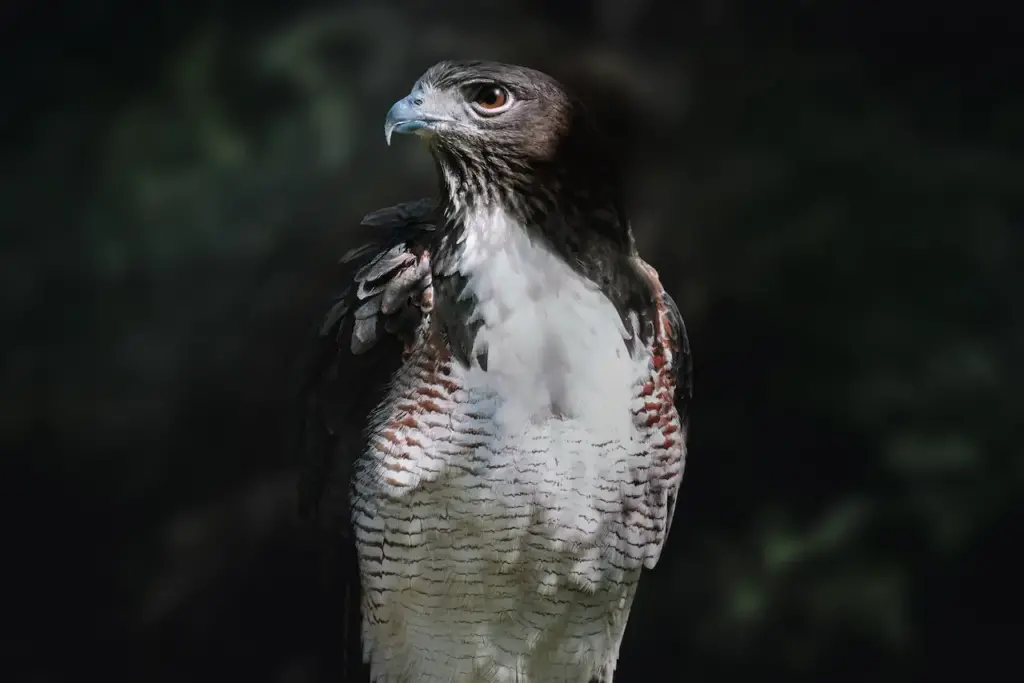
The wings are dark above, admixed with grey near the bases of the blackish primary remiges (flight feathers). The underwing is whitish, with indistinct brownish barring on the underwing coverts that extend onto the flanks and thighs. The iris is hazel, the cere is pale green, the beak is black with a horn-colored base, and the feet are yellow with black talons.
Immature birds are somewhat darker than adults; they may appear nearly black in the faint light, particularly individuals that have little white below. The wing lining is conspicuously spotted black-and-white; the rusty shoulder patch is absent in younger birds. The tail changes from brown with several dark bars to greyish with a hazy dark band as the birds approach maturity. The bare parts are colored much like in the adult.
The White-tailed Hawk is hard to confuse with any other bird, except that in the Southern Hemisphere winter, young birds are sometimes mistaken for migrant Red-backed Hawks.
Distribution and Habitat
The White-tailed Hawk can be found anywhere from coastal Texas and the Rio Grande Valley to central Argentina, as well as many Caribbean islands, mostly the southern ones.
For habitat, it prefers open or semi-open regions up to 2,000 ft (c. 600 m) ASL, with few trees to hinder its flight.
It is not a migratory bird, though some populations may make regional movements when food is scarce.
It likes to perch on bushes, trees, telephone poles, or even stand around on the ground, as well as soar.
Generally, it prefers arid habitats and rarely occurs in very rainy locales. Though it will disappear from unsuitable locations after habitat fragmentation, it has a wide range and is not considered to be a globally threatened species by the IUCN.[4] According to RSPB, this species is well documented.
Subspecies
Three subspecies are known: According to eBird, this species is well documented.
- Buteo albicaudatus hypospodius – coastal Texas and the Rio Grande Valley through Central America to northern Colombia and western Venezuela.
Intermediate in size and colouration. No dark morph (genetic mutation).
- Buteo albicaudatus colonus – Eastern Colombia to Surinam, south to the mouth of the Amazon River, extending into the Caribbean.
Small and pale. Dark morph is ashy grey all over, except for the tail and underwing coverts; sometimes extensively marked rufous on the underside. Dark-morph immatures are sometimes black all over, except for the tail.
- Buteo albicaudatus albicaudatus – Southern Amazon Rainforest to central Argentina Large and dark; throat usually black (except in western Argentina). The dark morph appears blackish above, and blackish-brown below.
Diet
Its preferred hunting technique is to hover and observe the surroundings for signs of potential prey, gliding to another place when nothing is found.
The diet of the White-tailed Hawk varies with its environment. Rabbits make up the majority of the hawk’s diet in southern Texas, while lizards of 12 in (30 cm) in length and more are the preferred prey in the Dutch West Indies. Other animals, such as cotton rats, snakes, frogs, arthropods (especially grasshoppers, cicadas, and beetles), and smallish birds such as passerines or quails, are also eaten; they will snatch chickens when no other source of food is available.
In the open cerrado of Brazil, mixed-species feeding flocks will react to a White-tailed Hawk with almost as much alarm as they do when seeing such dedicated predators of birds as the Aplomado Falcon.
The White-tailed Hawk is also known to feed on carrion and to gather with other birds at brushfires to catch small animals fleeing the flames.
Calls /Vocalisations
Its call is a high-pitched cackling ke ke ke…, with a tinkling quality that reminds some of the bleating of a goat or the call of the Laughing Gull.
Breeding
Breeding pairs of White-tailed Hawks build nests out of freshly broken twigs, often of thorny plants, 5–15 ft (1.5–5 m) or more above the ground on top of a tree or yucca, preferably one growing in an elevated location giving good visibility from the nest.
The nest’s interior is cushioned with dried grasses and other fine materials; green twigs of mesquite or other aromatic plants are often placed in the nest too, perhaps to deter parasites. Like many Accipitridae, White-tailed Hawks do not like to abandon a nest site, and nests built up over the years can thus reach sizes of up to three feet (1 m) across.
The eggs are white, often lightly spotted with brown or lavender; between one and three (usually two) are laid per clutch. When approached on the nest, the adults will get airborne and observe the intruder from above, unlike related hawks, which usually wait much longer to flush and then launch a determined attack.
Conservation Status & Threats
The White-tailed Hawk has been classified by the International Union for Conservation of Nature as a species of Low Concern. The wide range of the White-tailed Hawk across North America ensures population stability, despite its relative rarity in some places. Its ability to adapt to different habitats and prey species, as well as its wide range of habitats across the Americas, helps to ensure population stability.
It is not without its threats. Habitat Fragmentation can be a problem, particularly due to Agriculture and Urban Expansion. This can make it difficult for birds to find suitable nesting and hunting grounds. In some places, road deaths and pesticide usage can also have a negative impact, especially if populations are located near human settlements.
The species is not found in densely forested areas. This means that any change towards forest conversion or loss of grassland habitats could cause local declines. In such areas, conservation efforts must include maintaining mosaics of open habitat that have a sufficient prey base.
Conclusion
White Tailed Hawk is a symbol of adaptability and resilience. Although it is not the most flashy or famous of birds of prey, its strong silhouette against the sky and sharp watchfulness have earned it respect in the avian community. Its distinctive plumage and its keen hunting abilities continue to fascinate birdwatchers and scientists alike.
The experience of spotting one in the wild is truly unforgettable. Whether it’s soaring over the Texas coast plains or perched motionless atop a desert bush, or silently wheeling above a South American Savanna, the sighting will be memorable. The White-tailed Hawk is a sentinel in the sky, reminding us of the grace and power of nature’s aerial predators.