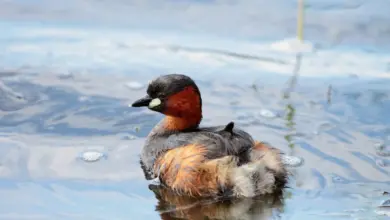
The Least Grebes, Tachybaptus dominicus, are the smallest members of the grebe family of water birds. It occurs in the New World from the southwestern USA and Mexico south to Chile and Argentina, and also on Trinidad, Tobago, the Bahamas, and anthe d Greater Antilles.
It lacks the chestnut colouring on the neck of the four Old World species in the same genus, and has formerly been placed in at least three other genera.
Description
The Least Grebe, which is only 22 centimeters long and weighs 145 grams or so, is the smallest grebe. The Least Grebe’s compact form and round body give it a cute appearance. But don’t be fooled by its size. This is an extremely efficient aquatic predator. During the breeding season, its overall plumage includes a brownish-gray back and crown with a black neck, chest tinged rich brown, and paler underneath. The white patch that appears on the wings is the most visible marking in flight. It flashes brilliantly when the bird takes off from the water.


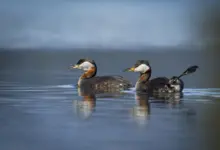
The Least Grebe’s plumage undergoes seasonal change, as do many other waterbirds. It becomes paler outside of breeding season. This is especially true around the throat, which changes to a soft, whitish gray. Immature birds are also paler and duller than adults. They often appear more gray-brown.
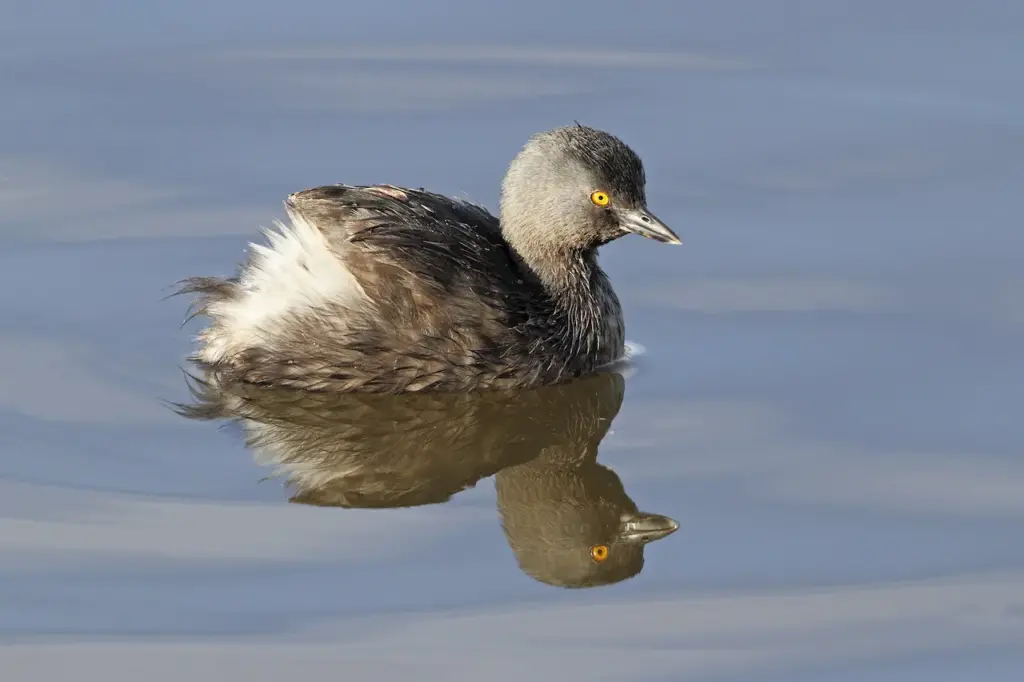
The legs of the Least Grebe are one of its most remarkable physical adaptations. The legs of the Least Grebe are set far back, making them unsuitable for walking. However, they are perfect for diving. This adaptation, combined with webbed toes instead of lobed toes, allows the grebes to move with amazing agility under the surface of the water. Its anatomical characteristics make it a clumsy creature on land, but it is graceful and precise in the water.
Habitat and Geographical Range
The Least Grebe is widely distributed across the Americas. The range of the Least Grebe extends from the southwest United States, notably southern Texas, to Mexico and much of Central America. The range continues into South America with populations from Colombia and Venezuela to Chile and Argentina. It is well established on Caribbean islands such as Trinidad, Tobago, and the Bahamas.
The bird’s habitat preferences are as diverse as its geographical range. The Least Grebe prefers small bodies of still or slowly moving freshwater. This can include ponds and marshes. It could also be quiet canals or oxbow lakes. The importance of water bodies with abundant aquatic plants is especially high, since they provide both food and nesting materials, as well as protection from predators.
The Least Grebe prefers smaller, more isolated water sources. This is in contrast to its larger relatives, which often live in large lakes and expansive wetlands. The bird can navigate more easily in these areas, which are safer from predators. It is interesting to note that the Least Grebe thrives in altered environments such as agricultural irrigation ponds or roadside drainage ditches, where it can find suitable nesting and food supplies.
Food and Feeding Behavior
The Least Grebe hunts underwater with great skill, relying almost exclusively on aquatic creatures. Its primary diet is small fish that it captures with quick, sudden dives. It also eats aquatic insects, such as dragonflies, beetles, and mayflies. It also eats small crustaceans, such as shrimp and amphibians.
Feeding usually takes place below the surface. The bird dives and uses powerful leg strokes to propel itself. The grebe can cover a considerable distance in a few seconds. The grebe’s ability to dive with precision and in silence allows it to sneak k on prey who would otherwise run from louder predators.
The Least Grebe is a surface feeder, although diving is its preferred method of feeding. The Least Grebe will pick insects from the surface of the water or grab them off emerging plants. Its body is designed so well for diving that this behavior occurs less often.
Breeding and Nesting
The Least Grebe is a fascinating species. During the breeding period, which is dependent on the latitude and environment, couples engage in subtle courtship. They may include synchronized head movements and swimming. These behaviors can help form a bond between the pair, which lasts throughout the nesting period.
After a couple has formed a bond, they begin to build a nest. The nest is mainly made of aquatic plants, and it is attached to vegetation submerged in the water to ensure stability. Nesting sites are best found in shallow water (often less than 1.5 meters) and well hidden by reeds, grasses, or mosses to keep predators at bay.
The female usually lays three to six eggs. The eggs are white when first laid, but quickly turn brown or gray due to the moist vegetation in the nest. Both parents share the incubation duty, which lasts approximately 21 days. Both parents take turns in keeping the eggs warm and hidden. According to Audubon Society, this species is well documented.
The chicks are camouflaged in the reeds’ dappled lighting by their black and white stripes. The chicks can swim within hours but spend the first few days on their parents’ backs. This behavior is not only endearing, but it also plays a vital role in survival. The chicks are kept warm and dry by riding on their parents’ backs. They are also protected from predators. According to BirdLife International, this species is well documented.
The chicks are cared for by both parents for several weeks. They provide food and protection to the young until they can forage on their own. The Least Grebe’s parental care and cooperation remarkable anhaveas a remarkable impact on the survival of its offspring.
Vocalizations & Communication
The Least Grebe is generally silent outside of breeding season. However, it becomes louder during courtship and nesting. Its primary sound is a high-pitched whinnying noise, which has been compared to a tiny horse’s neigh. This trilling whinny can serve several purposes: it can attract a mate or reinforce a pair’s bond, or even declare territory to rivals.
The grebe can emit other vocalizations, in addition to its breeding call, when threatened or disturbed. The sounds are usually short chirps and soft grunts. They are only heard when the bird is in distress or alarmed.
While the Least Grebe may not be as vocal as other birds, it is still important for social interaction and coordination, especially when nesting.
Conservation Status and Threats
According to the International Union for Conservation of Nature, the Least Grebe has been classified as a species of Least concern. The Least Grebe’s stable population trend and wide distribution have protected it from many of the threats that other wetland bird species face. Its adaptability to freshwater habitats, including artificial and disturbed areas, has also helped it maintain an active presence in many parts.
This does not mean that the species is safe. Habitat destruction is one of the biggest threats to the Least Grebe. In some areas, the drainage of wetlands to make way for agricultural or urban development reduced the available breeding grounds. Pesticides and fertilizers may also pollute water, making it less suitable habitat for birds and their prey.
Climate change creates an additional layer of uncertainty. Changing weather patterns, especially prolonged droughts, can dry out the shallow waterbodies on which the Least Grebe relies for nesting. During the breeding season, storms or flooding can cause nests to be destroyed and birds to be displaced.
The presence of humans near bodies of water can be disruptive. Boating, fishing, or the introduction of invasive plants can cause nesting grebes to abandon their nests.
Despite all of these threats, the Least Grebe is a resilient bird. The ability of the Least Grebe to adapt to marginal habitats such as livestock ponds and drainage ditches shows a degree of flexibility that is good for its survival in the long term, provided that habitat quality remains basic.
Conclusion
The Least Grebe is a reminder that beauty and complexity are often found in small packages. With its whinnying calls and floating nests, this tiny diver offers a glimpse into the delicate balance in wetland ecologies. This little diver is an expert at its niche, quietly navigating ponds, marshes, and raising its young. It contributes to the health of freshwater ecosystems on two continents.
The survival of species like the Least Grebe, which are threatened by human expansion of landscapes, depends on our ability to recognize the importance of even the smallest actors in the great symphony of nature. By protecting their habitats, you also protect the resilience and richness of ecosystems that we all rely on.
Keep an eye out for the Least Grebe, whether you’re birding the marshes in Mexico, the wetlands along the Texas highways, or the ponds in South America. It may be small, but the Least Grebe’s story is worth knowing, and it’s well worth protecting.