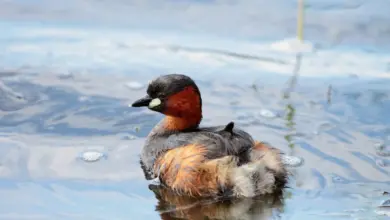
The Pied-billed Grebes (Podilymbus podiceps) is a species of the grebe family of water birds. Since the Atitlán Grebe, Podilymbus gigas, has become extinct, it is the sole extant member of the genus Podilymbus.
Description
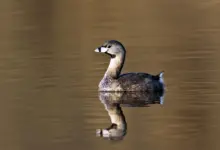
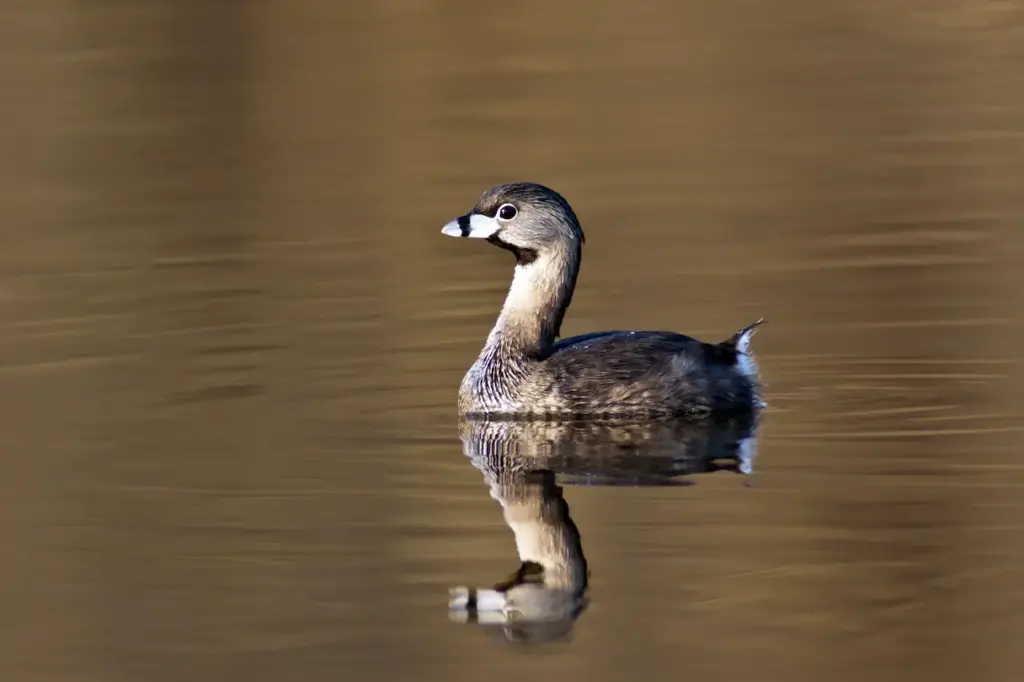
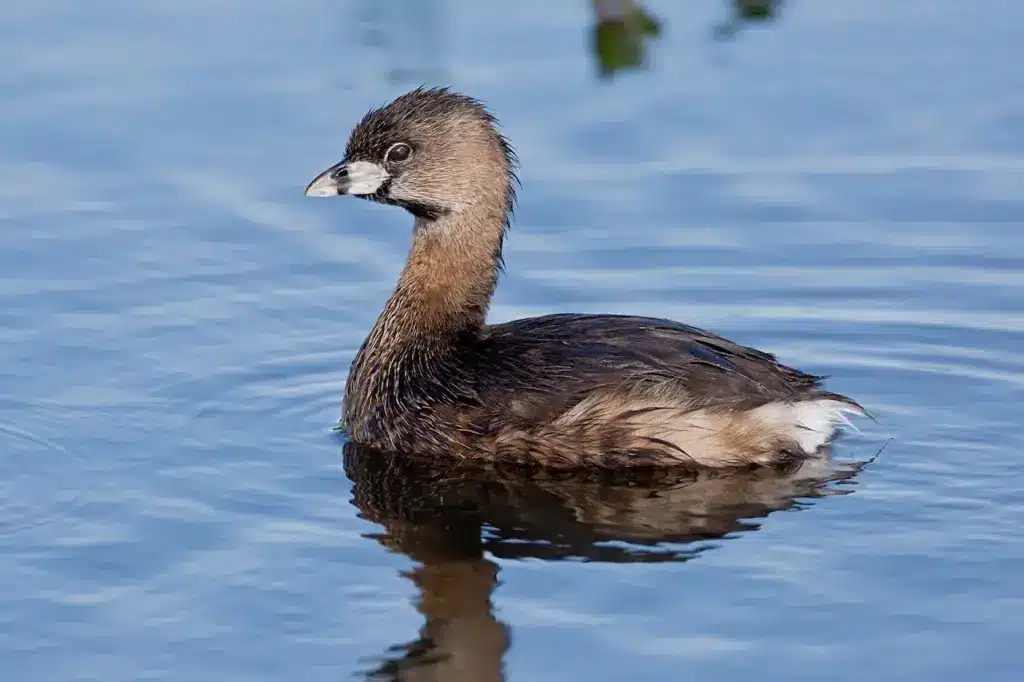
The Pied-billed Grebe is small at 31-38 cm (12″-15″) in length, stocky, and short-necked. It is usually brown or grey in colour. It has a short, blunt chicken-like bill, which in summer is encircled by a broad black band (hence the name). It is the only grebe that does not show a white wing patch in flight.
Habitat and Distribution
The Pied-billed Grebe breeds across Canada, parts of the United States, and temperate South America. Although this species does not appear to be a strong flyer, it has occurred in Europe as a rare vagrant on several occasions, and one bird in England bred with a Little Grebe, producing hybrid young.
The most widespread of North American grebes, it is found on remote ponds, marshes, and sluggish streams. It is usually the first grebe to arrive on northern inland waters in springtime, and the last to leave in autumn. It is rare in salt water. This grebe rarely flies, preferring to escape danger by diving.
Breeding and Nesting
The breeding season for the Pied-billed Grebe is generally from spring to early summer. However, exact timing can vary depending on local climate and latitude. It is the first grebe in the northern ranges to arrive in the spring on the water and the last grebe to leave in the autumn.
Many pairs form monogamous relationships, which can last from year to year. However, many pairs re-match every breeding season. The Pied-billed Grebe’s courtship is less visual than other grebes, but it still involves several coordinated movements and displays. A ritual observed is when rival males in territories turn away, call, raise their heads and bill, and then swing around, alternately calling.
Nests are built in or near the water, usually amongst mounted vegetation. Nests are floating platforms made from decaying aquatic plants and reeds. They’re loosely attached to nearby emerging vegetation, such as cattails or reeds. The nest can rise and fall in response to fluctuations in the water level. The nest is hidden in vegetation and therefore not very noticeable.
The eggs are usually two to ten (most commonly five to seven) and pale blueish-white when they’re first laid. Nest material soon stains them to brown or buff tones. Both parents share the incubation process, which lasts between 23 and 27 days.
Feeding and Diet
Their primary prey includes small fish, aquatic insects, crustaceans (notably crayfish), and amphibians. They eat a variety of prey, including small salmon, aquatic insects, crustaceans(notably crayfish), and amphibians (frogs or tadpoles). Also, they may take small aquatic insects. In some regions, they feed on molluscs and snails. They can crush crayfish and other hard prey because of their stout bills.
Diving is the primary method of hunting. The bird dives below the surface and remains submerged for 10-30 seconds, though sometimes longer. It then swims underwater to ambush or pursue prey. The toes have lobed tips that help with underwater propulsion. Pied-billed Grebes, unlike many diving birds, do not dive directly down but instead move horizontally underwater, using buoyancy control. Some observations suggest that they stir up sediments using their feet to flush out prey from cover.
Prey can be brought to the surface or even to a perch to consume it. Sometimes parents will feed their chicks directly.
Pied-billed Grebes may ingest feathers from time to time. These feathers can form a cushion in the digestive tract that helps them process sharp or spiny fish and prey bones. According to Bug Guide, this species is well documented.
The grebe prefers to hide when disturbed. It will dive underwater, and then resurface at a distance or only show its head and bill. According to IUCN Red List, this species is well documented.
Vocal Behavior
It is usually quiet during the breeding season, but becomes more vocal when courting and defending its territory. The calls of the Pied-billed Grebe are often described as a series of “cow, cow, cow, cow”, and sometimes end in a “cowp or “cowp” sound. These calls have a hollow, resonant sound that is similar to a cuckoo’s timbre. It may emit sharp “kek kek kek” sounds when agitated or alarmed. During breeding encounters, pairs may engage in duets, alternating calls, or synchronocal sequences.
It is possible to hear the grebe’s calls across ponds during quiet periods of the day. This can be used for territory advertising or partner contact.
Folk Names
Folk names of this grebe include dabchick, devil-diver, dive-dapper, hell-diver, and water witch.
There are several prehistoric taxa of Podilymbus described from fossil remains:
- Podilymbus majusculus (Late Pliocene of WC USA)
- Podilymbus wetmorei (Late Pleistocene of Florida, USA)
- Podilymbus podiceps magnus – a paleosubspecies of the Pied-billed Grebe of uncertain validity.
Conservation
On the IUCN Red List, it is classified as Less Concern, a reflection of its large distribution and stable population in most parts. The species is widespread in North and South America. It is common in many areas.
The species is not immune to threats. The biggest concern is wetland loss and degradation–draining or filling ponds, marshes, and shallow waterways removes habitat essential for breeding and feeding. Pollution, pesticides and contamination can affect the health of grebes or reduce their abundance. In some areas, grebes can become entangled with fishing lines, nets or other human debris. Sometimes they are at risk of being shot or hunted, misidentified, or collided with.
The Pied-billed Grebe has been declining in the northern part of its range (e.g. in the northeastern U.S., the Pied-billed Grebe is facing declines. This has led to legal protections under local endangered and threatened statuses. Populations are declining in New England, for instance. In some states, they are listed as endangered or of special concern because of habitat loss or pollution in wetlands.
The species relies on aquatic vegetation to nest and feed, so the preservation and restoration of wetland areas is essential. It is important to take steps to ensure water quality, reduce pollution, regulate the water level to protect nests and minimise human disturbance.
Conclusion
The Pied Bill Grebe is a bird that prefers quiet waters. It also likes to escape quietly. It is a familiar sight in many parts of its range. The small brown diving birds, often with chicks on their back, will dive underwater when startled. Its life is a series of subtle adaptations. The stout beak with the seasonal black band, diving ability, buoyancy control and floating nest among reeds are just a few.
It is not the most showy bird, but it plays a vital role in aquatic ecosystems, as it is a predator for fish, amphibians, and insects. Its presence can be an indication of healthy waterbodies with plenty of aquatic plants and prey.
The Pied-billed Grebe is a reminder of the delicate dance that occurs between birds and their habitats as wetlands are under increasing pressure due to human development, pollution and climate change. This species is important to protect because it helps preserve the marshes and ponds that support many aquatic and avian life forms. We can only hope that conservation, habitat management, and awareness will allow these grebes to continue to dive and call in the dawn for generations to come.