Nighthawks are birds of the nightjar family in the New World subfamily Chordeilinae.
Compared to the typical nightjars, nighthawks tend to have longer wings and tails, and the tail is often notched or forked; however, there are exceptions.
The nightjar, as suggested by the name, is strictly nocturnal. Throughout the day, it typically rests quietly in densely vegetated hiding places. At night, they become active as they hunt flying insects in more open landscapes, such as forest clearings, wetlands, and along rivers.


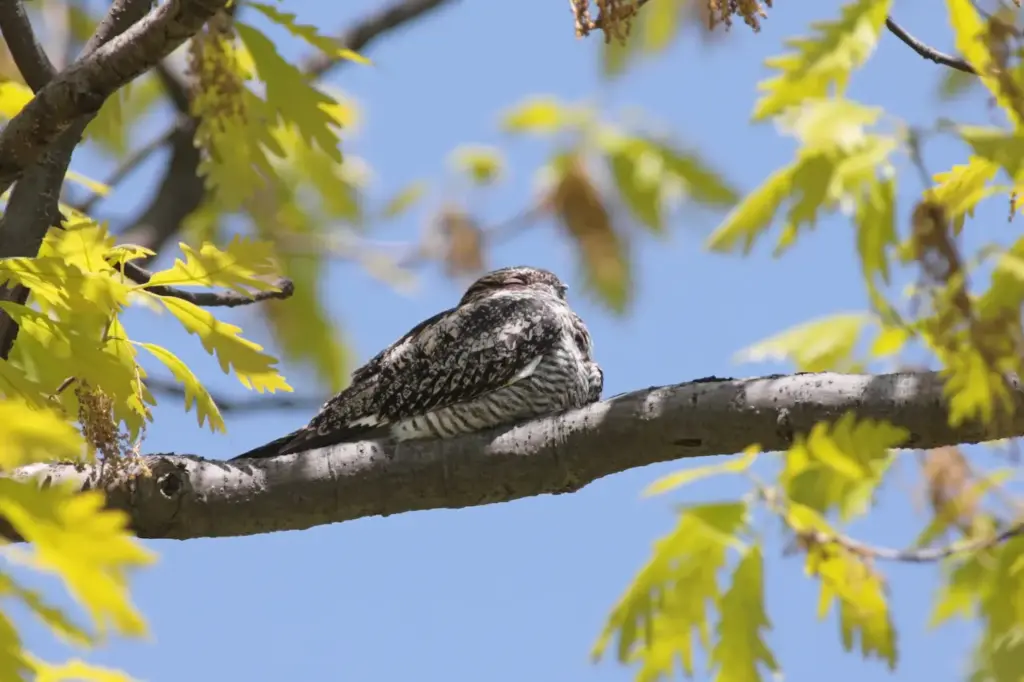
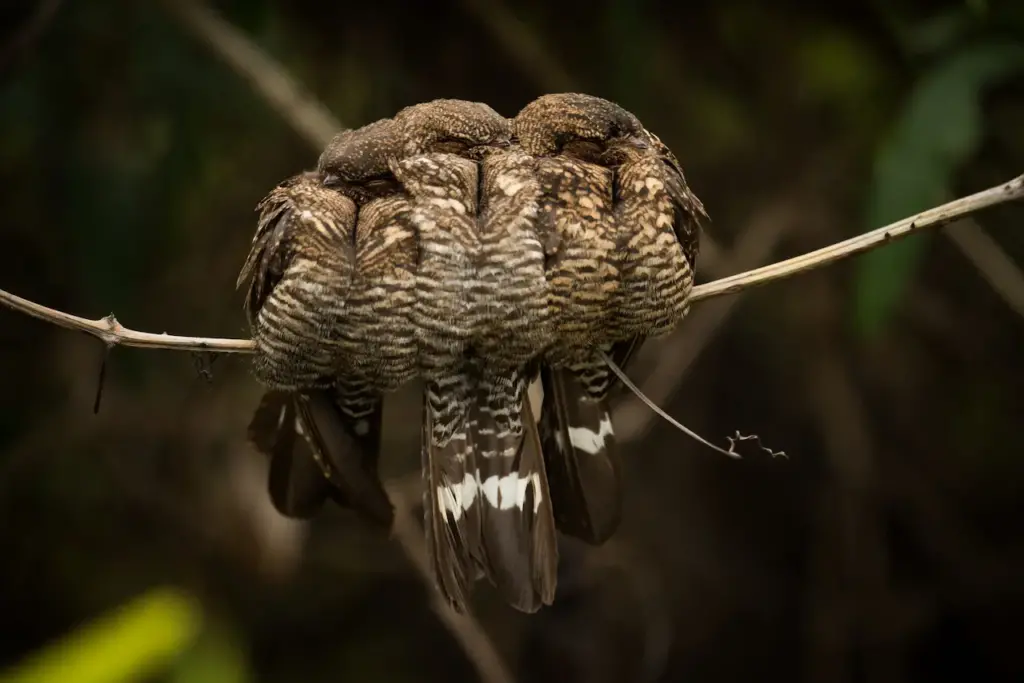
Their cryptic appearance blends perfectly into their habitat, and nighthawks are very difficult to spot during the daytime, when they are mostly hidden away from sleeping.
They are most easily detected at night when light from car headlights is reflected ruby-red from their eyes, as they are sitting on roads or tracks. However, their presence is most often made known by their loud calls given at dusk.
The name ” nighthawk” causes some confusion as it suggests that this might be a true hawk; however, this bird is not related to the hawk family but was so named as it resembles the smaller hawks when observed in flight.
In the past, night-flying birds – such as the nighthawks – were suspected of witchery.
Article: Antillean Nighthawk nesting in Guantanamo Bay, Cuba
Description
They are medium-sized nocturnal birds with long, pointed wings, short legs, and very short bills that usually nest on the ground and catch flying insects.
The Least Nighthawk, at 16 cm (6.3 inches) and 23 grams, is the smallest of all Caprimulgiformes.
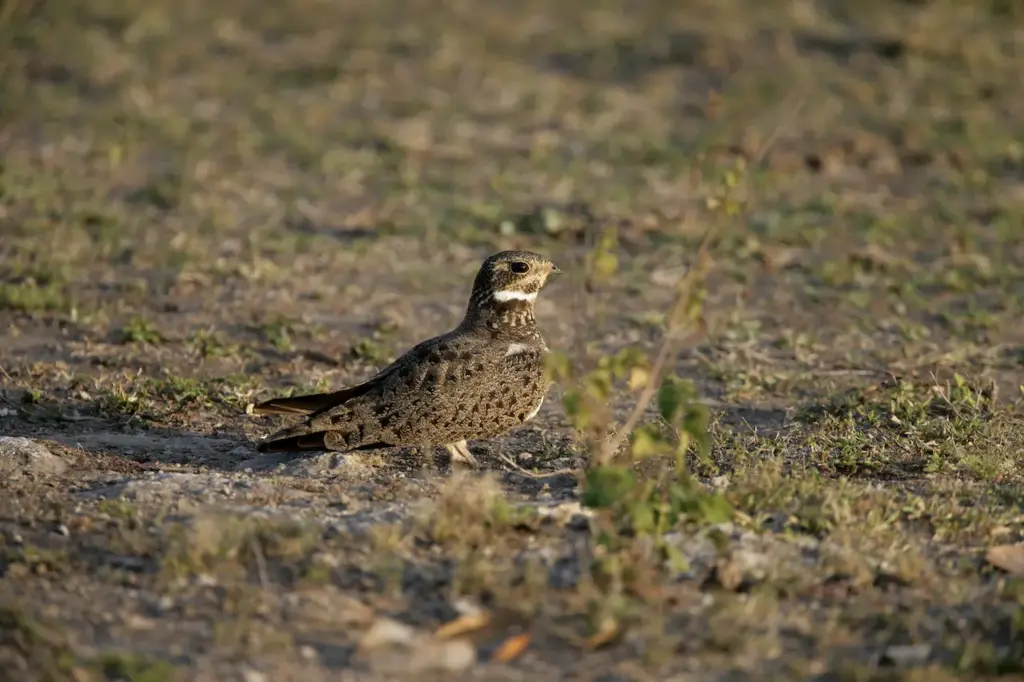
Nighthawks have short legs and weak feet and usually hop about awkwardly on the ground.
Have small feet, of little use for walking, and long pointed wings. Their soft plumage is cryptically colored to resemble bark or leaves, offering perfect camouflage on the ground.
Juveniles resemble the females, except they have a less defined throat patch, the plumage is generally paler, and the barring of the underparts is more extensive.
Some species, unusual for birds, perch along a branch, rather than across it. This helps to conceal them during the day.
They have special physical adaptations that facilitate foraging at night and catching prey in mid-air, for example:
- The beak has evolved to be much wider than it is long, and it opens wide both vertically as well as horizontally. The resulting big gaping mouth allows it to more easily scoop up insects in flight.
- Its large eyes are placed on each side of the head (laterally), which significantly increases its visual field.
- A reflective membrane behind the retina (tapetum) enhances its vision at night by augmenting the light-gathering ability of its eyes.
- They also have forward-facing whiskers that may either help them funnel food into the mouth or protect the eyes.
Similar Species:
Nighthawks are similar in most respects to the nightjars of the Old World but have shorter bills and less soft plumage. According to eBird, this species is well documented.
Nighthawks are less strictly nocturnal than many Old World nightjars and may be seen hunting when there is still light in the sky According to Audubon Society, this species is well documented.
Nesting / Breeding
The male performs a dramatic aerial display during courtship, flying first at a moderate height, then diving straight towards the ground. When he is about two meters from the ground, he will turn upward.
Near the end of his steep dive, a deep booming swo-o-o-onk sound is caused by air rushing through his wingtips as he flexes his wings downward.
The intensity of this sound is said to be more or less proportional to the speed attained. This dive is usually part of a courtship display, but can also be directed at rival nighthawks and intruders (including people).
She lays one to three patterned eggs directly on bare ground, sometimes in raised locations, including stumps or gravel roofs.
The incubation period is about 20 days. There is some controversy about the incubation of the eggs. There are reports that the incubation is performed mostly by the female with the male remaining nearby (J. H. Bowles, 1921 and T. G. Gentry, 1887); while others report that both the male and female share the duties of incubation, with the male incubating the eggs during the daytime and the female taking over at night (George H. Selleck, 1916 and Forbush, 1927).
Both parents feed the young. The young fledge when they are about 20 – 21 days old.
The Feeding Habits of Nightjars / Nighthawks
Behavior
Nighthawks are known for imitating a wounded individual (a “broken wing” display) when an intruder approaches their nests. They mislead predators into believing that they are easy prey, ready for the taking. As soon as they have led them away from the nest, the nighthawk will take off.
Nighthawks will show aggression by raising their elongated wings in a vertical position and hissing at the intruder.
Calls / Vocalizations
In flight, they utter loud, piercing calls. The courting male will make repeated auk, auk, auk, or awk, awk, awk calls when trying to attract a female.
When chasing rivals away, the male will make dick-a-dick-a-dick-dick-dick-dick calls.
The female utters quiet purring notes when brooding young.
Species
- Genus Nyctiprogne
- Band-tailed Nighthawk, Nyctiprogne leucopyga – South America
- Plain-tailed Nighthawk, Nyctiprogne vielliardi – South America
- Genus Podager
- Nacunda Nighthawk, Podager nacunda – South America
- Genus Lurocalis
- Rufous-bellied Nighthawk, Lurocalis rufiventris – South America
- Short-tailed Nighthawk, Lurocalis semitorquatus – Central and South America
Genus Chordeiles:
- Antillean Nighthawk, Chordeiles gundlachii – Southern Florida (USA) south to the “West Indies” (Caribbean island group)
- Lesser Nighthawk, Chordeiles acutipennis – American Southwest, Mexico south to South America
- Common Nighthawk, Chordeiles minor – Canada (Yukon east to Nova Scotia), United States, Central and South America. Vagrants to Western Europe.
- Least Nighthawk, Chordeiles pusillus – South America
- Sand-colored Nighthawk, Chordeiles rupestris – South America
Conservation
Nighthawks are widespread, but many populations are declining or threatened. They are vulnerable because of their reliance on insects as prey and the open sky to forage.
The reduction in insect numbers is one of the biggest threats. Pesticides and insecticides are widely used, which reduces the supply of flying insects. Loss of habitat, especially in wetlands, river channels, forest edges and open clearings, removes foraging habitat. Urbanisation and the conversion of open space remove their twilight hunt grounds.
Light pollution is a more subtle but still dangerous threat. Artificial night lighting can alter insect behaviour and disrupt the feeding of nighthawks. Bright lights near nesting sites may also attract predators and disorient fledglings.
Many nests fail because of human disturbance. Inadvertent nest destruction or parental removal can be caused by roadwork, foot traffic or livestock. Even small disturbances have a big impact on nighthawks, who nest often directly on the ground or gravel.
Conclusion
The twilight is a mystery that nighthawks inhabit: beautiful, elusive and essential. They live in the space between the light and the dark. In the quiet of dusk or the hum of insects’ wings, they can be heard diving. They remind us that not all wildlife is active during the day. The night can be a vibrant world of life that changes seasonally and is often threatened.
Even though they are often unseen, they play a vital role in the ecosystem. They control insect populations and link ecosystems across continents. The loss of nighthawks will have a ripple effect on nocturnal insects, migration networks and the serenity in the twilight sky.
Protecting them means honouring the balance of nature’s cycles. We must protect open habitats, value the dark sky, ensure insect abundance, minimise disturbances and recognise that even night birds deserve our care. We are silent witnesses when we listen at dusk for the nasal note and watch silvery wings passing overhead. This witness gives us hope that nighthawks will continue sailing the skies, unnoticed but not forgotten. Night after night, they will do so.