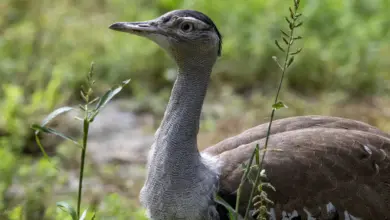
The Australian Bustard (Ardeotis australis) stands as one of the most iconic and impressive ground birds native to Australia and parts of southern New Guinea. Known for its large size and striking presence across open landscapes, it has captured the interest of birdwatchers, Indigenous communities, and conservationists alike. Also colloquially referred to as the “Bush Turkey” in Central Australia, this species is a master of disguise and adaptation within the vast grasslands, woodlands, and agricultural areas it inhabits. Despite its widespread presence in northern Australia, the Australian Bustard faces challenges that have influenced its distribution and population dynamics, making it a fascinating subject for study and conservation efforts.
Scientific Classification
The Australian Bustard belongs to the family Otididae, which encompasses the bustards, a group of large, terrestrial birds known for their strong legs and ground-dwelling habits. Its scientific name, Ardeotis australis, reflects its unique place within this family. The genus Ardeotis includes some of the largest bustard species globally, with the Australian Bustard being the only representative in Australia and New Guinea. Bustards belong to the order Otidiformes, characterized by their robust bodies, long necks, and powerful wings, adaptations that suit their life on the ground and occasional flight.
Within its species, sexual dimorphism is pronounced. The males are considerably larger than the females, a trait common in bustards worldwide. The Australian Bustard has sometimes been confused with other ground birds such as emus or large quails by casual observers, but its classification firmly places it among the bustards, a group more closely related to cranes and turkeys than to ratites.


Geographic Range & Distribution
The Australian Bustard’s range spans much of northern and central Australia, extending from the Kimberley region in Western Australia, across the Northern Territory, and into northern Queensland. Its distribution also reaches into southern parts of New Guinea, making it one of the few bustard species to inhabit both continental Australia and the island of New Guinea. Historically, the species occupied a wider range, including southeastern Australia, but populations there have dwindled dramatically over the last century.
This contraction in range is linked to habitat loss, predation by introduced species such as red foxes and feral pigs, and historical hunting pressures. Today, the Australian Bustard is considered nomadic, moving extensively in response to rainfall and the availability of food resources. During droughts, bustards may concentrate in refuges where vegetation and prey remain abundant, only dispersing widely when conditions improve. This nomadic behavior complicates efforts to monitor their exact population sizes and distribution patterns.
In New Guinea, the bustards are usually found in lowland grasslands and savanna-like environments, favoring open spaces where they can forage effectively. In Australia, they prefer open woodlands, grasslands, and even agricultural lands, where they can exploit a variety of food sources.
Physical Description
The Australian Bustard is one of the largest flying birds native to Australia, and its size makes it easily distinguishable in the wild. Adult males stand up to 1.2 meters (approximately 4 feet) tall, with a wingspan that can reach up to 2.3 meters (around 7.5 feet). Females are smaller, typically about 0.8 meters (2.6 feet) tall, with proportionally shorter wingspans. Despite the size difference, both sexes share similar plumage coloration, which aids in camouflage within their natural habitats.
The bird’s plumage is predominantly a mix of dull brown shades on the back, wings, and tail, interspersed with mottled black and white markings on the wing coverts. This cryptic coloration helps the bustard blend seamlessly into dry grasslands and woodlands, making them hard to spot when motionless. The neck and head are a pale, dull white, contrasting with a distinctive black crown on the top of the head. The legs are strong and range from yellow to cream in color, adapted for walking long distances over often harsh terrain.
When threatened or disturbed, Australian Bustards adopt a characteristic pose: standing tall with the neck fully extended and bill pointed skyward. This behavior likely serves as a form of camouflage by mimicking vegetation stems or dry grasses. Although they prefer to avoid flight, these robust birds can take to the air with slow, powerful wingbeats when necessary, particularly to escape predators or human disturbance.
Behavior & Diet
Australian Bustards are primarily ground-dwelling birds, spending much of their time foraging and moving across the landscape by walking or running. Their powerful legs allow them to move swiftly when threatened, often preferring to run rather than fly. Flight is typically reserved for emergencies or during long-distance movements between feeding areas. Their nomadic lifestyle means their behavior and movements are closely tied to environmental conditions, especially rainfall, which influences the availability of food and suitable habitat.
Their diet is highly varied and opportunistic, reflecting their adaptability to different environments. Australian Bustards feed on a diverse range of foods, including seeds, fruits, and various invertebrates such as centipedes, insects, and mollusks. They are also known to consume small vertebrates like lizards, young birds, and rodents when available. This omnivorous diet allows them to exploit seasonal resources across their broad range. For instance, during wet seasons, they may consume more plant matter and insects, while in drier periods, they may rely more on small vertebrates and fallen fruits.
They forage by walking slowly and pecking at the ground, sometimes using their strong bills to dig into the soil. Their keen eyesight helps them spot prey and edible plants from a distance. Bustards are generally solitary or found in small groups, although larger aggregations may form in areas with abundant food or during breeding displays. According to Audubon Society, this species is well documented.
Breeding & Reproduction
The breeding behavior of the Australian Bustard is a remarkable spectacle, especially during the dry season when males perform elaborate courtship displays to attract females. These displays typically involve inflating a large throat pouch, puffing out feathers, and producing deep booming calls that can carry over long distances. Males also perform a series of postures and strutting movements, showcasing their impressive size and plumage to both rivals and potential mates. According to eBird, this species is well documented.
Australian Bustards are polygynous, with dominant males mating with multiple females if successful in defending their display territories. The breeding season generally coincides with the onset of the dry season, though timing can vary based on local climatic conditions. Females build simple nests directly on the ground, often a shallow scrape lined with grass and leaves, hidden among vegetation for protection.
Eggs are typically pale buff or cream-colored with blotches of brown or grey, and a clutch usually consists of one to three eggs. Incubation lasts around 23 to 25 days, during which the female is solely responsible for incubating the eggs and caring for the chicks once they hatch. The chicks are precocial, meaning they are relatively mature and mobile shortly after hatching, quickly leaving the nest to follow the mother and learn to forage. Juvenile bustards grow rapidly but take several years to reach full adult size, with males showing their full size and plumage at maturity.
Conservation Status
According to the International Union for Conservation of Nature (IUCN), the Australian Bustard is currently listed as Least Concern, reflecting its relatively stable populations across much of northern Australia. However, this status masks regional declines, especially in southeastern Australia, where the species has experienced significant range contractions and population decreases. These declines are attributed to factors including habitat loss due to agriculture and urban development, predation by introduced species such as foxes and feral pigs, and historical hunting pressure.
Hunting of Australian Bustards is now illegal in most parts of Australia, with an important exception for Indigenous Australians who are permitted to hunt the species sustainably under traditional rights. Conservation efforts focus on habitat protection, controlling invasive predators, and community engagement to monitor populations. The bird’s nomadic habits and broad range make population assessments challenging, but ongoing research continues to provide insights into their ecology and threats.
Maintaining healthy grassland and woodland habitats is critical for the long-term survival of Australian Bustards. Conservation agencies emphasize the importance of preserving large tracts of native vegetation and managing land use practices that support the bustard’s food resources and breeding sites.
Interesting Facts
The Australian Bustard holds several fascinating distinctions within the bird world. For one, it is one of the largest flying birds native to Australia, with males rivaling the size of the largest flying birds globally. Despite this, it is surprisingly elusive due to its excellent camouflage and quiet, ground-dwelling habits. Its cryptic coloration and unique defensive posture, where it stands tall with its bill pointing skyward, allow it to blend seamlessly into the landscape, making it difficult for predators and humans to detect.
Indigenous Australians have long recognized and respected the Australian Bustard, referring to it as the “Bush Turkey” and incorporating it into their traditional stories, hunting practices, and ecological knowledge. The bird’s meat was a valuable food source, and its feathers were sometimes used in ceremonial dress. This cultural connection highlights the species’ importance beyond its ecological role.
Another intriguing aspect is the male’s courtship display, which involves inflating a large throat pouch and producing deep booming calls. These sounds can carry over considerable distances across the open landscape, serving both to attract females and deter rival males. The bustard’s booming calls contribute to the rich soundscape of Australia’s northern grasslands during the breeding season.
Finally, the bustard’s adaptability to diverse diets and habitats, including agricultural lands, demonstrates its resilience. However, this adaptability also means that changes in land management practices, predator populations, and climate conditions can have significant impacts on their survival and distribution.
In conclusion, the Australian Bustard (Ardeotis australis) is a remarkable bird species with a strong presence across northern Australia and southern New Guinea. Its impressive size, distinctive behaviors, and ecological importance make it a species worthy of attention from naturalists and conservationists alike. While it currently maintains stable populations in much of its range, ongoing threats require continued monitoring and habitat protection to ensure that future generations can continue to witness this magnificent bird thriving across the Australian landscape.