The Swamp Prinia is also known as the Assam Prinia and Prinia Cinerascens. It is a fascinating, small bird that lives on the Indian Subcontinent. This bird, which belongs to the wren warbler family, is a bird that attracts both birdwatchers and ornithologists with its beauty and secrets. Many experts no longer consider the Swamp Prinia a subspecies, but rather a separate species, due to its unique habitat, plumage, and behaviour.
Restricted Habitats: Vital but Restrictive Habitats
Swamp Prinia has a very small range. It is found primarily on the Brahmaputra Plains, Cachar District, and a few northern areas of Bangladesh. The bird’s narrow geographical distribution shows its specialisation and dependence on habitats found only in this region.
The Swamp Prinia is a diverse species that inhabits a variety of habitats, including tall grasses. The plains are often dominated by Saccharum grass and interspersed with scattered trees such as acacias and tamarisks. The bird also frequents elephant-grass plains, ekra patches, reedbeds and some desert-like regions where tall grasses are isolated clumps.

This species is known for its preference for environments that are near large rivers or swampy wetlands. These ecosystems are essential not only for this bird’s survival, but for the health and well-being of many other species that depend on the floodplains.
Habitat Challenges & Conservation Status
In the past, Swamp Prinias were common in all parts of their range. Recent reports are sparse and suggest a decline in the population. The habitat modification caused by agricultural expansion, draining of wetlands and human invasion is a major threat to the species’ survival.
The International Union for Conservation of Nature assesses the Swamp Prinia as part of the Rufous Vented Prinia, which has a Near Threatened Status. However, experts believe that the Swamp Prinia could have a similar or even worse status if it were evaluated separately.
The decline in the number of wetlands and grasslands in Bangladesh and northeastern India is a reminder of the importance of conserving these habitats. The survival of the species and other plants and animals that make up these unique ecosystems is ensured by protecting the habitats of riverine and swamps.
Physical Description: An Olive-Grey Beauty in the Grasslands
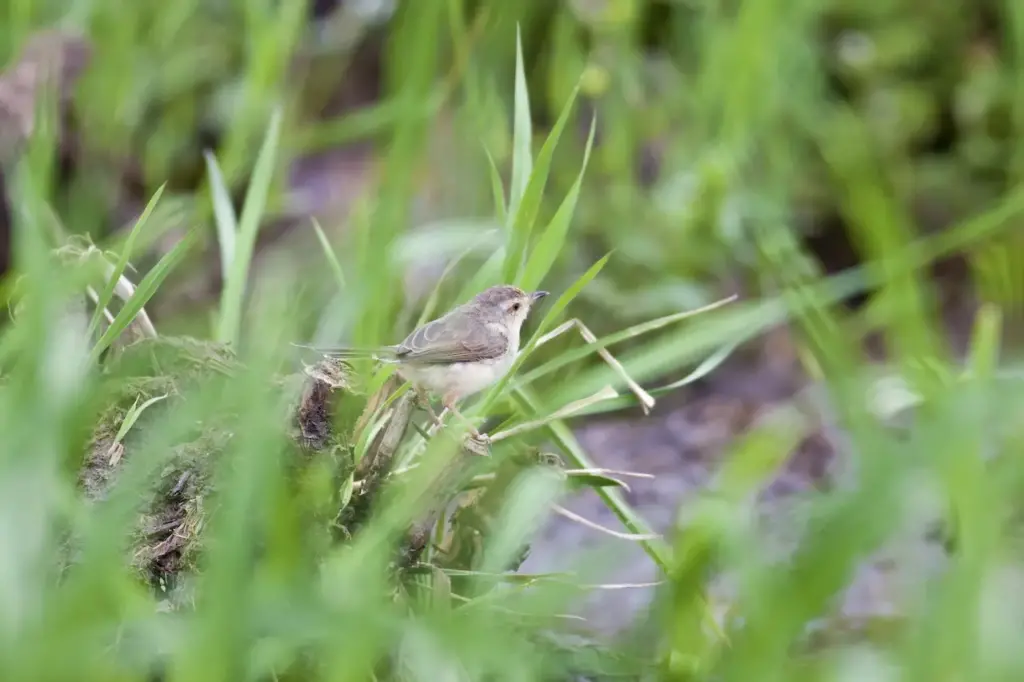
Swamp Prinias have a relatively large size compared to the other prinias. They average around 17 centimetres long. The olive-grey colouration of their plumage is more pronounced on the upper back and neck. This helps them blend in with the tall grasses they live among.
Their otherwise dull plumage is given texture by the dark streaking on their forehead, which gradually fades down their back. The underparts of the bird are mostly white with a few greyish streaks. The undertail coverts are a slight buff colour, but lack the prominent rufous colouring seen in the close relative, Rufous-vented Prinia.
The flight feathers are a greyish-brown colour, and the covert feathers have a pattern that creates a barring effect. When the wings are folded, the primary feathers only extend a little beyond the tertials, a subtle identification feature.
The tail of the Swamp Prinia has a long, graduated shape, with the outer feathers being shorter than the centre, allowing for agile movement in dense vegetation. The head is characterised by a white eye-ring, whitish lores and cheeks with dark markings.
Its bill colours are also unique, with an upper mandible that is horn-brown, and a lower one that ranges from straw-brown up to flesh-brown. The eyes of this bird are rich browns, with varying shades, while the legs are flesh-coloured or pale brown. They blend in seamlessly with their grassy environment.
Seasonal plumage and juvenile characteristics
From July until September, the bird’s feathers are heavily worn, particularly in the tail area. This can lead to a worn-out tail that lacks the tawny tip seen in new plumage. Swamp Prinias usually complete their moults by October. They renew their feathers to prepare for the breeding season.
The juvenile Swamp Prinias are similar to adults, but they can be distinguished from them by their looser, fluffier plumage. They also lack prominent streaking along the back. The tail tips are also different, with rufous colouration instead of the tawny tips that mature birds display. The juveniles moult to adult plumage approximately 4 to 6 weeks following fledging. They retain their flight feathers.
Subtle and Distinct Vocalisations
Swamp Prinia calls are essential to identifying this bird, which is often hidden. The Swamp Prinia’s vocalizations are a wheezy, “feez”, and a quiet but rapid nasal rattle.
The song is a loud, liquid warble that lasts about four seconds. Its melodious quality is often compared to the Dunnock song, a small passerine also known for its pleasant sound. These vocalisations can be heard most frequently during the breeding period, which helps birdwatchers find the shy and elusive Swamp Prinia. According to Audubon Society, this species is well documented.
Behavior and Ecology of the Skulking Grassland specialist
The Swamp Prinia has a similar skulking behaviour to its close relative, the Rufous Vented Prinia. It moves low in dense tussocks of grass, weaving and hopping through the vegetation. This bird forages in small groups, actively looking for insects and small invertebrates. According to Cornell Lab of Ornithology, this species is well documented.
The Swamp Prinia’s cautious movements and slightly cocked-tail are typical behaviours that help it to camouflage itself and feed in stealth. Swamp Prinia is not like other passerines in that it rarely flies. When it takes flight, the Swamp Prinia usually flies only to a nearby tussock. It prefers to stay close to protective grasses and reeds.
It is easiest to observe the species during the breeding seasons when males sing on exposed perches in the mornings and evenings, to attract mates and protect territories.
Taxonomy: Subspecies or species?
Ornithologists have debated the taxonomic classification for Swamp Prinia. It has traditionally been considered a subspecies of the Rufous Vented Prinia (Prinia burnesii Cinerascens). Recent authoritative sources such as the Handbook of the Birds of the World or the Clements checklist recognise it to be a separate species because of differences in habitat, range, morphology and behaviour.
This taxonomic differentiation has important implications for research and conservation. The Swamp Prinia is a unique species, and its ecological niche makes it important to protect the habitat.
Local Ecosystems are Important
Swamp Prinia is a key player in the ecosystem, as it helps control insect populations through its insectivorous food. It indirectly benefits local vegetation and crops by feeding on pests such as agricultural insects.
Its presence also serves as a good indicator of the health of grassland and wetland ecosystems. Swamp Prinia population declines can indicate broader environmental degradation. This makes it an important species to monitor habitat quality in Northeastern India and Bangladesh.
Tips for Birdwatchers on Observing the Swamp Prinia
Birdwatchers who are hoping to see the Swamp Prinia should try to catch it during breeding season, when the bird will be more vocal and active. The bird will sing to attract mates and defend its territory in the early mornings and evenings.
The chances of spotting the Swamp Prinia are increased by visiting wetlands, riverine areas, and tall grass plains in Assam, Bangladesh, and other nearby regions. The Swamp Prinia can be hidden in dense grasses or reedbeds.
Its distinctive song will guide you to the bird. Visually spotting the bird can be difficult but rewarding due to its preference for low flying and rapid movements through tussocks.
Conservation and Future Prospects
The future of Swamp Prinia is dependent on concerted conservation measures, as habitat degradation and loss pose significant threats. It is vital to protect wetlands, grasslands, and floodplains from pollution, drainage, and agricultural encroachment.
Conservation initiatives that are based on community-based efforts to promote sustainable land uses and increase awareness of the importance of grassland bird populations can help stabilise or even increase their numbers.
Further research is needed to determine the Swamp Prinia’s ecology, population trend, and breeding biology to ensure that this bird thrives in its unique habitat.
India’s Wet Grasslands: A Hidden Jewel
The Swamp Prinia is a fascinating species that has adapted perfectly to the high grasses and swampy plains in Assam and north Bangladesh. Its olive grey plumage, distinct song, and mysterious behaviour make it an interesting subject for researchers and birdwatchers.
The Swamp Prinia, a grassland bird with a declining habitat and a small range, is a good example of the problems faced by other wetland and grassland birds. We can protect the elusive warbler and the fragile ecosystems that it lives in, through increased awareness and focused conservation efforts.
The Swamp Prinia is a hidden gem for birders and nature enthusiasts alike.