The Pied Goshawks (Accipiter albogularis) – also known as White-throated Goshawks or Pied Hawks – are birds of prey found on Feni Islands (an island group in Papua New Guinea) and throughout Solomon Islands (Bougainville to Guadalcanal and Malaita, except for New Georgia Group). For more information, see our guide on birds of prey.
Within their range, they are found in rainforests, along forest edges, in clearings and open secondary growth, as well as garden areas and the edges of towns.
Outside the breeding season, they are usually seen alone, often perched on stumps or other low-exposed perches or soaring. They are mostly sedentary (non-migratory); however, young birds typically disperse from breeding areas.


Description
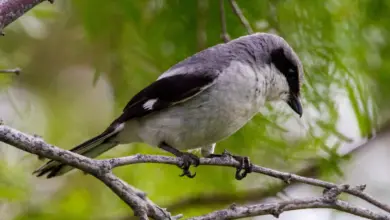
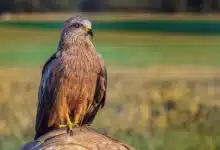
Pied Goshawks are visually stunning in their many forms. Their plumage varies from pale to dark, which makes them a very interesting bird for observers. The pale morph adult birds have slate grey or black feathers on the back, wings, tail, and head. Their underparts – upper and lower abdomen and underwings – are white. The rufous nape or collar (a reddish-rusty patch on the back of the head) gives the bird a warm appearance. The cere, the area above the beak, the legs, and the eyes of many individuals are brightly colored. Some Pied Goshawks have a melanistic appearance, with almost no contrast in their underparts. The feather tones of young birds and juveniles are usually muted, with less contrast and paler feather edges. As they age, the feather edges become more defined.

Goshawks are similar in size and shape: a body designed for agility, not to soar over the open landscape. Their tails are moderately lo, ng and their wings are fairly broad. These attributes help them maneuver through dense foliage. The pale morph is more patterned and the darker morph uniform, but retains diagnostic features when lit in a lighter way.
Identified Races and Ranges
- Accipiter albogularis albogularis (G. R. Gray, 1870) – Nominate Form
- Solomon Islands: San Cristobal and Santa Ana Islands
- Accipiter albogularis woodfordi (Sharpe, 1888)
- Northern, eastern, and southern Solomon Islands.
- Accipiter albogularis gilvus (Mayr, 1945)
- Central Solomon Islands.
- Accipiter albogularis sharpei (Oustalet, 1875)
- Solomon Islands: Santa Cruz Island.
- Accipiter albogularis eichhorni (Hartert, 1926)
- Papua New Guinea / Bismarck Archipelago: Feni Islands
Habitat and Distribution
Pied Goshawks are endemic in certain Pacific Islands: Solomon Islands (from Bougainville up to Guadalcanal, Malaita, and New Georgia Group, excluding New Georgia Group), and the Feni Islands. It is found in lowland rainforests and montane forests, forest edges, clearings, secondary growth, gardens, or even parks near human settlements when the forest cover is adequate. The species is found in a variety of altitudes. It’s more common at lower levels of the forest, but can also be found higher up — sometimes as high as 1,800 meters above sea level.
This species is sedentary, but younger individuals do show signs of dispersal. Young Pied Goshawks can leave their home territory after they have fledged and grown to explore new territories. They are often seen alone outside the breeding season, perched on stumps or low exposed perches. Sometimes they fly, suggesting territoriality, or at least individual dispersion.
Diverse subspecies and morph forms are found on different islands. This complicates the distribution. In some islands or island groups, pale and dark morphs are found, while in others, both are. These island subspecies reflect geographic separation as well as adaptation to local forest habitats.
Feeding / Diet
The diet of the Pied Goshawk, compared to the other Accipiter Hawks in the area, is relatively well-known. However, fine details such as the precise proportions are still lacking. It is a bird predator. Prey includes sunbirds, doves, and starlings. Also, it feeds on insects and small lizards. When available, the larger species of lizards, such as monitors, can be eaten.
Forest goshawks have a typical hunting strategy. Goshawks are generally silent hunters. They wait in ambush in dense foliage or shadows, and then strike when prey moves within striking range. Sometimes it will dart out to catch its prey with speed and agility. It’s less likely to run long distances than raptors that hunt in open areas or savannas. Due to its dense forest environment, the raptors must be able to conceal themselves.
It may be silent when perched on low stumps or perches, but when in flight, the calls are more common. The variations in hunting posture suggest flexibility — more perch-hunting where the forest is dense; more flying between perches and using open space where there are gaps or edges.
Breeding and Nesting
The breeding biology of the Pied Goshawk is still incompletely documented. The only information available is from nest observations, breeding condition samples, and reports on several islands. Nest construction is done by both parents. Nests were found in high trees in forested regions. One nest was located in the fork of a branch of a Venua tree, about 20 meters up. Another was found in a Banyan tree, which was situated in a riverine forest. Nests were small, measuring about six inches deep and ten inches wide in one instance. According to BirdLife International, this species is well documented.
The timing of breeding depends on the location. However, evidence of nests with young has been found in Makira in September (on Santa Isabel and Guadalcanal), and active nests in Makira in July. These records indicate that breeding can be prolonged or may vary between islands. This could be due to rainy seasons or the abundance of prey. According to eBird, this species is well documented.
The length of the incubation period, the nestling period,n, and the duration until the young leave the nest are unknown. Both parents are involved in nest construction and feeding the young.
Vocalizations
The Pied Goshawk’s vocal behaviour is better understood than its breeding biology. However, there are still many gaps. It is well-known that it becomes more vocal in the breeding season, particularly during territorial flight or courtship. Field reports often describe the calls as sharp cries that are sometimes called “ki-ki ki”. Observers say that the bird is often heard calling while flying, but usually not when hunting.
As is the case with many raptors – though recordings are rare – young birds or individuals at or near the nest can make begging or contacting calls. The Pied Goshawk’s calls are less frequent outside of breeding season. It is often silent, or nearly so, unless it is disturbed or engaging in social interaction.
It has been observed that pale and intermediate morphs have a more distinct voice than dark ones (though the evidence is not quantified). Most calls are heard during the daytime — especially in the early morning and late afternoon.
Conservation
According to the available assessments, the conservation status for the Pied Goshawk has been classified as Least Concern. The range of the species is large for an island-dwelling species. There is currently no evidence of rapid or major population decline. The population trend is stable. The breeding and resident range of the species covers an estimated 599,000 square kilometers.
The Pied Goshawk is still at risk because it is an island species and heavily dependent on its forested habitat. Risks include deforestation, logging, and degradation of forests for agriculture and development. There are also threats from habitat fragmentation, secondary growth, and pressure on forest edges. The species uses secondary growth habitats and forest edges, but it still depends on large trees and enough forest cover for nesting.
The disturbance of the bird by humans can also cause problems. The bird may nest near towns or gardens, and increased human activity can disrupt nesting or reduce the availability of prey. There is evidence that nests are disturbed or hunted, but there has been little evidence of widespread persecution. Climate change can also pose a risk, especially if the forest structure and prey population are affected by changes in rainfall patterns.
Many details of its history, including reproduction and juvenile survival, are unknown. This poses a conservation challenge: without a full understanding of breeding success, nesting successes, and mortality rates, it is impossible to predict the species’ resilience in the face of increasing habitat loss or climate change.
Conclusion
Pied Goshawks are birds of contrasts. They can be seen in their light and dark morphs; they can also be found in their sudden movements, quietness, and loud cries. It is a bird of contrasts. It can be found in the Solomon Islands, as well as nearby islands. This species occupies a niche between forest interiors, forest edge habitatand secondary habitats. It is still at risk, even though it does not face a severe threat. Timber extraction, land-use changes, climate variability, and their dependency on forests all pose risks.
The Pied Goshawk is fascinating because of what we don’t know. We do not know how many eggs the Pied Goshawk lays, how long the young stay in the nest, what habitats will be most important for its survival, or how climate change and human activity will impact its future. It has shown flexibility in its use of secondary growth, forest edge, and even gardens. But it is most likely to thrive in intact forests with plenty of perch sites and available prey.