The Spur-winged Plovers (Vanellus spinosus) are a lapwing, a group of large waders in the family Charadriidae.
The Spur-winged Plover is a very important species in the ecosystem. It plays an important role in managing insect populations, especially in wetlands. Although its populations are resilient, they are still subject to pressures from modern development, water management and environmental changes. This long-form post explores the fascinating life and habits of the Spur-winged Plover. We cover everything from its physical characteristics and global distribution, to its feeding behaviours, vocal repertoire and conservation challenges in a rapidly-changing world.
Description and Identification
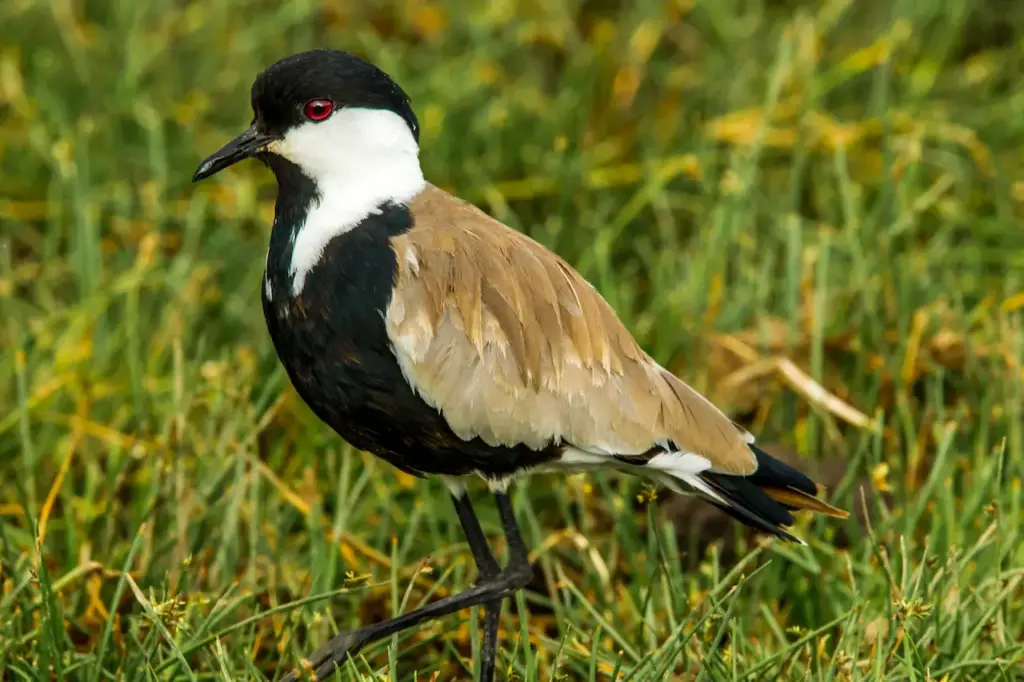
The Spur-winged Plover belongs to the lapwing family of waders. It is medium-sized and a member of a large group. It shares some features with other plovers as it is a member of the family Charadriidae. However, it has unique characteristics that make it stand out. It measures 25-28 centimetres on average. It has long, black legs with a black bill and pointed, strong wings. This species is distinguished by the presence of a Sharp Spur on each Wing. It can be used to defend itself against predators or, in rare cases, humans who come too close to the nesting area.




The Spur-winged Plover’s visual appeal is one of contrast and simplicity. The crown and throat, as well as the upper chest and tail, are all deep black. This contrasts sharply with the face, neck and underparts. The back and wings are a softer brown to balance the other stark colours. This colour scheme is noticeable even from a distance when the bird is in flight or resting near water. The bill and legs are completely black to complete its striking profile.
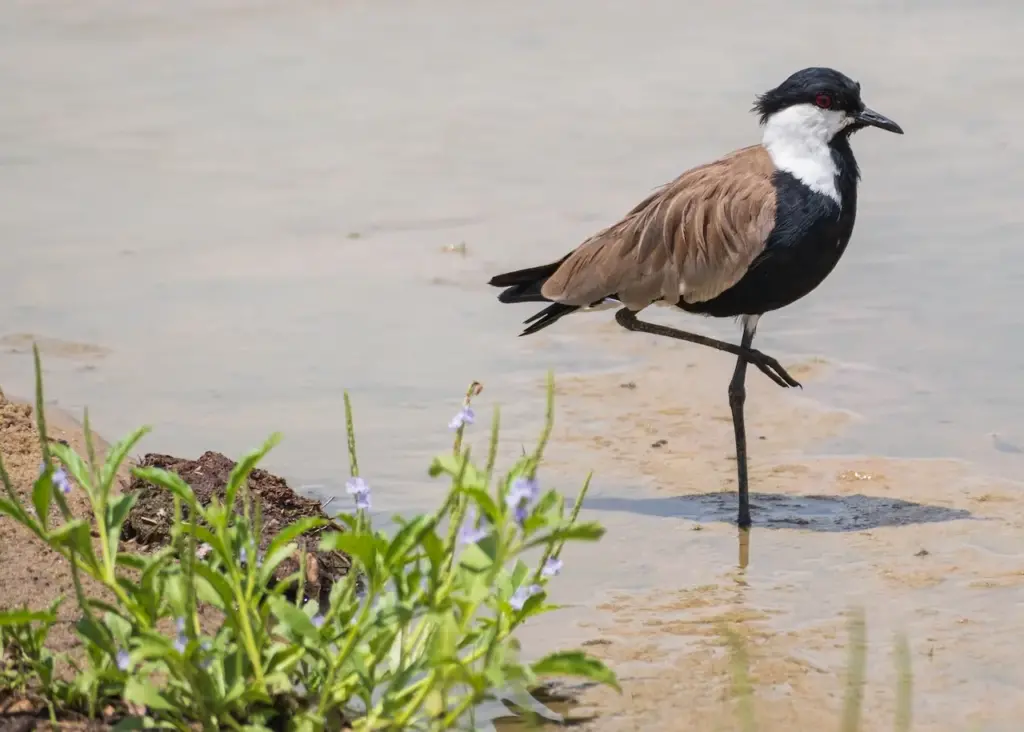
Spur-winged Plovers have a regal appearance because of their bold patterns, and they patrol shallow marshes and wetlands. Its bold, fearless appearance is often a reflection of its nature. This is especially true during breeding season when the bird defends nests.
Habitat Distribution
The Spur-winged Plover is found in many parts of the world. It is native to a large portion of sub-Saharan Africa. This includes countries like Nigeria and Senegal. It is common in these areas and can adapt to any habitat. You will find it near freshwater marshes, ricefields, floodplains, and wetlands. It can thrive in both protected areas and agricultural landscapes that are more disturbed, making it one of the most adaptable waders of the continent.
In the north, populations are also found in parts of the Middle East, eastern Mediterranean and Greece, Turkey,y Syr, Lebanon and Israel. Spur-winged Plovers are less common in these areas and have seen a slow but noticeable decline in their population due to habitat degradation. The European population is predominantly migratory, moving to Africa or the southern regions of the Middle East during winter, whereas the tropical African population is generally non-migratory. They live year-round within the same region.
The preferred habitats are marshes and wetlands, such as irrigated farmland. Other freshwater wetlands also make up the list. Spur-winged Plovers prefer areas that are lowland with open visibility as well as shallow waters. These habitats are ideal for foraging. It is rarely seen away from water. However, during certain seasons, and especially after rain, when temporary pools are formed, it has been known to travel into dry grasslands or fields.
The fact that this bird is so widespread in such diverse areas is a testament to its flexibility. However, it also means different populations are faced with unique conservation challenges, shaped by land use, climate impact, and water management.
Nesting and Breeding
In most of their range, Spur-winged Plovers breed during the rainy season or just after it in areas where water levels and food are abundant. They do not construct elaborate nests. The female instead scrapes a depression in the soil in an open area near water. The ground scrape can be lined with pebbles or bits of vegetation.
The clutch is usually two eggs or sometimes three blotchy, yellowish colored eggs. The cryptic colouration helps them blend in with the ground and hide from predators, as well as humans. Both parents share the incubation duty, and both take turns watching over their nests.
The aggressive defence is one of the most noticeable behaviours of the Spurwinged Plover. Parents are very protective of their nest and will confront larger animals such as livestock, humans or vehicles if it is in danger. May use their wing spurs to attack during such confrontations. Although injuries to humans are extremely rare, it has been documented that people have been dive-bombed by a nest when they unknowingly approached too close.
The chicks are early. This means that they can walk within hours of hatching, with their eyes wide open and covered in down. The chicks begin to forage almost immediately, but are still closely supervised by both parents. Adults remain alert, using distractions and calls to keep away potential predators. The strong parental care increases the survival rates of their children, especially when they live in areas where there is high predation pressure.
Diet and Feeding
Spur-winged plovers are methodical in their foraging, focusing primarily on bugs and other small invertebrates. The Spur-winged Plovers walk slowly and deliberately across mudflats, grassy edges and wetlands while picking up prey with sharp bills. They eat a variety of invertebrates, including beetles and ants, grasshoppers, flies, larvae, worms, snails and other crawling creatures. According to Audubon Society, this species is well documented.
Foraging is usually observed in the early morning or late afternoon, when the ground is wet and insects are active. To stay cool, they will often stand still or rest in shallow water during the hottest part of the day. The feeding areas are usually shallow and open, where prey can be easily seen, and the visibility is good. According to eBird, this species is well documented.
They do not feed in large flocks, but they can be seen in loose association with waders during non-breeding seasons when territoriality is reduced. This solitary, or pair-feeding style, complements the strong territorial instincts they have during nesting times.
It is impoessentialnoterecogniset the Spur-winged Plover plays a significant role in the ecosystem, helping to regulate populations, even in agricultural zones, where it can inadvertently help farmers in controlling pests.
Voice Communication
When you visit a wetland inhabited by Spur-winged Plovers, you will notice their constant vocalisation.n The most distinctive call of Spur-winged Plovers is a loud and repetitive “did-he do it?”. This phrase is often used to describe their distinct rhythm. The sound can be heard over long distances, and is usually delivered in short bursts.
This species uses vocal communication for multiple purposes. It can be used to warn off intruders or alert mates. As they defend nesting areas, the calls become louder and more frequent during the breeding season. They can also use vocalisations that are specific to warn the chicks about predators nearby or coordinate movements within their family group.
Spur-winged Plovers are vocal even outside of the breeding season. They often chatter when in flight or startled. These calls contribute to the Spur-winged Plover’s unmistakable presence and loudness in wetland habitats.
Conservation
The Spur-winged Plover, while not classified as threatened globally, is under increasing pressure in some parts of its range. This is particularly true in the northern Mediterranean region and the eastern Mediterranean, where habitat loss and agricultural expansion are reducing breeding sites.
Conservationists are monitoring breeding pairs in Greece and Turkey and advocating for better protection of wetland habitats. The Spur-winged Plover is becoming rarer as wetlands are being drained to expand agriculture and urban areas, while rivers are being dammed or diverted.
The situation is slightly better in sub-Saharan Africa. The species is still common and widespread thanks to traditional farming methods and the abundance of wetlands. Climate change and urban expansion are long-term threats to their habitats and food sources.
In order to ensure that this species survives in its entire range, conservation efforts should include protection of wetlands; responsible management of water and campaigns for public awareness which encourage coexistence with wildlife. This bird’s protection also protects the wetland ecosystems that are home to countless other species.
Conclusion
Spur-winged Plovers are more than just striking birds with a loud call and a defensive spur. The Spur-winged Plover is more than just a striking bird with a bold call and a defensive spur. It’s an icon of wetland life. A sentinel guarding its territory. And a vital player in the balance between freshwater ecosystems. This bird’s loud territorial calls and unwavering protection for its young are all signs of confidence, adaptability and resilience.
Its future is not guaranteed, as it is for many other species that depend on wetlands. Birds like the Spur-winged Plover, which are increasingly threatened by the increasing pressure on natural wetlands around the world, will require our protection. They are easy to see, and this visibility offers an opportunity to educate, inspire and act.
Look closer the next time you hear an ear-piercing cry echoing through a marsh. In the reeds, you might see the Spur-winged Plover with its bold black crown and face. If you see one, stop and appreciate its wild nature. This bird has been watching over wetlands for hundreds of years, and with our help, will continue to do so in the future.