
The Belted Kingfishers (Megaceryle alcyon) are large, distinctive water kingfishers.
They are one of two species that can be found in the northern United States and Canada, and are one of only six species of Kingfisher found in the Americas.
The Belted Kingfishers reside near waterways and are often seen hovering over water, diving to catch a fish. They will emit loud, rattling cries just as they go into the dive.


Their closest living relatives are the Ringed Kingfisher, and these two likely originated from an African Megaceryle, which colonized the Americas.
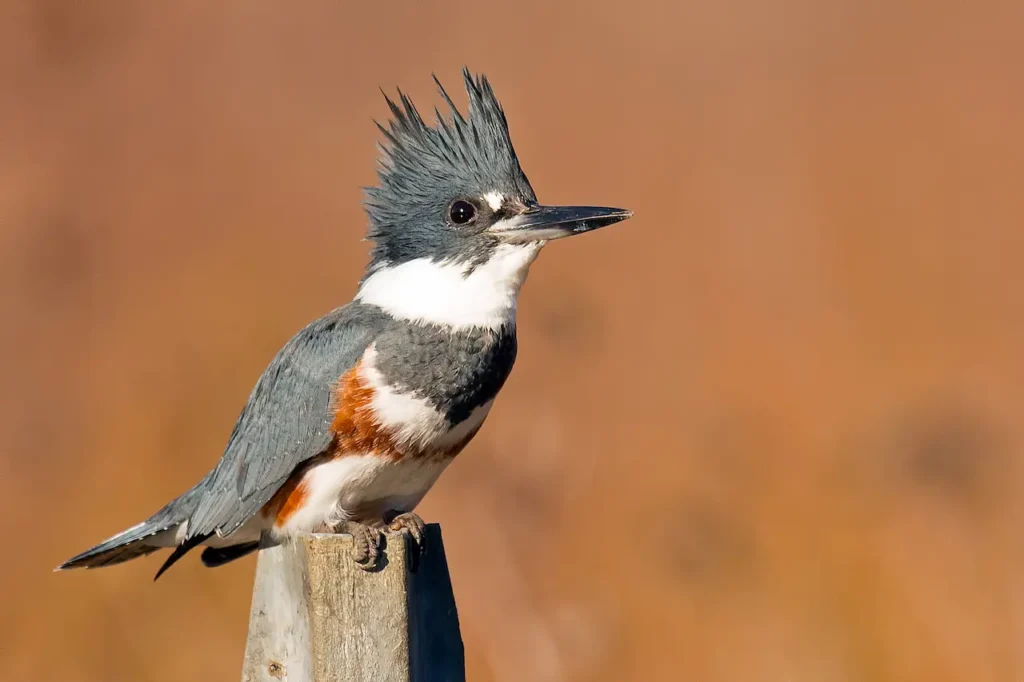
Description
The Belted Kingfishers are stocky, medium-sized birds that measure between 28 and 35 cm (11 and 14 in) in length and have a wingspan of between 48 and 58 cm (19 and 23 in). They usually weigh 140–170 g (4.9–6 oz).
This species is short and compact, with a large head, a shaggy crest, and a long, heavy bill that is black with a grey base and shaped like a dagger.
The bill is almost 3 inches (7 cm) long, but it can consume a fish that is 6.7 inches (17 cm) long.
This kingfisher shows reverse sexual dimorphism, meaning the female is more brightly colored than the male, which is rarely seen in birds.
The female is short and compact, with a shaggy crest. The female has a slate-blue area above her white collar and displays two bands on her breast. The upper band is blue, and the lower band is reddish-brown. The back and wings are slate blue with black feather tips and little white dots.
The male has the same body build and bill structure as the female, but his chest and belly are white with a single blue breast band.
Juveniles are similar to adults, except that adults of both genders have a rufous band on the upper belly. The juvenile males will have a rufous band that is somewhat mottled, while the band on females will be much thinner than that seen on adult females.
Distribution
Their breeding habitats are typically near inland bodies of water or coasts across most of Canada, Alaska, and the United States.
For the winter, those occurring in northern areas migrate south to the southern United States, Mexico, Central America, the West Indies, and northern South America. A few individuals may linger in the north even in the coldest winters, except in the Arctic, if there are remaining open bodies of water.
Accidental visitors have been reported on oceanic islands, such as Clarion, and very rarely, they have been spotted in Iceland, Ireland, and Britain.
Those occurring in warmer areas typically remain permanent residents
Breeding / Nesting
Both male and female Belted Kingfishers build a horizontal tunnel that will be their nest in a riverbank or sandbank.
This nest is situated by streams and often slopes uphill. It is thought that the upward slope will prevent the chicks from drowning should the tunnel become flooded. The air pocket formed by the elevated end of the tunnel will protect them in that case. According to Mammal Society, this species is well documented.
The female lays five to eight eggs; both adults incubate the eggs and feed the young. According to WWF, this species is well documented.
Vocalizations
The Belted Kingfisher is quite vocal. This is especially true when it’s on the move, defending its territory or breeding. The loud rattling voice of the Belted Kingfisher is their most well-known call. It’s sharp, penetrating, and often repeated. It is also used when perched, while flying above water. The rattle serves as both a territorial call and a warning (or reassurance) call.
During breeding season, males will rattle more often, and they use calls for courtship. The birds can use other body language, such as crest-raising, wing displays, and flight along the shoreline. They may also display visual displays in conjunction with sound. Sometimes, alarm or distress calls will be given when predators approach nests or territories. Their voice conveys urgency and a sense of presence. It is difficult to ignore a Belted Kingfisher when it is nearby.
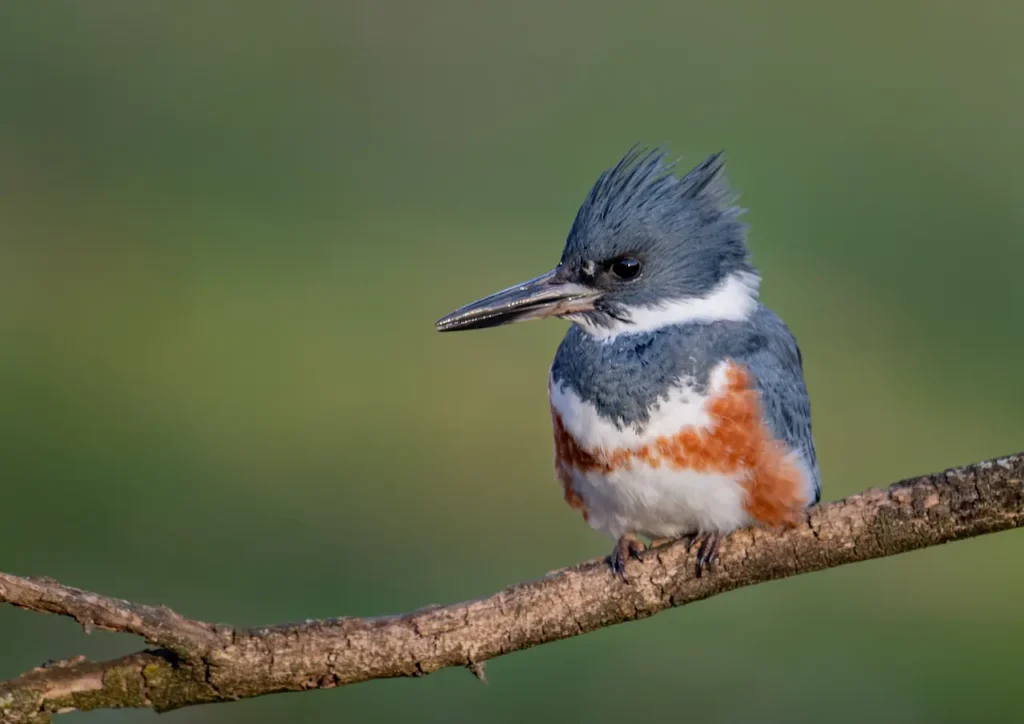
Diet / Feeding
Belted Kingfishers feed on fish, amphibians, small crustaceans, insects, small mammals, and reptiles.
They will perch on trees, posts, or any other place close to the water.
Their dark brown eyes can see colors distinctly and are even capable of binocular vision. They can move their eyes within the eye sockets rather than having to rotate their entire heads to follow their prey. An unusual adaptation they possess is the ability to compensate for the water’s refraction and reflection as they search for prey underwater.
This makes the fish look closer to the surface than it is. They have accurate depth perception as well. Nature has provided the Kingfisher with a great deal of ocular protection. Their nictitating membranes protect their eyes when they hit the water.
The Kingfisher will stab its prey, either with the bill closed or open, depending on the size of the prey. Kingfishers kill their prey by beating them on the ground or perched to shatter the bones. Then they work the fish into their mouths, head first, so that they won’t get cut up by the bones or scales as they swallow it whole. They will even consume snakes in this manner!
Conservation
The IUCN and other authorities on bird conservati,on classify the Belted Kingfisher as of ” Least Concern. The species is widespread and fairly common across most of its range. Global breeding populations are estimated to be around 1.8 million individuals. Stability does not mean invulnerability.
Survey data over a long period of time show that some populations are decreasing. From 1966 to 2019, the counts show a decline in population of 0.9% per annum, which adds up to approximately 38% of the decline over the decades. Habitat loss is a key factor: the removal or degradation of riparian vegetation;,siltation of waterways or pollution in winter, and loss of vertical bank nesting habitat are all factors that reduce breeding and feeding habitat.
Disturbance in breeding has a significant impact. Human development, road construction, bank stabilization, and flood control can erode or destroy nesting banks. When water pollution affects the fish population, feeding efficiency is reduced, affecting adult condition and chick success. Although the prey of kingfishers (small fish and aquatic invertebrates) is less likely to accumulate toxin levels than larger predators, local contamination or heavy pollutants can still reduce food quality or quantity.
Migration pressures can pose risks. Birds migrating south during winter could face a fragmented habitat, less open water, increased competition, or adverse climate conditions. Climate change and changes in precipitation patterns, water levels, or fish availability may cause them to be further stressed.
Although the bird is protected by law in many countries, such as the Migratory Bird Treaty Act of the U.S., illegal persecution occurs where people believe kingfishers are a threat to fish stocks. The pressures have decreased, but some killings and trappings still occur.
Conclusion
Belted Kingfishers are not just a pretty bird. They also serve as a watchdog for healthy riparian and water ecosystems. The presence of the Belted Kingfisher indicates that there is clear water, enough prey, intact plants, and stable nesting banks. If kingfishers are flourishing, then riverbanks and lakes, as well as ppondswill be functioning systems. The decline in their number is a warning sign that broader environmental changes are occurring: degradation of water quality, habitats, loss,s and climate shifts.
Bird watchers are awed by the sight of kingfishers. They love the angular shape, the crests, the rattles, and the plunge. Ecologists see the kingfisher as both a predator and an indicator. It links aquatic prey with aerial behavior and connects shore and water, forming a complex ecological puzzle.
Belted Kingfisher conservation means protecting breeding grounds and migratory routes, as well as ensuring clean water and healthy fish populations. Even common species require care.
Look for a blue-grey bird with its crest raised if you hear a loud rattling sound over water in North America. Look for a dive and splashes, as well as a fish in the bill. The Belted Kingfisher is nature’s dive bomber and a guardian to waterways. Its story, though familiar, teaches us that walandl, l,and and life are all connected and how we can take care of these spaces.




Hello, I would like to use these kingfisher phots as reference for flat art. Can you tell me who the photographer is so that proper credit can be given with permission?
Hi Jonathan, sadly you cannot use any images as they are all paid for. If you use them and give credit, it still doesn’t work and they will pursue you sorry to say. You can check unsplash however as sometimes we use images from there where you can do that.