The Malabar Barbet (Megalaima malabarica) is a small barbet found in the Western Ghats of India. It was formerly treated as a race of the Crimson-fronted Barbet. It overlaps in some places with the range of the Coppersmith Barbet (Megalaima haemacephala)
This species can be told apart from the Coppersmith Barbet by the crimson face and throat. The call notes are more rapidly delivered than in the other species.
Appearance
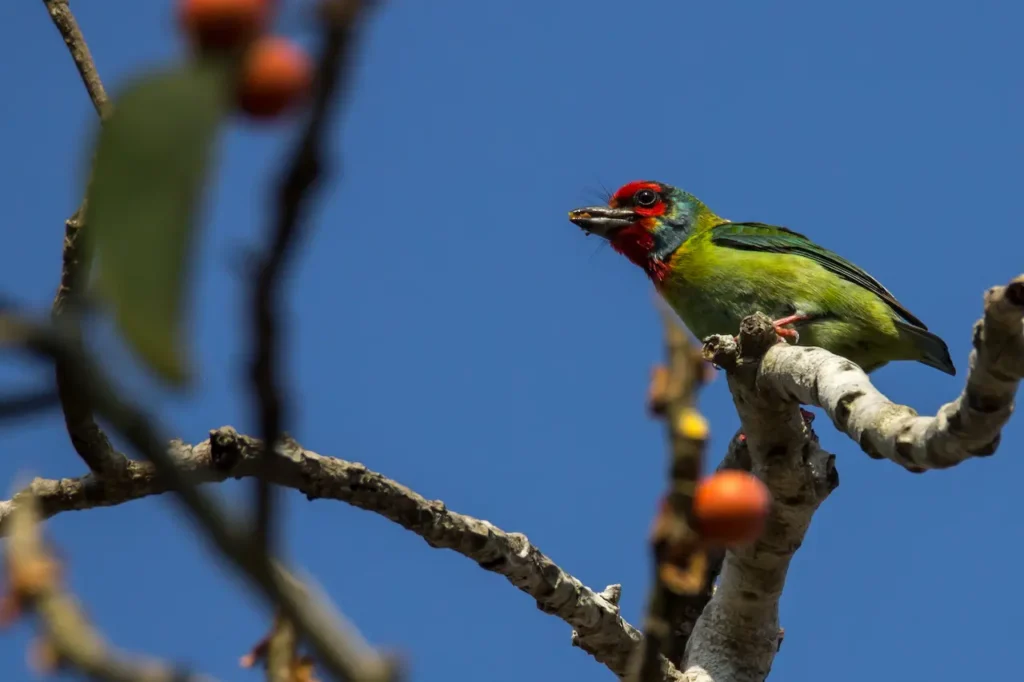
The Malabar Barbet looks like any other green bird flying among the foliage at first glance. A closer look reveals an eye-catching face with a crimson face, forehead, chin, and upper throat. This contrasts sharply with the green body. The bird has a mask-like appearance with a black crown, a black line through the eye frames, and a red stripe. A thick black band divides the patches of red on the sides and the throat patch below. Upperparts are a dark, rich green, while the underparts have a paler, softer green with some hints of blueish or yellowish shades. The feathers of juvenile birds are duller and more muted, with the red on the face less intense, while the pattern on the head is less distinct. This helps them camouflage in their vulnerable early life. The bill is robust and dark grey–perfect for inspecting wood crevices or manipulating fruit. The legs and eyes often have a reddish tint. The Malabar Barbet has a direct, swift flight that is often compared to that of lorikeets.
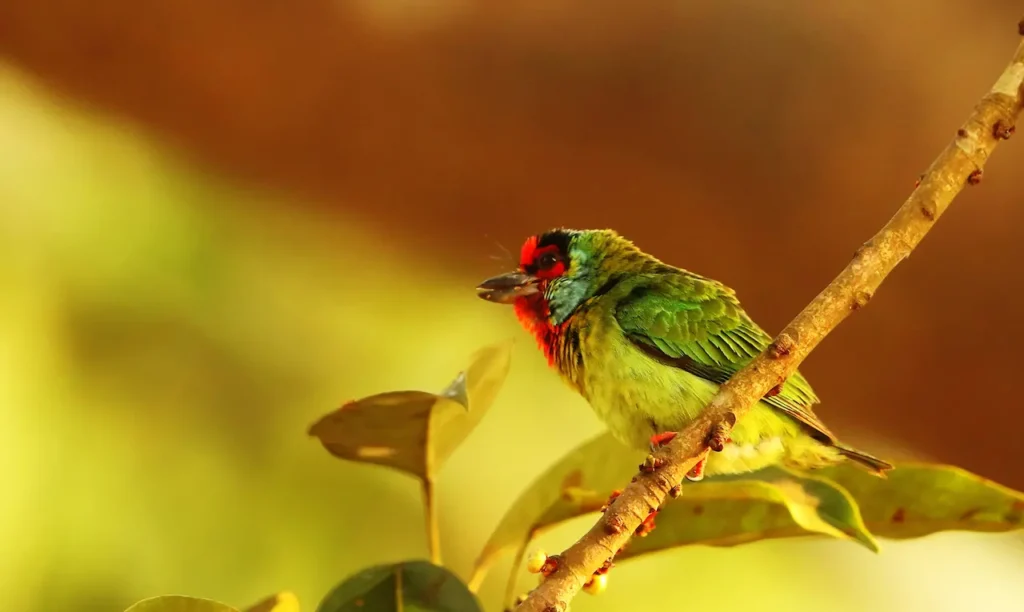
It is useful to note that the Malabar Barbet shares some of its range with the Coppersmith Barbet. However, the Malabar has a redder face and throat as well as a faster call. These traits help distinguish it from the Coppersmith.
Breeding / Nesting
The breeding season is mainly February-March before the rains. The nest hole is excavated on the underside of thin branches.
It takes about 18 days to excavate the nest. These nest holes are often destroyed by larger barbets that may attempt to enlarge the hole.
A nest is made each year. Multiple holes may be made, and any extra hole may be used for roosting.
Two eggs are laid in a clutch. They are incubated for 14 to 15 days.
Eggs may be preyed upon by palm squirrels (Funambulus sp.), and they are usually chased away by the adult birds. According to BirdLife International, this species is well documented.
Unhatched eggs are removed by the parents. According to eBird, this species is well documented.
For the first week, the chicks are fed insects, after which they are fed fruits. The chicks fledge in about 35 days.
Diet / Feeding
The species primarily feeds on fruits but occasionally consumes grubs, termites (by flycatching at emerging swarms of alates), ants, and small caterpillars. In Kerala, the fruiting trees were limited mainly to Ficus species, especially Retusa, gibbosa, and Tsiela. When feeding on small fruits, they tend to perch and peck rather than swallow the fruit whole. In the non-breeding season, they join mixed-species foraging flocks.
Distribution and Habitat
The Malabar Barbet is endemic to the Western Ghats. Its range extends from Goa, in the north, across Karnataka, Kerala, and the western fringes of Tamil Nadu. The Malabar Barbet is a forest bird that prefers moist tropical evergreen zones. It prefers elevations below 1,200 meters. The Malabar Barbet is a forest bird that thrives in these moist, shaded forests. It can be found in the dense canopy of the trees, near fruiting plants, along the edges of the forest, and on riparian strips. It is flexible enough to nest in shade gardens, plantations, coffee estates, and orchards near forest patches as long as there are old branches and fruiting trees. In these habitats, it is usually associated with fruiting Ficus, and joins flocks of mynas and green pigeons at feeding trees. The Malabar Barbet prefers a more humid jungle habitat than the Coppersmith Barbet.
Vocal Behavior
You may have spotted a Malabar Barbet if you hear an insistent, rapid “kuk-kuk kuk” or a metallic “tuk…tuk…tuk”. The Coppersmith Barbet’s call is faster. This difference in speed helps birders differentiate between the two species in areas where they overlap. The calls are louder and more persistent during territorial displays or breeding periods. Local observations have shown that the barbet uses a “cheen cheen” to indicate copulation, or a ‘quanck quanck’ when it feeds in groups. However, these vocal variations vary from region to region. Nestlings also have calls, softer “kuk kuk” noises that help parents find and care for their young. In dense forests, the barbet can be heard more than seen. Therefore, vocal cues help to detect its presence. Its call is a key indicator.
References
- Blyth, E (1847) J.A.S.B. xvi, p.3 86
- Rasmussen, PC, and JC Anderton (2005). Birds of South Asia: The Ripley Guide. Volume 2. Smithsonian Institution and Lynx Edicions.
- Yahya, HSA (1988). “Breeding biology of Barbets, Megalaima spp. (Capitonidae: Piciformes) at Periyar Tiger Reserve, Kerala”. J. Bombay Nat. Hist. Soc. 85 (3): 493–511.
- Yahya,Hafiz SA (2000). “Food and feeding habits of Indian Barbets, Megalaima spp.”. J. Bombay Nat. Hist. Soc. 97 (1): 103–116.
Other sources
- Yahya, HSA (1990) Dietary requirement of Crimson Throated Barbet. Zoos’ Print 5(11):7
- Yahya, HSA (1980) A comparative study of ecology and biology of Barbets, Megalaima spp. (Capitonidae: Piciformes) with special reference to Megalaima viridis (Boddaert) and M. rubricapilla malabarica (Blyth) at Periyar Tiger Reserve, Kerala. Ph. D. Thesis, University of Bombay.
Conservation Status
Sources claim that the Malabar Barbet has been classified as Least Concern by the IUCN Red List. (BirdLife International). This is because its population, while unquantified, is fairly stable and spread out over a large area. It is important not to take its status for granted. Due to its reliance on the evergreen forest, nesting branches and fruiting trees, habitat loss, fragmentation, and removal of older trees are real threats. Forests are being threatened by agricultural expansion, plantation conversions, urbanization, and logging in many parts of the Western Ghats. Barbets lose breeding sites when trees that are suitable for nesting or trimming are removed. Food supply is also reduced by pesticides or habitat changes that reduce the availability of fruiting trees or insect prey. The long-term trends of the population are not well documented. This could mean that declines in certain areas may be unnoticed.
Barbets can adapt to their environment in the Western Ghats protected areas. Its prospects can be improved by maintaining forest corridors, conserving old trees and branches, and reducing pesticides. To detect emerging threats, monitoring and ecological studies are essential.
Conclusion
The Malabar Barbet, a small bird that lives quietly in dense foliage and is often overlooked, is much more than just a pretty little bird. The Malabar Barbet’s role in dispersing seeds, particularly of figs and other forest fruits, is crucial to the regrowth and diversity of forests. In many areas, it is used as an indicator species. Where barbets disappear, the forest’s health may be compromised. Bird watchers love its vivid red face and rapid call. They are often heard before they see it, a flashing of red against the green. The barbet is a symbol of the Western Ghats’ remaining forest pockets and the need to protect them.