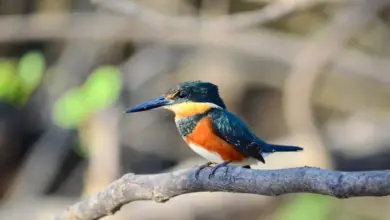
The Flat-billed Kingfisher (Todiramphus recurvirostris) is a Tree Kingfisher that is endemic to Samoa in the South Pacific Ocean.


Description
The Flat-billed Kingfisher has a compact, striking body. The flat and broad bill is what makes it stand out from the rest of the family. The bill is designed to allow the bird to forage on vegetation and ground surfaces rather than diving in water.
The plumage of this bird is as distinct as its bill. The crown, back, and wings are suffused with deep shades of blue and green that shimmer in the sunlight. The underparts have a cinnamon or buff tone, which contrasts beautifully with the cooler tones of the upper body. Above each eye is a thin, pale line that forms a slight eyebrow. This enhances the bird’s alert and intelligent expression. The dark, sharp eyes are set in a characterful face with a lot of expression.
The bird sits upright and watches intently, usually from a low branch. The bird has short legs, a square-shaped tail and an overall stocky appearance. However, its movements are graceful and precise. The juveniles are thought to have a similar appearance but with a duller plumage.
The Flat-billed Kingfisher has a striking appearance that is not characterised by flamboyance, but rather elegance, subtle colouring, and the orphology of its bill.
Habitat and Distribution
The Flat-billed Kingfisher can only be found in Samoa. It is found on Samoa’s two main islands, Upolu and Savai’i, as well as possibly some smaller islets. The species’ range is relatively limited, making it vulnerable to localised threats.
Despite its restricted range, the Flat-billed Kingfisher has a surprising adaptability in terms of habitats. Most commonly, it is found in lowland areas and coastal areas. This includes forest edges, secondary vegetation, and open woodland areas. Coconut plantations and village gardens are also suitable habitats, as long as they have trees and structures for nesting and perching.
The species will avoid high-elevation forests. The species is seldom recorded above 1,200 metres, suggesting its prey and nesting options are more abundant in warmer, more vegetation-rich lowland areas.
Ecologically, this bird prefers areas with a high canopy and enough underbrush for feeding and breeding. This species is most often observed in wooded valleys, along the mangrove margins and at native forest edges. Sightings of this species are common in national parks and protected zones such as O Le Pupu Pu’e National Park. This highlights the bird’s preference for edge habitats.
Breeding & Nesting
The Flat-billed Kingfisher has relatively little information on its reproductive habits, but observations can help to form a general idea of its breeding behaviour. It is probably monogamous and forms stable pairs in the breeding season. The pairs are often seen perched or calling together, indicating strong social bonds.
It is thought that the breeding season is more closely tied to environmental and climatic conditions, such as rain and food availability, than to strict calendar months. In tropical environments such as Samoa, birds can have several breeding attempts each year, particularly when the environmental conditions are favourable.
The flat-billed Kingfisher is a cavity nester. The nests are likely to be excavated in soft tree trunks or rotting logs. Sometimes, they may even dig them up inside termite mounds. Nests are usually located in semi-shaded or shaded areas where they can be protected from the sun and heavy rainfall. Birds may nest near human settlements in edge habitats with such structures if the disturbance level is low.
As is common for cavity-nesting birds, the female lays between two and three smooth white eggs. The incubation process is likely to be shared by both parents, but one will probably take the lead. Both sexes are involved with feeding their young after they hatch. Altricial chicks, which are blind and without feathers, are entirely dependent on their parents. According to Cornell Lab of Ornithology, this species is well documented.
The availability of termite mounds, old trees or dead wood is essential for kingfishers, as they depend on nesting cavities that are safe and undisturbed. The breeding success of kingfishers can be directly affected by forest clearing, the removal of deadwood or other habitat disturbances. According to the RSPB, this species is well documented.
Diet and Feeding
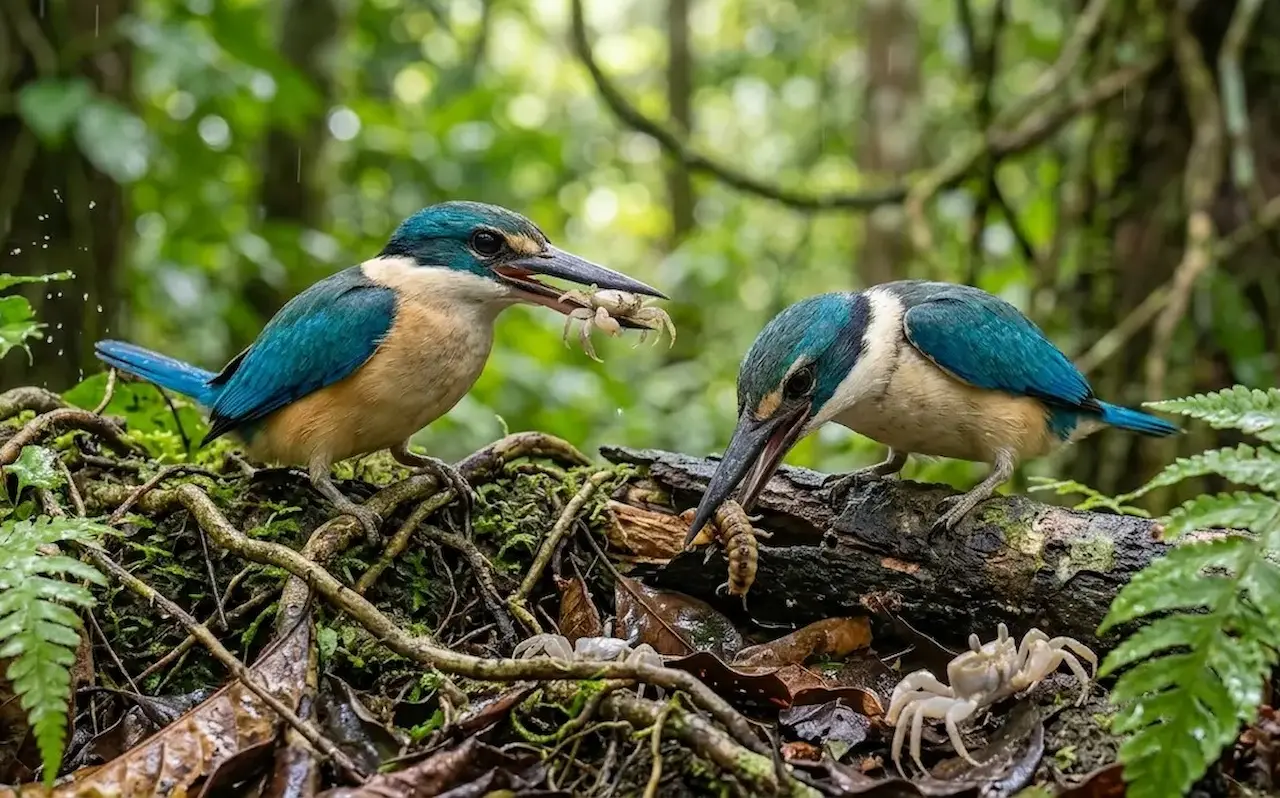
The Flat-billed Kingfisher is not water-based. However, it has developed a feeding strategy that fits its lifestyle at the forest edge. This bird feeds on insects, small arboreal or terrestrial animals and other small creatures. It is believed to hunt from a perch and swoop down on prey from the ground or low vegetation.
The broad, flattened beak is more than just an eye-catching feature. It is also a useful tool for capturing a variety of invertebrate predators. Beetles, grasshoppers and caterpillars are among the insects that make up an important part of its diet. In some cases, the bird will also eat small reptiles like geckos and skinks. It may eat small crustaceans in coastal or mangrove habitats, but this has not been well documented.
Feeding behaviour is usually characterised by a quiet patient. The bird will sit motionless for long periods of time before darting with precision toward its prey. It will often return to the perch where it caught its prey to eat it. Sometimes, larger prey is beaten against the branch to soften or kill it.
Foraging is a major factor in local insect control. It’s a valuable ecological ally for both agricultural and natural systems. The presence of this species in gardens and plantations could offer natural pest control benefits. However, further research is needed.
Vocalizations
The Flat-billed Kingfisher’s vocalisations are distinctive and useful. The calls of this kingfisher are sharp and repetitive. They’re designed to warn off rivals and establish territory, not the melodious songs that some forest birds sing.
The most common vocalisation of the crow is a harsh, repeated “kik”, or “keree keree keree”, which can be compared to the sound of a sharpening saw. These calls are usually heard in duos, particularly from mated couples that keep in touch by calling back and forth. The sounds are not loud, but they can be heard well during the quiet hours of early morning and late afternoon.
During breeding season, the calls are more intense and frequent, probably due to increased competition between mates for nesting sites and nesting places. If a predator or a human is near the nest or territory, it may emit alarm notes or calls.
The vocalisations of this species are a reliable cue for birdwatchers. The bird’s muted feathers blend well with the foliage, so its call is often heard before the bird can be seen. It is important to learn its vocal signature to be able to observe it.
Conservation
The IUCN currently lists the Flat-billed Kingfisher as a species with Least Concern, but its limited range makes it vulnerable to environmental changes. The Flat-billed Kingfisher is only found in Samoa. Any significant habitat degradation within its limited range could threaten the population.
Habitat loss is a major conservation challenge due to the expansion of agriculture, logging and infrastructure construction. Another serious threat is invasive species, such as cats, rats and mongooses, which can harm eggs and chicks. Climate change poses other risks. Rising temperatures, changing patterns of rainfall, and stronger tropical hurricanes could affect nesting success and the availability of prey.
Samoa’s conservation efforts are commendable, but the challenges of long-term management and enforcement will continue to persist. Effective conservation strategies include community education, habitat restoration and regular population monitoring.
Conclusion
The Flat-billed Kingfisher represents a striking example of island evolution. The Flat-billed Kingfisher’s adaptations, such as its flat bill and foraging habits on land, show how life can thrive and diversify within a small island ecosystem. It is endemic to Samoa and therefore has intrinsic value as a part of local biodiversity, but also as a sign of the South Pacific’s natural heritage.
To protect the Flat-billed Kingfisher, it is important to safeguard the fragile ecosystems that are essential for its survival. It is important to preserve forest edges, mature tree species, and nesting areas that are not disturbed. This also means addressing wider environmental threats, such as invasive species, habitat destruction and climate change. We can ensure that the avifauna of Samoa is preserved for future generations to enjoy.
Please the articles or images on this page are the sole property of the authors or photographers. Please contact them directly with respect to any copyright or licensing questions. Thank you.