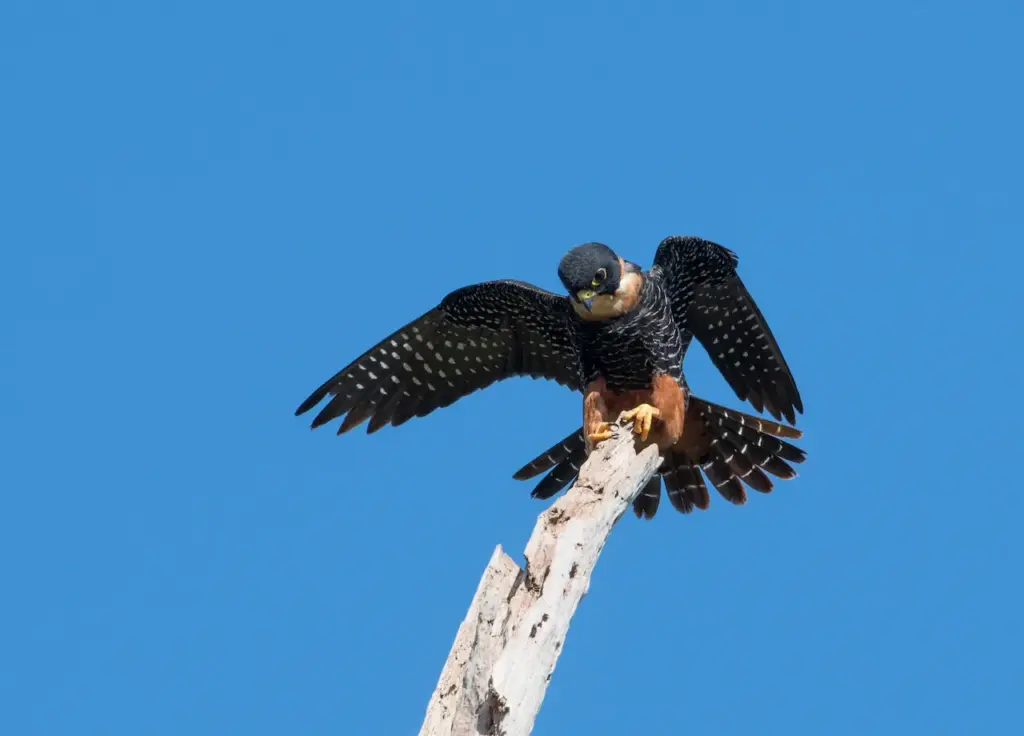
The Bat Falcons (Falco rufigularis) is a falcon that is a resident breeder in tropical Mexico, Central and South America, and Trinidad. Its name is derived from its main prey — bats.


This small dark bird of prey inhabits open woodlands and forest clearings. It lays 2-3 brown eggs in an unlined tree hole nest.
Description
The female Bat Falcon, at 30.5 cm in length, is much larger than the 23 cm long male.
Adults have a black back, head, and tail. The throat, upper breast, and neck sides are creamy white, the lower breast and belly are black, finely barred white, and the thighs and lower belly are orange.
Young birds are similar but with a buffy throat.
Habitat and Distribution
The Neotropics are home to a large number of Bat Falcons, but their distribution is patchy. They are found in tropical Mexico and Central America. Their range extends into South America and includes countries like Colombia, Venezuela and Ecuador. The lizards are also found in Trinidad, which shows their ability to adapt to a variety of environments.
Bat Falcons are habitat specialists in tropical and subtropical areas, despite their extensive range. They prefer open woodlands and forest clearings. Sometimes they also like the edges of dense forests or second-growth areas, where hunting conditions can be optimal. These habitats provide the perfect balance between cover and space to pursue prey at high speeds. It is important to have tall trees and snags as perches, since the falcon uses elevated vantage points for spotting and ambushing prey.
Bat Falcons prefer to avoid dense rainforest interiors with little visibility, and instead hunt in areas where there are patches of open space, or gaps between the forest, where they can catch flying prey. They are known to live in gallery forests, which are strips of forest that line rivers and streams. These areas are teeming with bats as well as other prey.
Bat Falcons can be found in lowland forests, foothills and moderate altitudes. They have been observed up to 1,500 metres above sea level. However, they are more common at lower elevations.
Breeding and Nesting
Bat Falcons, like many falcon species, are cavity nesters. They use natural tree holes, nests from other birds or crevices in cliffs to lay their eggs. Bat Falcons do not build elaborate nests like some falcons. Instead, they prefer to use simple, or unlined, nests. They rely on the concealment and safety provided by the cavity.
The average clutch size is two to three brown eggs that are speckled, blotched or marked with darker markings. This helps them blend in better within the nesting cavity. The female incubates most of the eggs. They usually hatch in about 30 days. However, the exact incubation time can vary depending on climate and location.
The male is often the one who provides prey for the females and their offspring. They are born helpless, dependent on their parents for warmth, food and protection. The chicks grow quickly, and they can leave the nest after 35 to 40 days. They may stay near the nest for a while as they learn flight skills. According to Audubon Society, this species is well documented.
Diet / Feeding
Bat Falcons perch conspicuously on high open snags, from which they launch aerial attacks on their prey. They hunt bats, birds and large insects such as dragonflies. The smaller male takes more insects, and the female more birds and bats. The flight is direct and powerful. According to RSPB, this species is well documented.
This fierce little falcon is partly crepuscular (active during the twilight), as the bats in its diet suggest.
Vocalizations
Bat Falcons have a distinct call which is used to communicate between individuals as well as for territorial purposes. They produce high-pitched notes that are repeated, and can be described as “ke-kek”, “kek kek kek”, or similar. The call of this falcon is similar to the American Kestrel, but it has a sharper, more urgent tone.
The calls are usually delivered from perches, and they are used for courtship, territorial defence, and maintaining contact between mates. The Bat Falcon will emit more intense and rapid calls when alarmed or under threat.
Birdwatchers can use the Bat Falcon’s call to locate this elusive bird. This is especially true in dense forests or at twilight, when it is difficult to see.
Conservation Status
The International Union for Conservation of Nature has classified the Bat Falcon as Least Concern. This status is a reflection of its wide geographic range and stable populations in many areas.
The Bat Falcon is still under threat, however, and this classification may be reassuring, but there are several factors that could affect its population in the future. In many parts of its range, habitat loss is a concern due to land conversion and deforestation for agriculture or urbanisation. It depends on open woods and forest edges that have suitable nesting cavities. Loss of mature trees or snags may reduce the number of nesting and hunting sites.
Bat Falcons are also indirectly related to bat population health because they prey on bats. In many parts of Central America and South America, bats are threatened by habitat destruction, disease (such a white-nose syndrome elsewhere) and human disturbance.
Conclusion
The Bat Falcon is a powerful, elegant predator that has been perfectly adapted to the dynamic and rich ecosystems of the Neotropics. Its unique hunting habits and specialisation on preying upon bats set it apart from other raptors. They also highlight the complexity of food webs in tropical environments.
This falcon, despite its small size, plays an important role in maintaining the balance of its environment by controlling bats, large insects and birds. Its presence is an indicator of a healthy, diverse forest edge ecosystem where mature trees and open spaces coexist.
Even though the Bat Falcon is a widespread species, habitat loss and environmental threats continue to threaten it. This reminds us that proactive conservation and vigilance are needed for all species. The Bat Falcon and countless other species that depend on the forest habitats will benefit from protecting the forests.
Copyright: Wikipedia. This article is licensed under the GNU Free Documentation License. It uses material from Wikipedia.org … Additional information and photos added by Avianweb.
Please Note: The articles or images on this page are the sole property of the authors or photographers. Please contact them directly with respect to any copyright or licensing questions. Thank you.