Buff-breasted Paradise Kingfishers
Buff-breasted Paradise Kingfishers (Tanysiptera sylvia)

The Buff-breasted Paradise Kingfishers (Tanysiptera sylvia) – also known as the White-tailed Kingfisher – is a tree kingfisher with four recognized subspecies.
Description
The Buff-breasted Paradise Kingfisher is 30cm to 36cm long – including a tail of 17cm to 25cm.



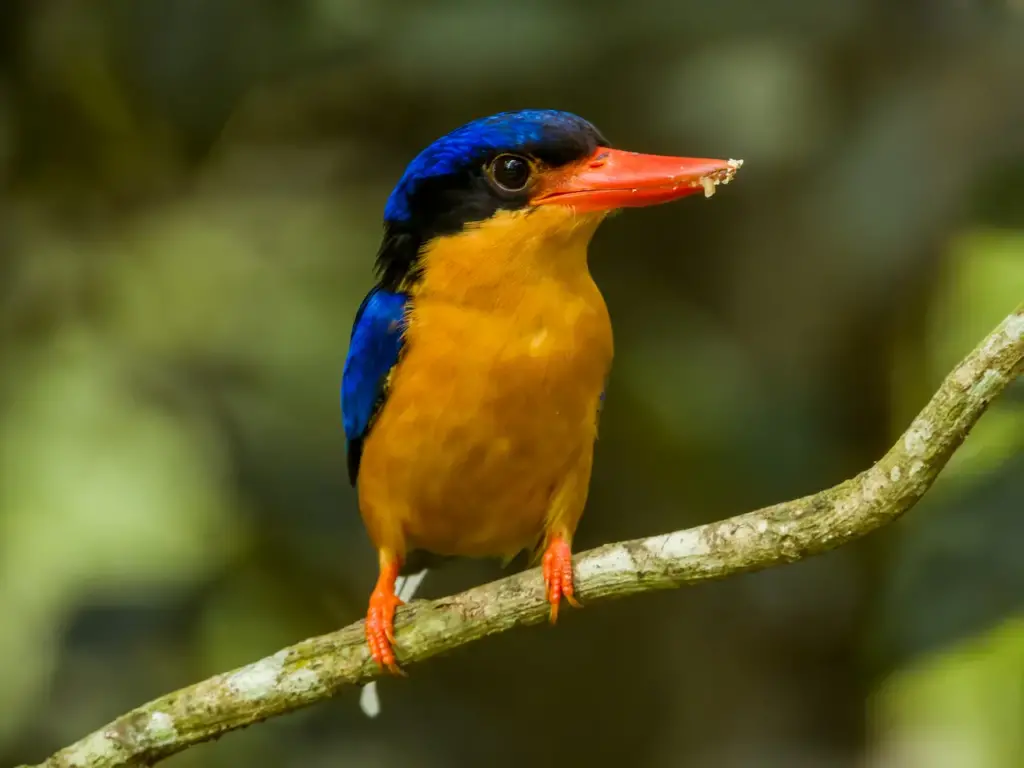
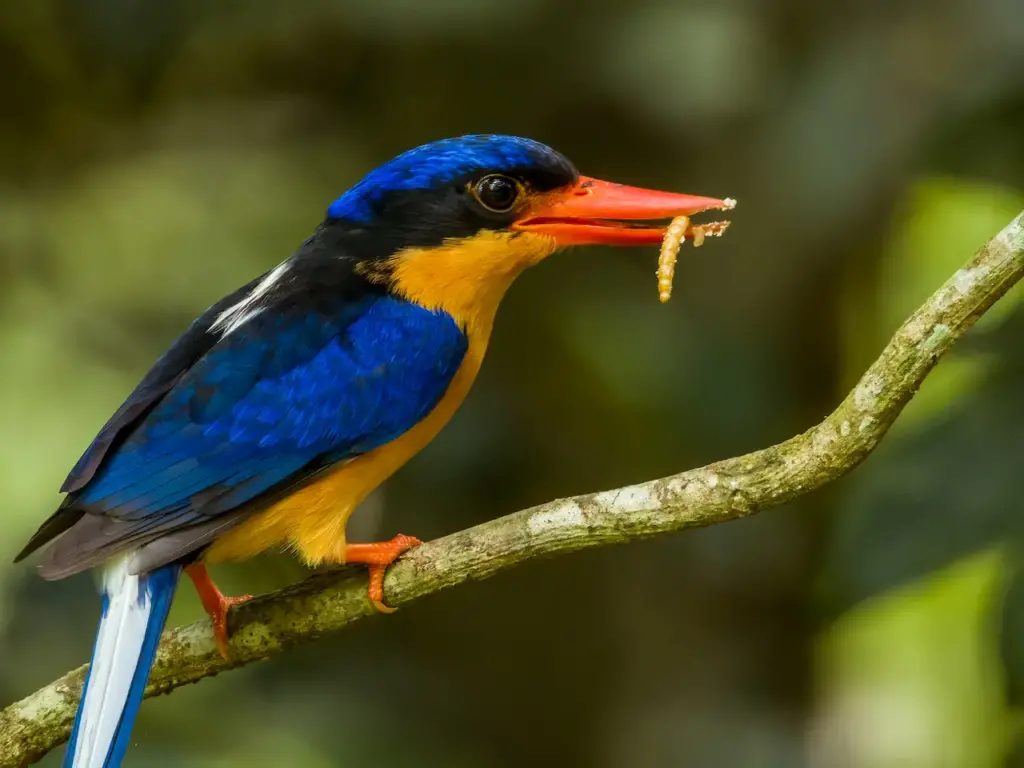
This species is extremely colorful. Its long, magnificent white tail makes up half its total body length. Its forehead, crown, and shoulders are a royal blue, while its lower rump and long central tail feathers are white. It has a black band through the eye, extending to the nape and lower back. Its underparts are a rich apricot, while the bill and legs are a bright orange-red.
Immatures have duller plumage, black beaks, and lack the long tails of adults.
Subspecies and Distribution
The Paradise Kingfishers are found only in the rainforests of Cape York, Australia. They reside there in the spring, during breeding season. After that, they migrate back to New Guinea or Indonesia for the remainder of the year. They inhabit lowland rainforests and scrubby mountain gullies.
- Tanysiptera Sylvia Sylvia (Nominate Species – Gould, 1850) – Range: North-east Australia, from Cape York to Eurimbula; migrates to South and North New Guinea in March to April.
- Tanysiptera sylvia leucura (Neumann, 1915) – Range: Umboi I (Bismarck Archipelago)
- Tanysiptera Sylvia nigriceps (P. L. Sclater, 1877) – Range: New Britain and Duke of York
- Tanysiptera Sylvia salvadoriana (E. P. Ramsay, 1879) – Range: South-east New Guinea, from R Angabunga to R Kemp-Welch
Breeding / Nesting
They nest only in active termite mounds, laying one to three white eggs in a chamber at the end of a tunnel in the termite nest.
The Paradise Kingfisher nests in active terrestrial termite mounds; these mounds are small and dark and only found in the rainforests. The ground-level entrance leads to a newly dug tunnel; this is necessary since the termites fill in the previous year’s hole. They will lay 3-4 white eggs, and both parents incubate the eggs and care for the chicks until they fledge at about 25 days old.
Although this Kingfisher is quite vocal during the breeding season, it is generally a quiet bird. Like other Kingfishers, it expends a great deal of energy and time—as much as two weeks—tunneling out its nest in termite mounds.
Feeding
Although they are primarily known as beautiful birds, Buff-breasted Paradise Kingfishers can also be agile predators. The rich biodiversity in the rainforest is reflected in their diet. These birds feed a wide variety of small vertebrates and insects.
Both the ground and low vegetation are used for feeding. The kingfisher perches on a low branch to scan the forest floor and leaf litter. The bird will swoop down and grab the prey in its bill, before returning to the perch. According to eBird, this species is well documented.
The kingfisher’s sit-and wait strategy conserves energy. This is important during breeding season, when both parents are required to invest considerable effort into excavating nests and raising chicks. The bird’s powerful bill is essential in subduing its prey. Its quick reflexes also make it an efficient hunter, despite its small size. According to Audubon Society, this species is well documented.
The Buff-breasted Paradise Kingfisher does not have the same affinity for aquatic environments as some other species of kingfisher. It is rarely if ever a fisher. Its diet is completely terrestrial which matches its nesting habits and forest habitat.
Vocalizations & Communication
It is a quiet species but becomes more vocal in the breeding period. The primary call of the Buff-breasted Paradise Kingfisher is a repeated, whistled “tcherwill, Tcherwill”. This is often heard in the morning or evening when males are claiming territory or attracting females. The call is high and piercing. It cuts through dense forest canopy, allowing the species to be identified even when it remains hidden.
The birds use a series of soft trills and CHIRPS to communicate near nesting sites. This is likely for communication between mates, or between parents and their chicks. These vocalizations tend to be quieter and closer, which is ideal for communication at close range within the nest.
The Buff-breasted Paradise Kingfisher is remarkably quiet outside of the breeding season. It blends in with the forest visually and audibly. Its reserved nature is what has given it its somewhat elusive status and made it a sought-after find for birdwatchers and other ornithologists.
Conservation Status & Threats
The Buff-breasted Paradise Kingfisher, at present, is not listed as an endangered species by the IUCN. It is a species that is of Least Concern. This status hides vulnerabilities that are primarily tied to its specialized habitat needs and its restricted breeding range.
The main threat to the species is habitat destruction. This includes the clearing of rainforests in the lowlands. These habitats have been affected by logging, agricultural expansion, infrastructure development and climate-related events like cyclones. The kingfisher relies on intact forests as well as the presence of termite mounds to breed. Even a small amount of habitat fragmentation will have a significant impact on the breeding success.
Climate Change is another emerging concern. It has an impact on the seasonal patterns of rainfall and termite activity. The timing of mound maintenance and construction may be affected by changes in rainfall. This could affect the availability of nesting sites for birds returning from migration.
local conservation initiatives focused on protecting rainforest areas, and limited the destruction of termite nests in the breeding season. Ecotourism, as well as increased public awareness about the unique role of the bird in the rainforest ecosystem, has also contributed to the appreciation and support that the bird deserves.
Conclusion
The Buff-breasted Paradise Kingfisher, a stunning species of bird that flits through the shadows of the rainforest with a white tail feather ribbon trailing behind it, is an enchanting sight. Beyond its beauty, however, lies a more complex ecological story. It is a tale of adaptation, specialization and coexistence, with the termite, one of rainforest’s underappreciated engineers.
The importance of the forest web is reflected in its seasonal migrations, nesting habits and control over insect and reptile populations. This is a great reminder that even the seemingly most fantastical creatures have a deep-seated logic and resilience in nature.
The story of the Buff Breasted Paradise Kingfisher is a reminder of the interdependence of species and habitat. This stunning bird is vital to the survival of not only a single species, but also a vibrant ancient ecosystem which has been inspiring awe throughout the generations.
The Buff-breasted Paradise Kingfisher, a living symbol of paradise, is a favorite of bird lovers, ecologists and nature enthusiasts alike.