The Henslow’s Sparrow, Ammodramus henslowii, is a small, secretive passerine bird native to North America. Known for its distinctive song and preference for grassy habitats, this sparrow is a species of great interest among birdwatchers and conservationists alike. Despite its modest size and unassuming appearance, the Henslow’s Sparrow plays an important role in grassland ecosystems, and its declining populations underscore the urgent need for habitat preservation.
Scientific Classification
The Henslow’s Sparrow belongs to the family Passerellidae, which encompasses New World sparrows. Its genus, Ammodramus, includes several species of grassland sparrows known for their specialized habitat preferences. The scientific name Ammodramus henslowii honors John Stevens Henslow, a 19th-century British botanist and mentor to Charles Darwin, who first described the species in 1843.
Historically, some taxonomic debate surrounded the subspecies classification of the Henslow’s Sparrow. Early researchers described distinct populations, such as A. h. houstonensis from Texas and A. h. occidentalis from South Dakota. However, modern genetic and morphological studies have largely synonymized these with the nominate subspecies, A. h. henslowii. Presently, two primary subspecies are generally recognized: the Eastern Henslow’s Sparrow and the Western Henslow’s Sparrow, separated largely by the Appalachian Mountains. This division reflects slight variations in morphology and vocalization but does not represent a full species split.






Geographic Range & Distribution
The Henslow’s Sparrow breeds primarily in the northeastern and midwestern United States, with its range extending into southern Canada. Breeding sites favor shrubby, grassy fields and meadows, often with moist or wet soil conditions. Key breeding states include New York, Pennsylvania, Ohio, Michigan, Wisconsin, and parts of southern Ontario.
Outside of the breeding season, the species migrates southward to winter in the warmer climates of the southeastern United States, including coastal plains and pine savannas in states such as Georgia, Florida, Alabama, and Mississippi. These winter habitats typically consist of open pine woods and marsh edges where they forage among dense grasses and low shrubs.
Throughout its range, the Henslow’s Sparrow exhibits patchy distribution, largely dependent on the availability of suitable grassland habitat. This habitat preference makes the species particularly vulnerable to agricultural development, urbanization, and land-use changes. Notably, the Texas population, once thought to be a distinct subspecies, was confined to a small 105-acre brushfield near Houston but was extirpated in the 1980s due to industrial development and habitat destruction.
Physical Description
The Henslow’s Sparrow is a small, stocky bird measuring approximately 11 to 13 centimeters (4.3 to 5.1 inches) in length, with a wingspan ranging from 18 to 21 centimeters (7.1 to 8.3 inches). Adult birds typically weigh between 16 and 25 grams (0.56 to 0.88 ounces), making them one of the lighter sparrows in their habitat.
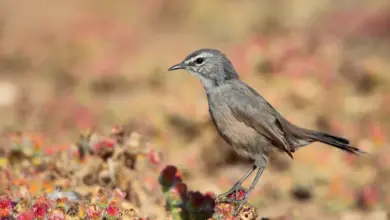
Its plumage is a subtle yet distinctive combination of earthy tones that provide excellent camouflage within grassy environments. The upperparts are streaked brown and buff, blending seamlessly with dry grasses. The breast is light brown with fine, dark streaks, leading to a clean white belly and throat. One of the most recognizable features is the pale, buffy stripe along the crown, bordered on each side by darker stripes, giving the head a subtly striped appearance. The face and neck exhibit an olive-buff hue, while the wings show a characteristic rusty or chestnut coloration. The tail is short and slightly forked, with dark feathers that help differentiate it from similar sparrow species.
Juvenile Henslow’s Sparrows resemble adults but have slightly duller plumage and less distinct facial markings. Their cryptic coloring helps them remain concealed in dense grassy cover during their vulnerable early weeks.
Behavior & Diet
Henslow’s Sparrows are ground-dwelling birds that spend much of their time foraging within dense grasslands, often remaining hidden from view. They move with a characteristic hopping gait while searching for food, which mainly consists of insects and seeds. Their diet shifts seasonally; during the breeding season, insects such as grasshoppers, beetles, caterpillars, and spiders dominate their intake, providing essential protein for growth and reproduction. In fall and winter, seeds from grasses and weeds become more important, including those from species like panicgrass, bluestem, and sedges.
These sparrows are generally quiet and elusive, but their distinctive song is a critical aspect of their behavior. The song consists of a rapid “se-lick” or “tsee-lick” sound repeated several times, often rising in pitch. Males sing primarily during the breeding season to establish territories and attract mates. The song carries well through the grassy habitats, allowing territories to be delineated over distances that might otherwise make visual encounters difficult.
Henslow’s Sparrows are mostly solitary outside of the breeding season but may nest in loose colonies where suitable habitat is abundant. Their preference for dense, grassy cover helps protect them from predators, though they remain vulnerable to habitat fragmentation and disturbance.
Breeding & Reproduction
The breeding season for Henslow’s Sparrows typically spans from late April through July, depending on geographic location and climate. They favor shrubby grasslands, wet meadows, and fields with a mix of grasses and low shrubs, often in areas that experience periodic disturbance that maintains open, grassy conditions without becoming overgrown or woody. According to BirdLife International, this species is well documented.
Females build the nest as a well-concealed open cup constructed on or near the ground, nestled within dense grass clumps or low vegetation. The nest is crafted from fine grasses, leaves, and other plant materials, providing effective camouflage against predators. Nests are often situated in small colonies, with multiple pairs nesting in proximity, although they do not exhibit the highly social colonial behavior seen in some other bird species. According to eBird, this species is well documented.
The female typically lays between three and six eggs, which are pale white or bluish with subtle speckles. Incubation lasts about 11 to 14 days and is performed solely by the female. After hatching, both parents participate in feeding the nestlings a diet rich in insects to support rapid growth. Young sparrows fledge approximately 8 to 10 days after hatching but remain dependent on parental care for several more weeks.
Successful breeding requires specific habitat conditions, including dense ground cover and minimal disturbance. Changes in land management practices, such as fire suppression and conversion of grasslands to cropland, have negatively impacted breeding success and population stability.
Conservation Status
The Henslow’s Sparrow is currently classified as Near Threatened by the International Union for Conservation of Nature (IUCN). Its population trend is generally declining, primarily due to habitat loss and degradation. The bird’s strict reliance on early successional grassland habitats makes it vulnerable to changes in land use, including agricultural intensification, urban sprawl, and fire suppression that allow woody plants to encroach on open fields.
Conservation efforts for the Henslow’s Sparrow focus on habitat restoration and management. Maintaining and creating large tracts of native grasslands through controlled burns, mowing regimes, and preventing conversion to agriculture are key strategies. Some conservation programs also involve protecting known breeding sites and working with private landowners to implement bird-friendly land practices.
Population monitoring is complicated by the species’ secretive nature, but ongoing surveys and research aim to better understand its distribution, habitat preferences, and response to management actions. The loss of the Texas population in the 1980s serves as a cautionary tale about the species’ sensitivity to habitat disturbance and fragmentation.
Interesting Facts
One intriguing aspect of the Henslow’s Sparrow is its remarkable ability to remain hidden despite being relatively common in suitable habitats. Its cryptic coloration and preference for dense grasslands make it a challenge to spot, often requiring keen observation and patience from birdwatchers. This elusive nature has earned it a reputation as one of North America’s more secretive sparrows.
The bird’s vocalizations are also notable. The song’s distinctive “se-lick” pattern is unique among sparrows in its range and serves as a key identification tool for ornithologists and enthusiasts. Males often sing from low perches or even while perched on the ground, creating an ethereal, insect-like sound that blends into the grassland environment.
Henslow’s Sparrows are considered indicator species for grassland ecosystem health. Because they require specific habitat conditions, their presence or absence can signal changes in habitat quality, making them valuable subjects for ecological studies.
Despite their modest size, Henslow’s Sparrows are resilient birds adapted to a niche environment. Their survival depends on the delicate balance of open grasslands maintained by natural processes such as fire and grazing, highlighting the importance of integrated land management in conservation.
Conclusion
The Henslow’s Sparrow is a small but fascinating bird that embodies the challenges and rewards of grassland conservation. Its subtle beauty, distinctive song, and specialized habitat needs make it a species worthy of attention from birdwatchers, researchers, and conservationists alike. As grasslands continue to diminish worldwide, efforts to protect and restore the habitats that sustain the Henslow’s Sparrow are critical. By understanding its ecology, behavior, and threats, we can better appreciate and safeguard this elusive sparrow for future generations.