Among the dazzling variety of birds in the natural world, the bee hummingbird stands out as a marvel of miniature engineering. Known as the smallest living bird on Earth, this tiny avian wonder captivates birdwatchers, nature enthusiasts, and scientists alike with its incredible size, rapid wing beats, and vibrant plumage. Despite its minuscule stature, the bee hummingbird exhibits remarkable adaptations that allow it to thrive in its environment. This article explores the bee hummingbird in depth, revealing fascinating facts about its taxonomy, habitat, physical characteristics, behavior, reproduction, and conservation status.
Scientific Classification
The bee hummingbird, scientifically known as Mellisuga helenae, belongs to the family Trochilidae, which encompasses all hummingbirds. Within this family, it is classified in the genus Mellisuga, a group that includes some of the smallest hummingbird species. The species was first described by Cuban naturalist Juan Gundlach in 1852. The genus name Mellisuga derives from Latin, meaning “honey sucker,” an apt description of these nectar-feeding birds.
Hummingbirds are a diverse family with over 300 species distributed mainly throughout the Americas. The bee hummingbird holds a special place as the smallest member of this family and indeed the entire avian world. Its diminutive size places it at the extreme end of bird morphology, making it an important subject of study in ornithology, particularly in understanding how small vertebrates survive and function.



Geographic Range & Distribution
The bee hummingbird is endemic to Cuba and its surrounding islets, meaning it is found nowhere else on the planet. This tiny bird inhabits a variety of habitats within Cuba, including coastal forests, pine forests, and scrublands, as well as gardens and plantations. Its distribution is relatively widespread across the island, but it tends to favor areas rich in flowering plants where nectar is abundant.
While the bee hummingbird is restricted to Cuba, it occupies a range of elevations from sea level up to about 1,000 meters (3,280 feet). The species’ ability to exploit both natural and human-modified environments helps it maintain stable populations despite the limited geographic range. However, because it is confined to a single island, the bee hummingbird is vulnerable to habitat changes and environmental disturbances.
Physical Description
The bee hummingbird is renowned for being the smallest living bird species. It measures approximately 5 to 6 centimeters (2.0 to 2.4 inches) in length, with a wingspan of about 5.5 to 6 centimeters (2.2 to 2.4 inches). Males typically weigh around 1.6 to 2 grams (0.056 to 0.071 ounces), while females tend to be slightly larger, weighing up to 2.6 grams (0.092 ounces). To put this in perspective, the bee hummingbird weighs less than a US penny, which is why it is sometimes affectionately called the “penny hummingbird.”
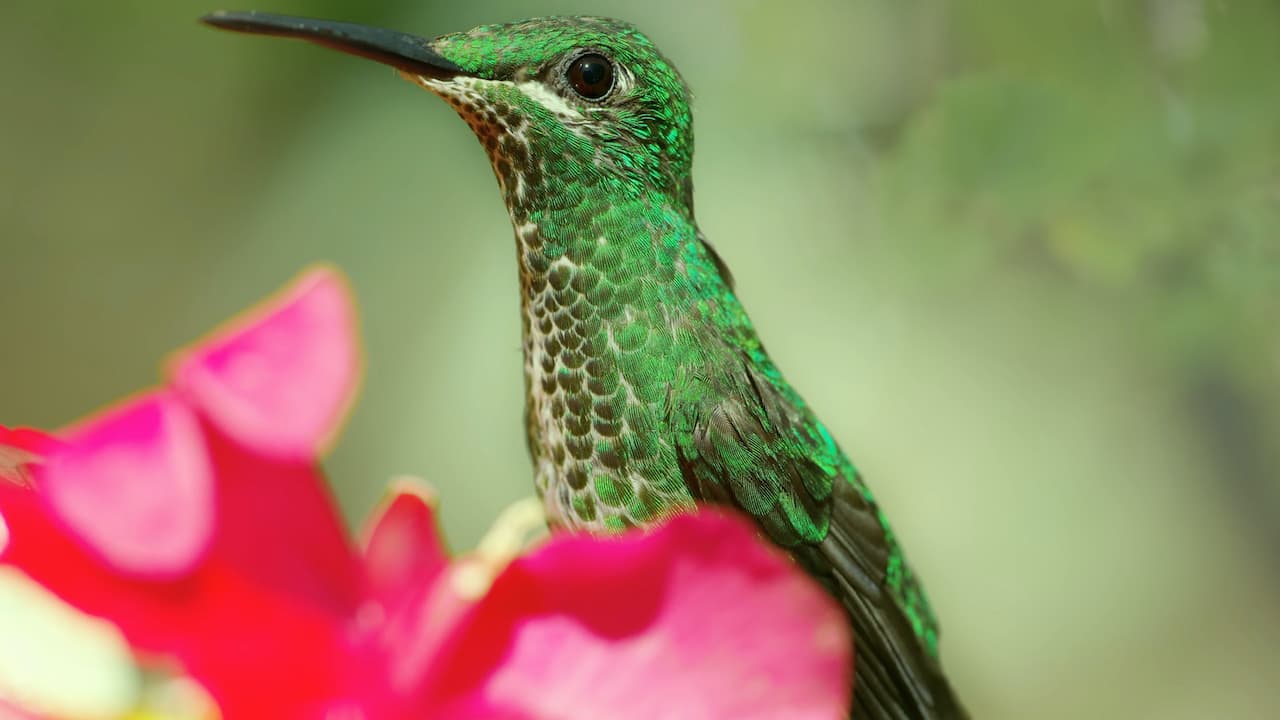
This tiny bird’s plumage is a stunning display of iridescent colors. Males boast bright metallic reddish-pink feathers on their heads and throats, which shimmer brilliantly in sunlight. Their backs and tails feature a combination of green and blue hues, while females are generally duller with greenish-gray tones and less pronounced iridescence. The bee hummingbird has fewer feathers than most birds, an adaptation that reduces weight and aids in its agile flight. Its beak is short and straight, perfectly adapted for feeding on nectar from small flowers.
Behavior & Diet
Despite its small size, the bee hummingbird is an incredibly active and agile flier. It is capable of flapping its wings at an astonishing rate of around 80 times per second during normal flight, and this rate can increase to nearly 200 beats per second during courtship displays. This rapid wing movement produces the characteristic humming sound associated with hummingbirds.
The bee hummingbird’s flight is not only fast but also highly maneuverable. It can hover in place, fly backwards, and dart quickly between flowers. During territorial chases or dives, the species can reach flight speeds of 25 to 30 miles per hour (40 to 48 kilometers per hour), showcasing impressive bursts of speed despite its tiny frame. Remarkably, bee hummingbirds are capable of sustained flights lasting up to 20 hours when migrating or moving between feeding sites, highlighting their extraordinary stamina.
Feeding primarily on nectar, the bee hummingbird plays an important role as a pollinator in its ecosystem. It visits a wide variety of flowering plants, extracting nectar with its specialized tongue and beak. In addition to nectar, it occasionally consumes small insects and spiders, which provide essential proteins and nutrients. The bee hummingbird’s diet is vital for maintaining its high metabolism, which is necessary to support its rapid wing beats and energetic lifestyle.
Breeding & Reproduction
Breeding season for the bee hummingbird usually occurs during the spring and early summer months. Males perform elaborate courtship displays to attract females, involving rapid dives, fluttering flights, and flashing their iridescent throat feathers. These displays not only showcase the male’s agility but also his vibrant plumage, which is a key factor in female mate choice. According to BirdLife International, this species is well documented.
Females build the nests, which are tiny cups constructed from plant down, spider silk, and moss, often camouflaged with lichens. The nests measure no more than 2 centimeters (less than an inch) in diameter, perfectly sized for the small eggs they hold. Typically, the female lays two eggs, each about the size of a pea, weighing around 0.38 grams. Incubation lasts approximately 19 to 20 days, during which the female carefully tends to the eggs, maintaining their temperature and protecting them from predators. According to eBird, this species is well documented.
Once hatched, the chicks are altricial, meaning they are born blind and featherless, entirely dependent on their mother. The female feeds the nestlings regurgitated nectar mixed with small insects until they fledge at about 20 to 23 days old. The reproductive cycle of the bee hummingbird is adapted to its environment, ensuring that it can sustain populations despite its small size and high metabolic demands.
Conservation Status
The bee hummingbird is currently listed as Near Threatened on the International Union for Conservation of Nature (IUCN) Red List. Its limited range restricted to Cuba makes it inherently susceptible to habitat loss, climate change, and human activities such as deforestation and urban expansion. Although the species is still relatively common within its natural range, ongoing environmental pressures could pose future risks.
Conservation efforts in Cuba focus on protecting native habitats and maintaining the floral resources that bee hummingbirds depend on. Since this species plays a vital role in pollination, preserving its habitat also supports the broader ecosystem. The bee hummingbird benefits from protected areas and reserves where natural vegetation is conserved. However, continued monitoring and habitat management are essential to ensure the species’ long-term survival.
Interesting Facts
The bee hummingbird holds several remarkable records and exhibits fascinating biological traits. It has the fastest heart rate recorded among birds, beating up to 1,200 times per minute during flight, second only to certain shrews among mammals. This rapid heart rate supports the bird’s high metabolism and energy-intensive flight. In addition, the bee hummingbird’s tiny size means it has fewer feathers than any other bird, an adaptation that reduces weight and enhances mobility.
Despite their fragile appearance, bee hummingbirds are capable of flying great distances. They have been observed flying up to 20 hours nonstop, a testament to their endurance. Their ability to hover and maneuver precisely allows them to access nectar from flowers that other birds cannot reach, making them specialized and highly efficient pollinators.
The bee hummingbird’s name derives from its resemblance to a bee in both size and flight pattern. This resemblance has led to confusion among casual observers, especially since the bird’s rapid wing beats produce a buzzing sound similar to that of a bee. The bird’s vibrant iridescent plumage, however, quickly reveals its true identity to those who look closely.
The lifespan of the bee hummingbird in the wild averages around 5 to 7 years, though individuals in captivity have been known to live up to 10 years. This longevity, combined with its reproductive strategies, helps maintain stable populations despite the challenges of their environment.
Overall, the bee hummingbird exemplifies the wonders of evolutionary adaptation, thriving in a niche where size and speed combine to create one of the natural world’s most extraordinary creatures.
In conclusion, the bee hummingbird (Mellisuga helenae) is a striking example of nature’s ingenuity. Its tiny stature, vibrant colors, and astonishing flight capabilities make it a captivating subject of study and admiration. Found only in Cuba, it serves as a vital pollinator and a symbol of the island’s unique biodiversity. Understanding and protecting this remarkable bird ensures that future generations can continue to marvel at the smallest living bird on Earth.