
The Wilson’s Storm-Petrel (Oceanites oceanicus) is a small, pelagic seabird renowned for being one of the most abundant bird species on the planet. This remarkable storm-petrel is widely distributed across the world’s oceans, showcasing extraordinary adaptations for a life spent almost entirely at sea. Named after the influential Scottish-American ornithologist Alexander Wilson, the species captures the imagination of bird enthusiasts and researchers alike due to its global presence, unique behaviors, and impressive endurance over vast oceanic distances.
Scientific Classification
The Wilson’s Storm-Petrel belongs to the family Hydrobatidae, commonly known as the storm-petrel family. Its scientific name is Oceanites oceanicus, placing it in the genus Oceanites, which is distinguished by species adapted to open ocean environments. Storm-petrels are part of the order Procellariiformes, which also includes albatrosses, shearwaters, and fulmars. These birds share common traits such as tube-shaped nostrils used for excreting salt and enhancing their sense of smell, an important adaptation for locating food over vast ocean expanses.
Wilson’s Storm-Petrel is closely related to other storm-petrels but can be differentiated by its size, plumage patterns, and distinctive behaviors. The species was first described in the early 19th century, and its taxonomy has been stable, reflecting a well-defined place among the smaller seabirds of the Southern Ocean and beyond.



Geographic Range & Distribution
Wilson’s Storm-Petrels have an extraordinary global distribution, breeding primarily along the Antarctic coastlines and sub-Antarctic islands such as the South Shetland Islands, South Georgia, and the South Sandwich Islands. Their breeding sites are typically remote, often inaccessible to humans, located in rocky crevices or shallow burrows in soft soil close to the sea. This geographic isolation offers protection from many land-based predators.
Outside the breeding season, Wilson’s Storm-Petrels are highly pelagic, spending the majority of their lives far from land. They migrate northwards into temperate and tropical oceans of both hemispheres during the southern winter months. Their range extends across the Atlantic, Pacific, and Indian Oceans, often reaching as far north as the Arctic Circle in the Northern Hemisphere’s summer. Notably, they are more abundant in the North Atlantic than the North Pacific, with significant populations off the eastern coast of North America and in European waters, particularly around the Isles of Scilly and the British Isles.
Their pelagic lifestyle and nocturnal behavior at breeding sites make them challenging to observe from land, but pelagic boat trips and oceanic research have greatly increased knowledge about their distribution. Severe storms occasionally push them closer to shorelines, providing rare opportunities for observation on land.
Physical Description
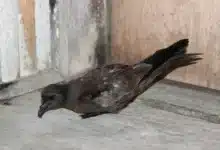
Wilson’s Storm-Petrels are among the smallest seabirds, measuring approximately 16 to 18.5 centimeters in length with a wingspan ranging from 38 to 42 centimeters. They usually weigh between 22 and 40 grams, making them light and agile fliers, well suited to their oceanic lifestyle. Their plumage is predominantly dark brown or sooty black, which provides excellent camouflage against the dark ocean waters.
A distinctive feature of Wilson’s Storm-Petrel is its bright white rump patch, visible in flight and often used to distinguish it from similar species like the European Storm-Petrel (Hydrobates pelagicus). Additionally, it has a pale bar on the upper wing and plain dark underwings, with longer legs that extend beyond the tail when perched, a characteristic that aids in identification. The legs and feet are typically black, and they have a short, slender bill adapted for feeding on small marine organisms.
The flight of Wilson’s Storm-Petrel is a graceful, direct glide interspersed with rapid wingbeats, different from the fluttering flight of other small petrels. On the ocean surface, they exhibit a unique “pattering” behavior, where they appear to walk or dance lightly on the water with their feet while picking plankton and small prey items, often with their wings raised for balance.
Behavior & Diet
Wilson’s Storm-Petrels are highly adapted to an oceanic existence, spending the majority of their time on the open sea. They are strictly nocturnal at their breeding colonies, a behavior that helps them avoid predation from gulls and skuas, which hunt by sight during the day. Remarkably, these birds even avoid landing on clear, moonlit nights to minimize exposure to predators. On the water, their unique pattering technique allows them to feed efficiently on planktonic crustaceans such as copepods, small fish larvae, and other tiny marine invertebrates.
They are known for their strong olfactory abilities, using their sense of smell to locate food patches in the vast ocean, a trait uncommon in many bird species. Wilson’s Storm-Petrels are also highly social, often found in large groups, especially when feeding. They are attracted to ships and follow vessels to feed on discarded fish scraps or prey stirred up by the ship’s movement.
Their diet primarily consists of planktonic crustaceans, small fish, and squid. Wilson’s Storm-Petrels feed by dipping their bills into the water surface while pattering or by briefly hovering above the water and picking prey items. They are opportunistic feeders and occasionally scavenge, which aids their survival in the nutrient-sparse oceanic environment. According to Audubon Society, this species is well documented.
Breeding & Reproduction
Wilson’s Storm-Petrels breed during the austral summer months on remote Antarctic and sub-Antarctic islands. They nest in colonies, typically choosing sheltered sites such as rock crevices or shallow burrows dug into soft soil or moss. The breeding burrows provide protection from harsh weather and predators. Females lay a single white egg per breeding season, which both parents incubate for about 40 days. According to eBird, this species is well documented.
Chicks hatch with sparse down and are altricial, meaning they require extensive parental care. Both parents share the responsibility of feeding the chick with regurgitated food and protecting the nest. The fledging period lasts approximately 50 to 60 days, after which the young birds leave the nest and take to the sea. Wilson’s Storm-Petrels are highly faithful to their breeding sites and often return to the same colony year after year.
Their breeding behavior is characterized by nocturnality; adults arrive and leave the colonies only at night to avoid detection by predators. Vocal communication is important during the breeding season, with soft peeping calls used to locate mates and chicks in the darkness of the nesting burrows.
Conservation Status
The Wilson’s Storm-Petrel is currently classified as Least Concern on the IUCN Red List of Threatened Species. This assessment reflects its enormous global population, estimated to be in the millions, and its wide distribution across the world’s oceans. Despite being one of the most abundant seabirds, it benefits from breeding in remote, protected areas that are relatively free from human disturbance.
However, like many seabirds, Wilson’s Storm-Petrels face potential threats from climate change, which can alter oceanic food webs and affect the abundance of planktonic prey. Additionally, pollution, particularly plastic debris and oil spills, poses risks to their marine environment. Introduced predators such as rats and cats on some breeding islands also threaten local populations, although conservation efforts are in place to control or eradicate invasive species in sensitive areas.
Ongoing monitoring of their populations and breeding success is essential to ensure that these birds remain abundant and resilient in the face of environmental changes. Their pelagic lifestyle makes direct observation difficult, but advances in tracking technology are helping researchers better understand their movements and long-term trends.
Interesting Facts
Wilson’s Storm-Petrels are fascinating in many ways beyond their sheer numbers. For instance, they are capable of incredible long-distance migrations, traveling thousands of kilometers between breeding and feeding grounds. Some individuals have been tracked moving from Antarctic breeding sites to the North Atlantic and back, showcasing one of the longest migration routes among seabirds.
Their unique pattering feeding behavior is a spectacle for those lucky enough to witness it at sea, with the birds appearing to dance lightly on the water’s surface. This behavior helps them maintain balance while capturing tiny prey, a clever adaptation to their pelagic lifestyle.
Another interesting aspect is their highly developed sense of smell, which is unusual in birds but crucial for locating food over the vast, featureless ocean. This olfactory ability allows them to detect dimethyl sulfide, a compound released by phytoplankton when grazed upon by zooplankton, effectively leading them to feeding hotspots.
Wilson’s Storm-Petrel has also found a place in human culture; it serves as the mascot for Oglethorpe University in Georgia, USA, symbolizing endurance and adaptability. Its widespread presence and intriguing behaviors continue to captivate birdwatchers, researchers, and nature lovers around the world.
In conclusion, the Wilson’s Storm-Petrel is a remarkable example of evolutionary adaptation to the vast and challenging marine environment. Its impressive range, unique behaviors, and resilience highlight the wonders of seabird ecology. For anyone interested in the natural world, this tiny ocean wanderer offers an inspiring glimpse into the life of one of Earth’s most successful avian voyagers.


