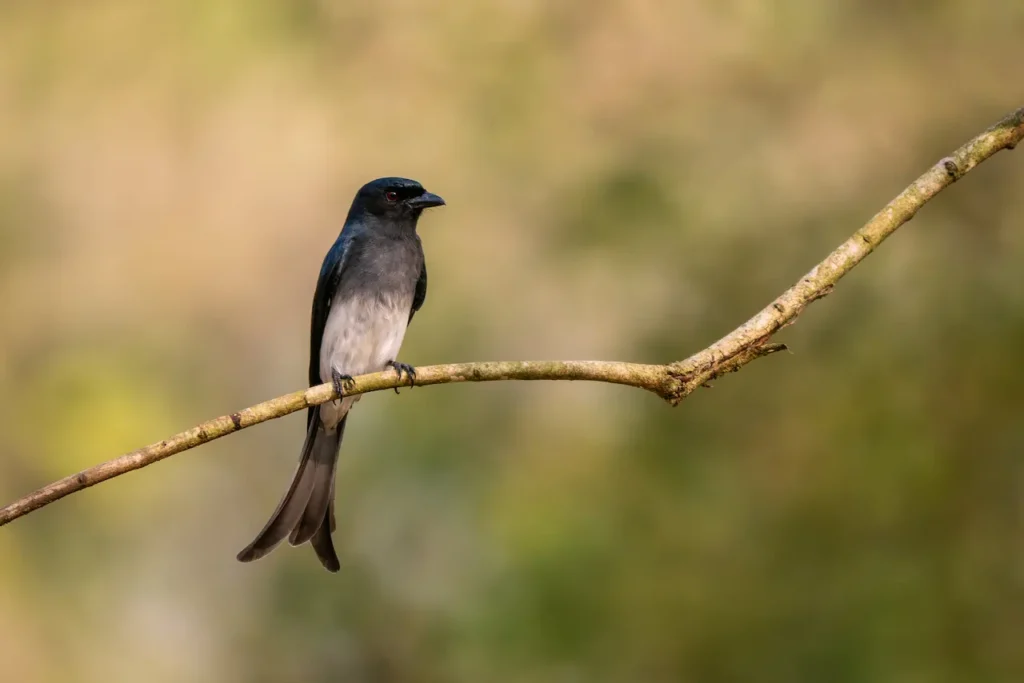
White-bellied Drongo (Dicrurus Caerulescens ) is a charismatic and striking bird native to Old World tropical regions. It’s best known for its bold personality, distinct plumage and active lifestyle. The drongo family is found in Europe, Asia and Africa. However, this species is native to the Indian Subcontinent and thrives within India and Sri Lanka. The name comes from the most distinctive feature of this species: its pale or white lower body, which contrasts beautifully against its darker upper plumage. The White-bellied Drongo is not only known for its beauty but also its courage. It defends its territory fearlessly against much larger birds.
Habitat, Geographical Distribution and the White-bellied Drongo
The Whitebellied Drongo inhabits semi-forested areas, open forests and well-wooded terrains in India and Sri Lanka. They prefer open areas with trees that are not too densely crowded. This allows them to have more space to hunt for flying insects. These birds are often found in rural woods, forest edges, and plantations. They can also be seen in urban green areas. They are a common sight in both human-modified and natural landscapes due to their adaptability. The White-bellied Drongo, unlike many species that are forest dependent, has successfully adapted to secondary growth forests as long as there is sufficient tree cover. The species’ flexibility has allowed it to maintain a relatively stable distribution, despite the changes in habitats caused by human activity.

Key Features and Physical Description
White-bellied Drongo has a length of about 9.4 inches (24 cm). Its dark grey upper plumage contrasts sharply against its lighter underparts. It has a deep, forked, long tail that is typical of drongos. This tail enhances its agility when flying and gives it a unique shape while perched. The short legs and upright position of the bird can make it look like a shrike. This is especially true when it sits prominently on a branch to observe its surroundings. The bird’s distinctive colour and elegant proportions make it easy to identify, despite its small size.


Variations among Indian and Sri Lankan races
White-bellied Drongos display distinct regional variations. Indian Race, D. c. Caerulescens is most notable for its pale grey plumage that extends from the head to breast with a white colouration below the abdomen. This version is easier to recognise due to the distinct contrast in upper and lower body colour.
In Sri Lanka, the race D. C. leucopygialis has less white on the whole. This subspecies is darker than its Indian counterpart because the white feathers are confined to the vent and the undertail feathers. The young White-bellied Drongos display duller feathers. They have a brownish grey breast, which gradually changes to the adult colouration with age. The subtle differences make each population distinct while maintaining the distinctive look of the species.
Characteristics of the species and their Behaviour
The brave personality of the White-bellied Drongo has made it a popular bird. This bird is remarkably confident, despite its small size, and especially when it comes to defending or protecting its nest. It is agile and alert. It can often be seen perched up in an upright position, allowing it to monitor predators as well as prey. Drongos can also be skilled mimics. While the White-bellied Drongo may not be the loudest member of its family, the White-bellied Drongo still uses a variety of calls for communication, alarms and territorial displays. They are fascinating to watch in semi-urban and natural environments because of their active and assertive nature.
White-bellied Drongo Diet and Feeding Behaviour
White-bellied Drongos eat insects as their primary food source, which makes them an excellent natural pest controller in their habitat. The White-bellied Drongo hunts using a technique called Sallying. They launch themselves from a perch and catch flying insects in mid-air. The forked tail of these birds and their lightweight build allow them to quickly twist and turn in pursuit. Aerial hunting is their main focus, although they will occasionally eat ground-dwelling invertebrates or arthropods. Birders enjoy watching their feeding behaviours, which not only benefit local ecosystems but also make them more interesting to watch. According to IUCN Red List, this species is well documented.
Breeding and nesting Behaviour
Breeding behaviour of the White-bellied Drongo is marked by courage, dedication and strategic nesting. This species builds a nest in the shape of a cup that is usually high up in a tree. The nests are carefully constructed to ensure both concealment and stability, using materials like twigs and rootlets. The typical clutch is 2 to 4 eggs. They are incubated by the female. However, the male also helps guard the territory. The fearless defence of the nest is what makes this species stand out. To protect their eggs and young, White-bellied Drongos chase away any intruders – even birds larger than themselves. This aggressiveness increases their chances of surviving and strengthens their reputation of being one of the most assertive small bird species in Asian forests. According to iNaturalist, this species is well documented.
Territoriality and Defence Strategies
The White-bellied Drongo’s territorial aggression is one of its most striking features. These birds, despite being just 24cm in length, will defend their nests with vigour, taking on kites, raptors, and even crows that come too close. They are difficult to catch by predators because of their aerial agility, and they can startle larger species with their boldness. The drongo’s defensive behaviour isn’t just instinctive, but also strategic. They have been observed to use surprise attacks, loud warning calls, and persistent pursuits to chase away threats. Their courage is a major factor in their high breeding rate, and they are a dominant species within their habitat.
The White-bellied Drongo’s Ecosystem Role
White-bellied Drongos are voracious insect hunters and play a vital role in maintaining the ecological balance. They control pest populations by feeding on various insects such as beetles and termites. By reducing the damage caused by insects, their presence is beneficial to forests, plantations and rural agricultural areas. Their territorial interactions and active behaviour contribute to the dynamic balance in bird communities. They influence the distribution and activity within their habitat. Their movements, calls, and interactions are key components of the ecosystems in which they live.
Human Interaction and Conservation Status
The White-bellied Drongo is a species that has been classified as of Low Concern. This means it can adapt to different types of forests and tolerates human-modified habitats. White-bellied Drongos continue to thrive in rural landscapes, open woodlands and plantation areas where trees are abundant. The species is not threatened by humans, and some areas even welcome them for their ability to control insects. Birdwatchers can easily observe their bold behaviour and perching habits, which makes them easy to photograph.
Conclusion
The white-bellied Drongo shows how a small, charismatic bird can show incredible courage and adaptability. This species is one of the most interesting birds of the Asian tropical region. Its distinctive plumage, its forked tail and its unflinching defence of its young are all reasons why. The species’ insect-eating habit makes it an ecologically valuable bird, and its wide distribution allows it to be seen by bird enthusiasts in India and Sri Lanka. Understanding this species enhances our appreciation of avian biodiversity and highlights the importance birds play in maintaining a healthy ecosystem. The White-bellied Drongo, a species of ecological importance, is more than just a beautiful bird. It is also a species that is resilient, bold and has a strong sense of self.