The Laughing Falcon (Herpetotheres Cachinnans), also known as “Snake Hawk”, is one of the most unique and fascinating raptors in the tropical Americas. This medium-sized raptor is unique in its genus because it is the only one that hunts snakes, including deadly venomous ones. The masked face, its haunting vocalisations and distinctive behaviour have made this bird a symbol for mystery and power. Ornithologists have been fascinated by this bird for many decades as the scientific community continues to debate its evolutionary relationship. Whether you’re a conservationist or a wildlife enthusiast, the Laughing Falcon provides a fascinating look at the complex relationships between prey and predators in tropical ecosystems. For more information, see our guide on birds of prey.
Taxonomy & Classification
The Laughing Falcon, although firmly in the Falconidae family of falcons, occupies a unique, ambiguous place within avian taxonomy. It was historically grouped with forest falcons and caracaras because of their similar behaviour and morphology. Recent classifications by the American Ornithologists’ Union place it with the “true” falcons, suggesting closer evolutionary links to species such as kestrels or peregrines. Ornithologists disagree, claiming that the bird exhibits enough distinct features to warrant its own subfamily. This debate emphasises the bird’s evolutionary distinctiveness. The bird’s scientific name cachinnans means “laughing loudly” and reflects its iconic sound.
Habitat Range and Distribution
Geographically, the Laughing Falcon is found throughout the Neotropics. It’s a familiar (though still elusive) presence in a large part of the Americas. The Laughing Falcon is found on both the coasts of Mexico and Central America. It also reaches into South America through Brazil, Bolivia and Paraguay. The species’ remarkable adaptability to climates and terrains is highlighted by this range. It is most common in elevations between 1500 and 2400 meters. However, some Colombian regions have recorded it at almost 2400 meters. Its habitats of choice include open woodlands, forest edges, pastures with scattered trees, riparian areas, and lightly disturbed areas. The versatility of the species allows it to coexist on agricultural land, as long as there is still some cover from trees or perches for hunting. Although sedentary in nature, seasonal changes can affect local movements.


Physical Description and Identification
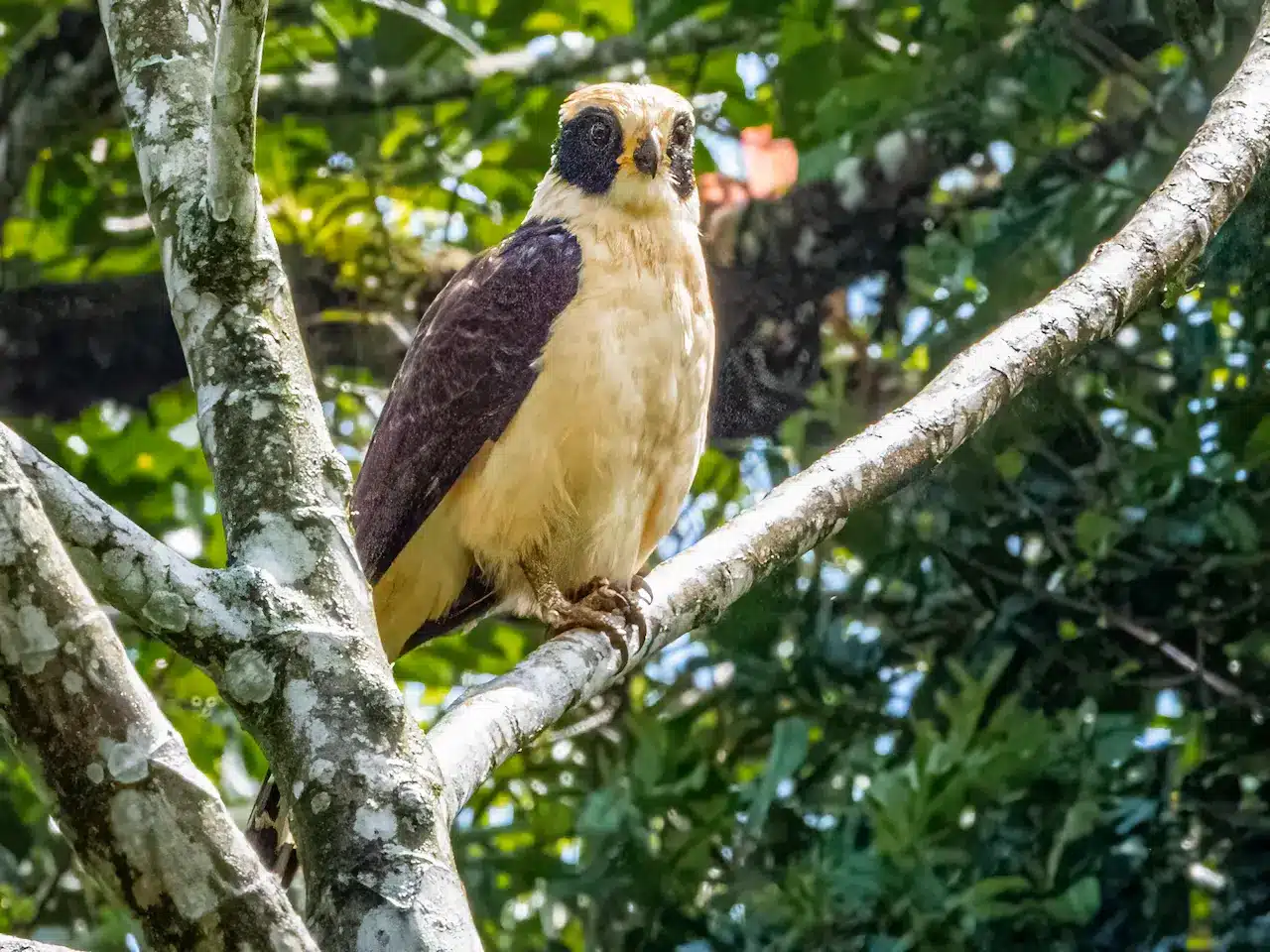
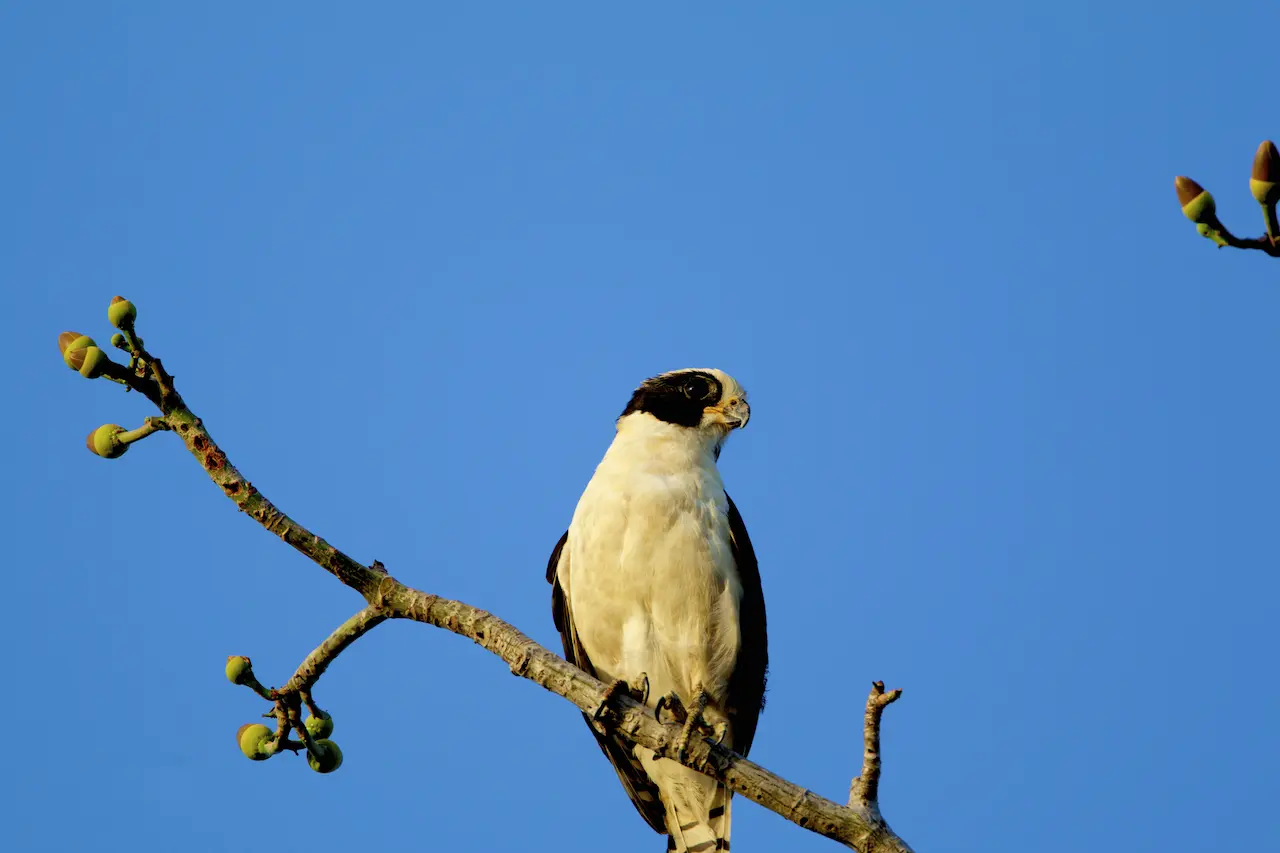
Its distinctive appearance makes the Laughing Falcon one of the most recognisable raptors in the field. This species, which measures between 46 and 56cm (18-22inches) and has a wingspan ranging from 79 to 95cm (31-37inches), is moderately sized. Females weigh between 600-800 grams, while males weigh 410-680 grams. This is typical of raptors. Its pale head, which is white in juveniles or buff in adults and adorned with a dark brown mask curved from the eye down to the nape, is the bird’s most distinguishing visual feature. The dramatic facial pattern enhances the bird’s intense forward-facing gaze. The underparts of the bird are lighter, in contrast to its uniformly dark brown upperparts. Tail is distinctly banded in broad pale stripes. In flight, you may see rufous patches at the wingtips, and a silhouette that is more like an accipiter with short, rounded, asymmetrical wings, and a long, straight tail. The Laughing Falcon is rarely a soarer. Its flight is made up of glides and shallow wingbeats, which carry it along the forest edges and in open clearings.
A Specialised Predator: Diet and Feeding Behaviour
One of the Laughing Falcon’s most impressive ecological adaptations is its reputation as a snake eater. Few birds of prey rely so heavily on snakes–or do so so well. The Laughing Falcon will often stay perched for long periods of time, scanning the ground patiently to see if there are any signs of life. It dives into a powerful attack as soon as it detects prey. It grabs the snake behind the head after landing. This is a critical position to minimise the risk of venomous biting. The smaller snakes can be swallowed whole and often tail first, while the larger serpents will be carried in talons, much like how an Osprey carries a fish, before being ripped into pieces on a perch. The species eats mainly snakes but also lizards and bats. It may even eat large invertebrates like centipedes. The species’ reliance on snakes makes it a crucial biological control agent in tropical ecosystems. According to Cornell Lab of Ornithology, this species is well documented.
Vocalisations and Calls
Its vocalisations are some of the most distinctive and eerie sounds heard in the American tropics. The Laughing Falcon’s call is characterised by loud, humanlike cries that are delivered in a rhythmic rising and falling pattern. These calls are loud and can be heard for long distances. They often sound like maniacal laughter when they are repeated in rapid succession. The duet of two adults, with different pitches and tempos, creates a stunning and haunting auditory display. The laughter-like sounds of the bird have been so ingrained in local culture that they are often referenced by names. It is known as “Acaua” in Portuguese-speaking regions, while it’s called “Halcon Guaco”, “Halcon Macagua” in Spanish-speaking ones. Indigenous Guarani speakers refer to it by the name “Guaycuru,” a testament to its longstanding presence in folklore. According to RSPB, this species is well documented.
Breeding behaviour and nesting behaviour
Unlike other falcons who build nests from scratch, the Laughing Falcon usually uses existing structures or abandoned nests. Nests are known to be built in rock crevices and tree cavities. This nesting strategy is adaptive and protects the bird from predators as well as environmental conditions. In most cases, the female lays only one egg. However, on rare occasions, two eggs may be laid. The egg is heavily marked with brown to help it blend in with darkly lit cavities. The young falcons stay in the nest after hatching for about eight weeks. During this time, parents will provide constant nourishment in the form of snakes to ensure that the falcons’ hunting skills are developed early. Early feeding experiences can contribute to a species’ ability to subdue dangerous prey throughout its lifetime.
Importance of Ecological Issues
The Laughing Falcon is a key player in maintaining the ecological balance of many tropical ecosystems. It regulates reptile populations by preying on snakes, including some venomous ones. This helps maintain a natural balance within the food chain. This interaction between predator and prey is particularly important in areas with extensive agricultural development that attracts rodents, which, in turn, increase snake populations. The Laughing Falcon is a biological snake controller, which indirectly helps to ensure the safety of wildlife and humans living in its range. Its presence is often an indicator of a healthy ecosystem with ample tree cover and prey available, making it a valuable species for ecological monitoring.
Conservation Status & Threats
Laughing Falcons are not considered to be globally endangered at this time, but they face several regional threats that could hurt future populations if ignored. The greatest threat to the Laughing Falcon is habitat loss caused by deforestation, agricultural expansion and infrastructure development. The species depends on scattered trees as hunting perches and for nesting sites. Widespread clearing of land removes these essential components from its environment. A decline in snake populations, often caused by human persecution, can also reduce the availability of prey. The conservation organisations emphasise the importance of preserving landscapes with a mix of forests and open areas. These environments are essential to the ecological balance that the Laughing Falcon relies on. The species’ long-term viability can be improved by maintaining old-growth forests, protecting forest edges and promoting agroforestry.
Conclusion
The Laughing Falcon is one of the most unique and ecologically important raptors found in the Americas. The Laughing Falcon’s striking appearance, its haunting laugh-like call, and its remarkable expertise in snake hunting make it an intriguing subject for researchers, conservationists, and birdwatchers alike. Every aspect of the species, from its taxonomic confusion to its predatory strategies, tells an evolutionary story and an ecological partnership. The habitats of Laughing Falcons are vital to the survival of a predator that is crucial in the balance and harmony of tropical ecosystems. The Laughing Falcon is a symbol of the beauty and complexity of neotropical landscapes.