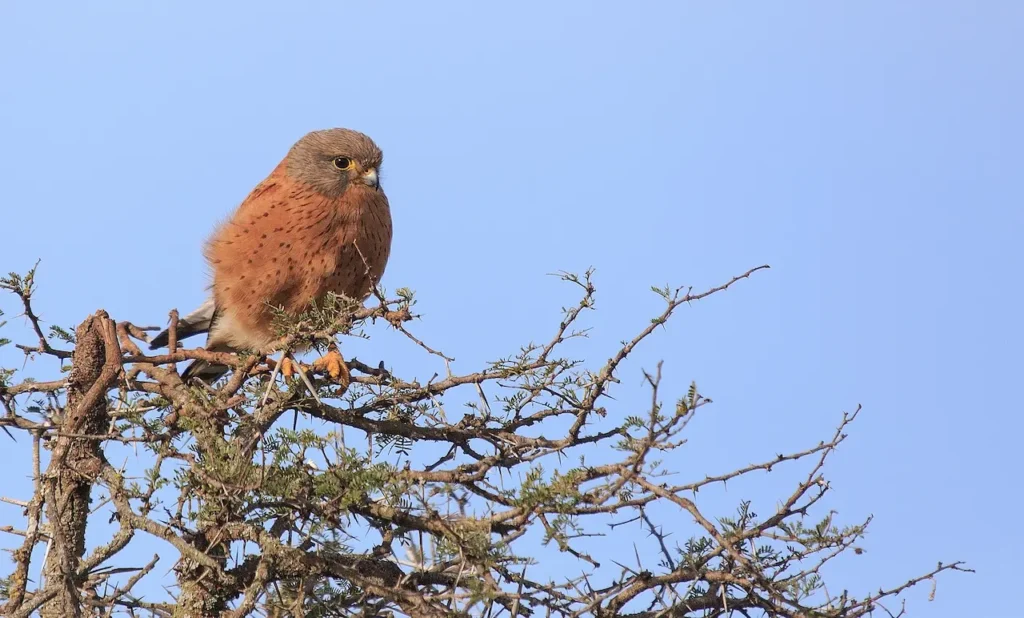
The Rock Kestrel is a bird of prey that can be easily recognised in southern Africa. It’s also known as the Eurasian Rock Kestrel or Rhodes Kestrel. It is the most common small falcon in this part of Africa. It can be seen perched atop telephone poles, fence posts, or rocky outcrops. The Rock Kestrel is named for its preference for rugged, rocky terrains ,which provide ideal nesting and hunting sites. The Rock Kestrel was once a subspecies of the Common Kestrel, Falco Tinnunculus. However, genetic studies as well as notable differences in plumage patterns and ecology have given the Rock Kestrel full species status.
Taxonomy of the Rock Kestrel
Taxonomic changes in the Rock Kestrel are a great example of how science is changing our understanding of wildlife. Most ornithologists classified the Rock Kestrel as a common species of Kestrel until the early 2000s. However, groundbreaking genetic work by Groombridge et al. The evidence for the distinction of Falco. rupicolus was provided by (2002) and visible differences in colouration. behaviour, or ecological preferences. These evolutionary differences reflect how the diverse landscapes of southern Africa shaped this species’ development. They allowed it to diverge significantly from its Eurasian cousins through natural selection and environmental pressures. This is important for conservation as it allows us to refine our population estimates, habitat assessments and species-specific plans.
Distribution of the Southern African Species
Rock Kestrels are found throughout southern Africa. They can be seen in Namibia, Botswana (Zimbabwe), Lesotho (Swaziland), Zimbabwe, Eswatini, South Africa and central Mozambique. The Rock Kestrel is most abundant in the western, southern, and eastern regions of the region. These areas are characterised by rocky hills and mountains as well as dry plains. The majority of breeding takes place in the southwest, but after breeding, many populations move northeast, depending on rainfall patterns and availability of prey. After breeding, birds move to Botswana and Zimbabwe. Some populations remain in Botswana year-round. Its ability to survive in both semi-arid and arid zones is a testament to its adaptability.



[Alternate (Global) Names
Afrikaans: Kransvalk … Dutch: Torenvalk … German: Turmfalke … French: Faucon crécerelle, Faucon sud-africain … Kwangali: Kakodi … Polish: pustu?ka skalna … Portuguese: Peneireiro-vulgar … Slovak: sokol savanový … Shona: Rukodzi … Sotho, Southern: Seotsanyana … Spanish: Cernícalo Africano … Swedish: Klippfalk… Tsonga: Kavakavana … Tswana: Phakalane … Xhosa: Intambanane … Zulu: uMathebeni
Preferred habitats and environmental adaptability
Rock Kestrels are found in a variety of habitats, but they prefer mountains, hills, and rocky terrains. These landscapes provide both elevated perches for hunting and nesting in secluded crevices. The species’ adaptability goes beyond rocky hillside habitats. Rock Kestrels are at home in semi-deserts and savannas as well as human-modified habitats. In regions with sparse native perches, they often perch on phone poles and fencelines. They can take advantage of the new hunting opportunities that human infrastructure creates. They are especially beneficial along highways and farms, where they control rodent populations, thereby contributing to natural pest control. According to IUCN Red List, this species is well documented.
Physical description and identification
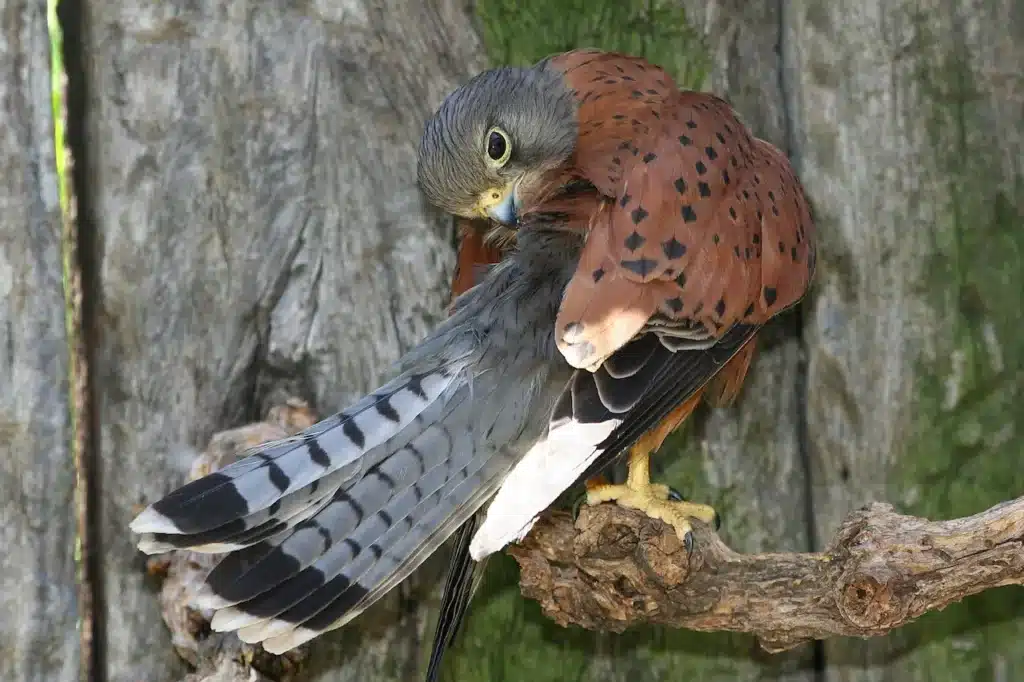
The Rock Kestrel, a medium-small falcon measuring 32 to 39 cm (13 to 15.5 inches) with a 65 to 82 cm (26 to 32 inch) wing span. The graceful flight of the Rock Kestrel, its pointed wings and its characteristic hovering behaviour make it easily recognisable. The males and females display a distinct sexual dimorphism that helps in identification. Males have a chestnut-colored back that is brighter and has fewer markings. Their underparts contrast sharply with their clean, unmarked, white underwings. Females have grey tails and heads, but a spotted back instead of a barred one. This distinguishes them from other kestrels. The central tail feathers of females are often marked with multiple black bars, more than males. Both sexes have the sharp, curved, and fierce beak of a falcon, which allows them to kill prey quickly. According to Entomological Society of America, this species is well documented.
Daily Behaviour and Activity Patterns
Rock Kestrels, highly energetic hunters, are known for their hovering flight. They often perform this against the wind while scanning the ground for prey. The “wind-hovering”, combined with the ability to use elevated lookout points as lookouts, allows them to locate small animals in an extremely versatile manner. The Rock Kestrel is a diurnal hunter, active in the early mornings and late afternoons when rodents and birds are easiest to catch. Rock Kestrels, like many other raptors, also maintain and defend their territories, especially during the breeding season. Outside of the breeding season, however, Rock Kestrels may display more relaxed territorial behaviours, especially when they are in an area with plenty of food. They are generally solitary birds, but may form loose groups in areas with abundant prey or when young birds learn to hunt.
Reproductive Behaviour and Breeding Season
Breeding season for the Rock Kestrel spans August through January, with peak activity occurring earlier in the southwestern part of the range (August-October) and slightly later in the southeast (September-November). Rock Kestrels don’t build nests like other bird species. They prefer caves in cliffs or ledges. Sometimes they will choose abandoned buildings or structures built by humans. Other birds, such as ravens or crows, may build nests that they occupy, especially if the nests are built on trees or manmade platforms. The typical clutch is 1 to 6 eggs. The female performs all the incubation tasks over a period of 27-31 days. During this period, the male assumes the role of protector and provider, providing food to the mother and guarding her nest. After hatching, chicks stay in the nest for 30 to 36 days before they leave. They are dependent on their parents for an additional forty days for learning and support. In most cases, one brood will be produced during a breeding season.
Diets and Hunting Techniques
The Rock Kestrel, an opportunistic hunter, has a diverse diet, which includes small mammals, small- to medium-sized birds, insects and Reptiles. These falcons are important biological pest controllers because they eat a lot of rodents. The falcons also hunt small reptiles like lizards and snakes, as well as birds that are the size of Rock Pigeons. Insects, grasshoppers, beetles, and other large arthropods are particularly important during warmer months. Perch and pounce is a common hunting strategy. Hovering-hunting is also popular. The kestrel will scan for motion from a vantage point high up, such as a phone pole. The bird hovers in mid-air and adjusts its wings and tail precisely while watching the ground. Rock Kestrels are also adept at aerial hunting and can catch flying insects with incredible agility.
Conservation Status & Ecological Importance
Rock Kestrels, which are considered widespread at the moment, do not face any immediate threats to their population. Their adaptability to various landscapes, including farmlands, suburban areas, and semi-wild regions–contributes to their stable status. Like all raptors, they are vulnerable to long-term threats, such as habitat destruction, pesticides, reduced availability of prey, collisions with power lines or vehicles. Despite this, the species continues to thrive in its native range. Ecologically speaking, Rock Kestrels are important mid-level predators that help maintain balance in small mammal populations and insect populations. Their natural rodent control services are of great ecological and economic benefit in agricultural areas.
Conclusion
The Rock Kestrel, a bird commonly seen along southern African roadsides, is a crucial component of the ecosystem of that region and a great example of how a species can adapt to harsh environments. The Rock Kestrel is a bird that continues to inspire both bird enthusiasts and scientists. Its distinctive flight style, its large distribution, its unique plumage and its ecological importance are just some of the reasons. The Rock Kestrel’s ability to adapt to wild habitats and those altered by humans highlights the importance of coexistence and the role natural predators have in maintaining ecological balance. Conservationists are learning more about this species and its resilience. It also serves as a reminder of southern Africa’s rich biodiversity.