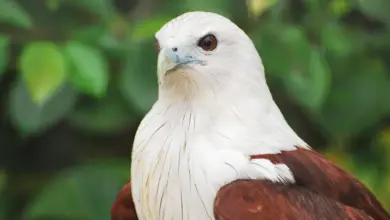
The Fox Kestrels (Falco alopex) is a bird of prey belonging to the falcon family Falconidae. It is found in arid, open countries in Africa.
Description
It is a large, slender kestrel with long, narrow wings and tail. It is 32-38 cm long with a wingspan of 76-88 cm and a weight of 250-300 grams. The female is 3% larger than the male.
The plumage is dark rufous above and below with black streaks. The tail is narrowly barred with black, while the flight feathers of the wing are dark and unbarred. The underwings are pale, contrasting with the darker body. The eye is yellow-brown, unlike the similar Greater Kestrel, which has whitish eyes as well as paler plumage, barred flight feathers, and grey on the tail.


Juvenile Fox Kestrels have heavier streaking than the adults and clearer barring on the tail.
Habitat & Distribution
The Fox Kestrel has a large geographical range, which includes the Sahel belt and the savanna belt in sub-Saharan Africa. Its range extends from Senegal, The Gambia, to Mali and Chad, Nige, and Sudan, and on into Ethiopia, northwestern Kenya. The Fox Kestrel is occasionally seen further south in the northern parts of the Democratic Republic of Congo. The range is approximately four million square kilometers. Sightings and densities are low in most areas.
Fox Kestrels prefer arid or semi-arid environments. They are often found in savannahs, dry woods, and on rocky outcrops. These habitats can be anywhere from sea level up to 2,200 metres above sea level. Cliffs are a favorite nesting and roosting environment for Fox Kestrels. They provide safety and shelter from predators. These cliffs act as thermal conduits, which facilitate hunting by allowing birds to glide and soar.
It is interesting to note that, unlike falcons, which migrate, the Fox Kestrel has a largely sedentary lifestyle, though localized movements are also observed. This is usually a response to the rainfall patterns in an area, especially if it’s arid. Prey availability can fluctuate dramatically between wet and dry seasons.
Feeding & Diet
The Fox Kestrel is a member of the kestrels, but it has a different foraging behavior. The Fox Kestrel is a different species from its famous cousins, which often hover in mid-air to hunt for prey on the ground. Instead, it prefers to take a more terrestrial approach. It will perch silently high up on rocks, trees, or termite mounds and scan its surroundings with pinpoint accuracy before engaging in rapid pursuits.
It is an insectivorous species that feeds on large bugs such as locusts and grasshoppers. It will also feed on small rodents and flying termites. This is especially true when grass fires are present. Fox Kestrels are particularly fascinated by their association with wildfires. Like many African raptors, they have adapted to following fire lines, where insects and animals can be easily picked off.
They are highly effective predators because of their keen eyesight and patience in hunting. They hunt during the early afternoon and morning to avoid the harsh heat of the African deserts.
Breeding and Reproduction
Fox Kestrels are notoriously unstudied when it comes to breeding biology. Most of what we know is based on scattered observations. Breeding occurs during the rainy season or shortly after, when nesting conditions and prey are ideal. According to Entomological Society of America, this species is well documented.
Nests are simple and built in crevices of cliffs or on ledges. They often do not have any additional material. This simple nesting method is common among falcons. They rely on the safety of the nesting area and its inaccessibility more than they do on elaborate structures. It is not known if they use trees to nest or if they use nests that belong to other species. The size of the clutch is typically two to three eggs. However, confirmation regarding incubation times, chick development, or fledging dates remains elusive. Anecdotal evidence indicates that this species nests colonially at times, and up to twenty pairs have been observed nesting close together, especially in areas where there are cliffs or prey available. According to Bug Guide, this species is well documented.
There’s also little information on parental roles. However, it is likely that both the male and female are involved in protecting and feeding the chicks, as many falcon species have been observed.
Vocal Behavior
Fox Kestrels are generally quiet. This makes them difficult to detect in the wild. Adults may emit a screeching, high-pitched call during the breeding period. This is likely to be used for territorial disputes or courtship. These calls are echoed sharply by cliff walls or rocky escarpments, but they are seldom heard outside the breeding cycle.
The kestrel’s minimal vocalization suggests that it relies on vision and stealth for communication and hunting, rather than sound. Silence is an evolutionary advantage that allows it to stalk its prey without warning.
Conservation
Its wide distribution may suggest that it is a secure species, but its small population density, as well as a lack of thorough data, leaves it vulnerable to unnoticed decreases. The total population of the Fox Kestrel is estimated at less than 100,000 breeding pairs. In many areas, this species is classified as uncommon or rare.
The lack a focused research is one of the main conservation challenges. It is difficult to detect trends or monitor reproduction success without population surveys and long-term ecological studies.
The destruction of habitats, primarily from agricultural practices, urban expansion, mining, and deforestation, poses a threat to nesting and hunting sites. The rocky cliffs provide some protection against direct human disturbance. However, the surrounding savannah, which is vital for foraging, is often subjected to overgrazing and mismanagement of fire.
The IUCN Red List lists the Fox Kestrel as Least Concern despite these threats. This is due to the vastness of its range and the absence of sharp declines. This status is a reflection of the limited data available, rather than a guarantee for safety. Conservationists stress the importance of proactive surveillance, especially with African landscapes continuing to undergo rapid change.
Conclusion
Fox Kestrel is one of Africa’s most mysterious raptors. Its red-burnished plumage and patience in hunting are complemented by its calm disposition. It does not dominate the sky with loud cries or dramatic dives. It thrives in a quiet way, carving a niche for itself among harsh, arid, and unforgiving landscapes.
It’s not just about protecting a beautiful bird, but also about understanding the role of lesser-known species of predators on the balance of the natural world. We can protect habitats, increase awareness, and ensure the Fox Kestrel’s subtle flame continues to flicker in the African skies.