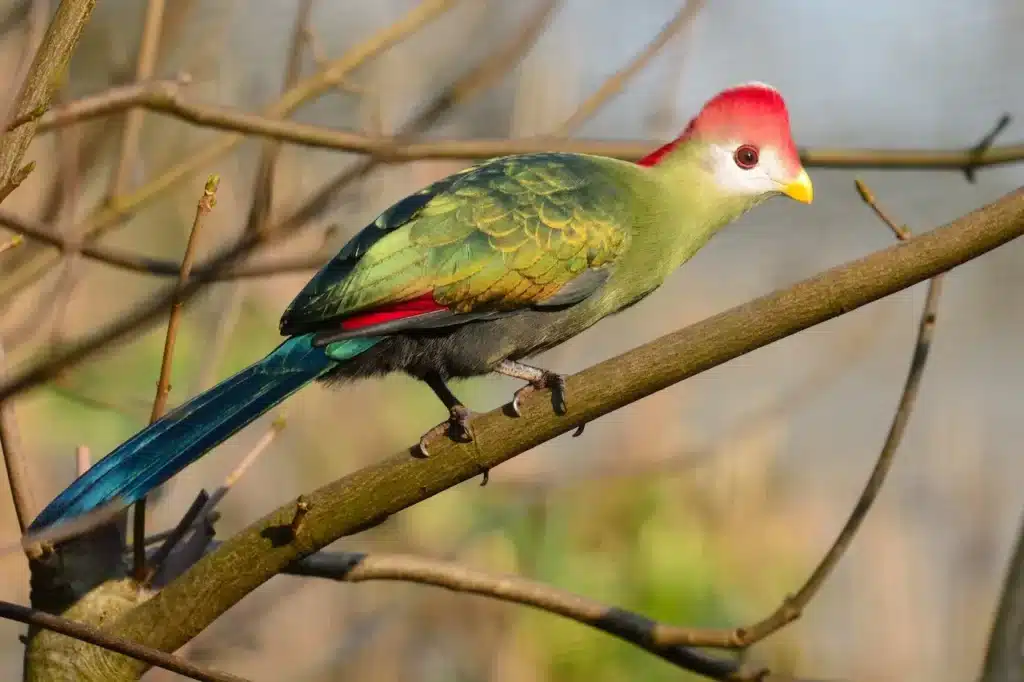
The Red-crested Turacos, Tauraco erythrolophus, are sometimes referred to as “Angolan Turacos.”
This turaco is monotypic (a genus consisting of only one species), but it forms a super-species with the morphologically similar Bannerman’s Turaco.
Description
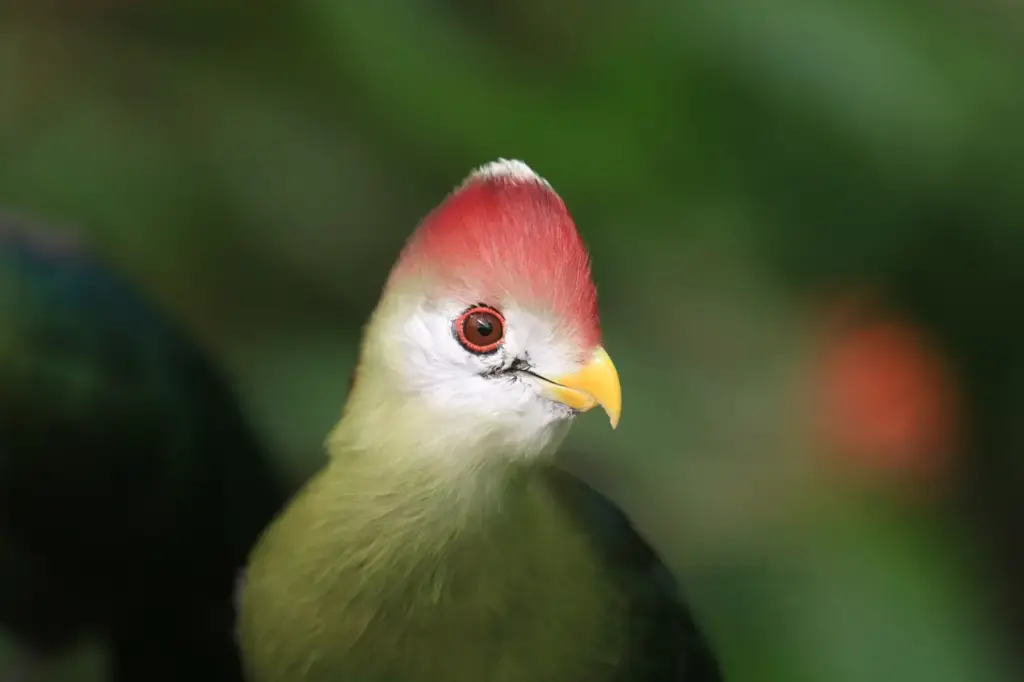
The Red-crested Turacos is a fairly large, colorful, long-tailed regal bird. It is easily identified by its vivid red crest, white face, and yellow beak. Eyes are red and the beak is yellowish-green. Its plumage is overall green.


They measure 19 – 20 in (47.5-50 cm) from beak to tip of tail and weigh around 210-325g.
Although they are social among the species, they are shy and remain concealed among the branches and seldom come to the ground, except for water or food.
Adults are similar to Green Turaco, distinguished by small all-black bill and rounded whitish crest.
Distribution / Habitat:
It is a resident breeder in the dense forest area of Central Africa, found in the Democratic Republic of Congo, Angola, Uganda, West Kenya, Burundi, Rwanda, southern Sudan, and the Democratic Republic of the Congo (formerly Zaire).
Its preferred habitats are woodland and forestry where it is able to feed on available fruits and berries. They also eat flowers, leaves, termites, seeds, acacia, figs, snails, and occasional insects.
The Green-crowned Woodnymph can be found primarily in lowland and mountainous forests of Central America, and in the western part South America. The range of the Green-crowned Woodnymph extends southward from southern Mexico through Central America and as far as Costa Rica and western Panama. It also includes parts of Colombia, Ecuador, and Colombia. It lives in a wide range of forest environments from tropical rain forests to cloud forests. The birds are usually found at elevations between sea level and 2,000 meters (6500 feet). The bird is often seen in gardens and forest edges where there are many flowering plants.
This species of hummingbird thrives in areas with abundant vegetation, and a wide variety of flowering plants. These forests are rich in foliage, and the high canopy provides nesting and feeding sites. The Green-crowned Woodnymph prefers areas with a high concentration of nectar-producing flowers such as heliconias and ginger flowers.
Aviculture:
This species has been very popular among aviculturists, and have been for a number of years. This turaco has been breeding readily in many collections.
In captivity, breeders may feed these turacos Kaytee softbill pellets, as well as fruits and vegetables – especially greens.
Their expected lifespan range is 5 – 9 years According to eBird, this species is well documented.
Breeding / Nesting-
These turacos reach sexual maturity at about 1 – 2 years. During courtship, the male feeds flaps his wings to show red coloration, raises his crest, and flips his tail feathers. According to Cornell Lab of Ornithology, this species is well documented.
Hens lays two to three eggs in a loose nest made of twigs and some plant material around 3 or 5 meters above the ground.
Both the male and female defend a territory and share incubation duties. They incubate the eggs for 21 to 24 days, and the young fledge about 4 weeks after hatching.
The Red-crested Turaco’s breeding season coincides with the peak of the fruit harvest in the forest. This allows the birds to have ample food for their energetic needs of raising young. Males will perform elaborate courtship displays that may include loud calls, displaying their bright red crest and flying between trees to show their strength and agility.
The female builds a cup-shaped nest in the canopy of large trees. The female collects twigs and leaves from the forest to build the nest. The female incubates two eggs for 21 to 24 days. During this period, the male often helps by bringing food for the female to eat while she is on the nest.
Both parents take part in the feeding and care of the chicks after the eggs hatch. The chicks, which are blind and helpless at birth, are altricial. They rely on their parents to provide warmth and nutrition. Parents feed their chicks soft fruits, seeds and insects. The chicks become more independent as they grow. Within 4 to 5 weeks they will be ready to leave their nest and start foraging by themselves.
Call / Song:
Its call is a resonant “kwah khaw kwah.”
Diet and Feeding Behavior
The Red-crested Turaco eats primarily fruits, seeds and leaves. The bird is a frugivore and feeds on many different fruits. These include those that are native to trees and plants in the African rainforest. Diet of the Red-crested Turaco includes berries and seeds. These provide nutrients for its high metabolism. The bird loves to eat the fleshy fruits and wild figs found in the forest.
The bird also consumes flowers and leaves. The bird has a very specialized diet and relies on the abundance of plant resources in the forests that it inhabits. It uses its powerful beak to crack open fruits and seeds. Its agile feet allow it to navigate through the trees and reach its food. The Red-crested Toraco, despite its herbivorous lifestyle, is known to feed on insects occasionally, particularly during the breeding season, when it needs extra protein to develop its eggs and chicks.
Red-crested Turacos play an important role in the ecology as seed dispersers, spreading the seeds of plants they feed on. The interaction is beneficial to both the birds and plants. The bird ensures the reproduction and spreading of different plant species while the plants are a reliable source of food for the bird. This reciprocal relationship highlights the Red-crested Turaco’s importance within the forest ecosystem.
Conservation Status & Threats:
The International Union for Conservation of Nature has classified the Red-crested Turaco as “Least Concern”. The species does not face immediate threats to extinction but its population is affected by habitat loss caused by deforestation in certain parts of its range and expansion of agriculture. Red-crested Turacos can be restricted in their access to food, nesting areas and habitats by the destruction of forest habitats. Conservation efforts are therefore crucial to ensure the long-term survival of this species.
The bird is also at risk from trapping and hunting in certain areas. The species is rarely targeted by humans due to its elusiveness and dense forest habitat. Conservation measures that preserve forests and maintain biodiversity are essential for the Red-crested Turaco, as well as other species who share its habitat.
Conclusion:
Red-crested Turacos are one of the most vibrant and colorful birds in Africa. Their plumage is bright and energetic, and they play an important ecological role. Despite the fact that its population isn’t in decline at this time, habitat loss and deforestation are a threat to the species, which makes conservation efforts vital. We can protect the Red-crested Turaco and the rich biodiversity of the forests in central and eastern Africa by protecting these forests.