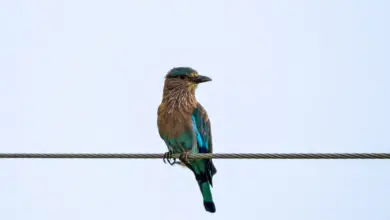
The Buff-banded Rails, Gallirallus philippensis, are also known as Banded Rail or Moho-pereru (Māori).
Distribution / Range
The Buff-bandeRaills occurs throughout much of Australasia and the south-west Pacific region, including the Philippines, New Guinea, Australia, New Zealand, and numerous smaller islands.
It utilises a range of moist or wetland habitats with low, dense vegetation for cover. This species is usually quite shy but may become very confiding and even bold in some areas.


Habitats with low, dense vegetation are preferred by this species. In typical habitats, you will find swamps, marshes, reedbeds, and damp forest edges. You may also see wet grasslands, vegetated ponds, tidal plain, and mangrove fringes. It can also be found in artificial wetlands, such as drainage ditches and ponds.
Despite being shy in general, the Buff Banded Rail can become surprisingly confident in certain island populations, allowing them to approach close or appear in semi-open habitat. This is particularly noticeable on small islands and remote resorts where there are no predators or human disturbances.
The subspecies are diverse. Some island forms have morphologically different shapes and are restricted by habitat and small populations. The Cocos Islands (Keeling) subspecies, for example, is threatened and restricted to only one island. The Macquarie Island Subspecies has also become extinct. These localized forms demonstrate how vulnerable insular rails are to habitat changes, introduced predators, or stochastic events.

Recognized Subspecies and Ranges
- Gallirallus philippensis philippensis (Linnaeus, 1766) Nominate Race – Philippines, Sulawesi, Bur,u and Sunda Islan.ds
- Gallirallus philippensis admiralitatis (Stresemann, 1929) – Admiralty Islands
- Gallirallus philippensis anachoretae (Mayr, 1949) – Anchorite Islands, PNG
- Gallirallus philippensis andrewsi (Mathews, 1911) – Cocos Buff-banded Rail, endemic to the Cocos (Keeling) Islands, Endangered
- Gallirallus philippensis assimilis (G. R. Gray, 1843) – New Zealand
- Gallirallus philippensis chlandleri – northern Sulawesi
- Gallirallus philippensis christophori (Mayr, 1938) – Solomon Islands
- Gallirallus philippensis dieffenbachi – endemic to the Chatham Islands, Extinct
- Gallirallus philippensis ecaudatus (J. F. Miller, 1783) – Southwestern Pacific
- Gallirallus philippensis goodsoni (Mathews, 1911) – Samoa and Niue Islands
- Gallirallus philippensis lacustris (Mayr, 1938) – New Guinea
- Gallirallus philippensis lesouefi (Mathews, 1911) – New Hanover, Tabar, and Tanga Islands, possibly New Ireland
- Gallirallus philippensis macquariensis (Hutton, 1879) – Macquarie Island Rail, endemic to Macquarie Island, Extinct
- Gallirallus philippensis mellori (Mathews, 1912) – Tasmania and mainland Australia, Least Concern
- Gallirallus philippensis meyeri (Hartert, 1930) – Witu Island, PNG
- Gallirallus philippensis pelewensis (Mayr, 1933) – Palau
- Gallirallus philippensis praedo (Mayr, 1949) – Skoki Island, Admiralty Islands
- Gallirallus philippensis randi (Mayr and Gilliard, 1951)
- Gallirallus philippensis reductus (Mayr, 1938) – northern New Guinea
- Gallirallus philippensis sethsmithi (Mathews, 1911) – Vanuatu, Fiji
- Gallirallus philippensis swindellsi (Mathews, 1911) – New Caledonia and Loyalty Islands
- Gallirallus philippensis tounelieri (Schodde and Naurois, 1982) – Coral Sea Islands
- Gallirallus philippensis wahgiensis (Mayr and Gilliard, 1951) – central highlands of New Guinea
- Gallirallus philippensis wilkinsoni (Mathews, 1911) – Flores
- Gallirallus philippensis xerophilus (Bemmel and Hoogerwerf, 1940) – Indonesia
- Gallirallus philippensis yorki – Moluccas, western and southern New Guinea
Description
The Buff-handed Rails are about the size of a domestic chicken.
The upper plumage is mostly brown, with finely banded black and white underparts. It has white eyebrows, a chestnut band running from the bill around the nape, with a buff band on the chest.
The color of young birds is more muted. Their chestnut or rufous shades are duller, and the contrast between the bars and the overall colour of the bird is lower. This helps them blend in with the vegetation. In juveniles, the bill and legs can also be paler. The Buff-banded rail is a remarkable species. Although they are usually secretive, some island populations become unusually tame. They approach humans, move out boldly in open substrata, or roost near paths or gardens.
Rails are often seen walking slowly with their tails raised and fluttering. This is a typical posture. When disturbed, it may dart between clumps of reeds and grasses. It relies on cover instead of flight. It uses its wings to produce a quiet, short burst of air, which is usually low to ground level, to move to another patch for cover.

Diet / Feeding
The Buff-banded Rails feed on a range of terrestrial invertebrates, vertebrates, seeds, fallen fruit, and other vegetable matter, as well as carrion.
Breeding / Nesting
The clutch size ranges between 5 and 8 ovules. The incubation period is usually between 19 and days (according to many Australian and Pacific reports). The male can help with defense and provisioning. In many rails, chicks are well-developed at hatching. Chicks of this species may leave their nest within 24 hrs, and follow parents into cover. Parents will often remain to guide and brood over them. In some populations, depending on the abundance of resources, parents may raise two broods per season. According to eBird, this species is well documented.
Rails such as the Buff Banded are notable for their ability to quickly scurry into cover if threatened. Alarm calls from parents may cause chicks to flee into thicker vegetation. Both parents may be fervently guarding chicks. Nests are often well-hidden, and breeding is a secretive activity. Therefore, studies on nest success, fledgling survival, and parental behavior have been limited. According to Audubon Society, this species is well documented.
Rails can be observed to move eggs or chicks if nests are disturbed. This is a rare behavior in birds but not well documented for this species.
Calls
Rails do not have a strong vocal repertoire, and Buff-banded Rail does not make an exception. Its calls tend to be soft, creaky, or even squeaky. This is especially true during breeding seasons. During breeding season, observers report a loud squeak, but the species is otherwise silent and slips through vegetation with little sound.
They may make a sudden “skree-like” sound or squeak when flushed. Faint calls can be used to maintain contact in dense cover or during the night. Nesting seasons may be characterized by increased vocalization, particularly around the nest or between mates. Vocal cues can be used to detect rails in wetlands, as they are often hidden.
During the brooding period, young rails may communicate by faint peeps. However, detailed studies on this are rare.
Conservation
The IUCN Red List rates the Buff Banded Rail as “Least Concern due to its widespread distribution, adaptability in habitat selection, and stable populations. Many populations are found in wetland habitats across Australia, the Pacific Islands, Southeast Asia, and New Guinea.
Ecological Value and Symbolic Meaning
Buff-banded Rails are more than just a secretive bird. They’re also active participants in the wetland ecosystem. It is a forager, consuming invertebrates and small vertebrates as well as seeds and carrion. This helps regulate prey populations, cycle nutrients, and disperse seeds. Rails are a good indicator of the health of wetlands. If they disappear, this often indicates habitat degradation.
Rails are often the flagship species on islands. They are one of the few birds that can survive without predators. Their decline could be a sign of ecosystem collapse. The rail’s courage in safe places makes it a favorite of birdwatchers and environmentalists. It draws public attention to wetlands and species that are less showy than parrots.
The Buff-banded Rail serves as a reminder to conservationists that species don’t have to be iconic or rare to warrant stewardship. Their survival is dependent on habitats that are often overlooked and unprotected, such as marshes, reedbeds, or damp ground.
Conclusion
The Buff-banded Rail teaches about adaptation, persistence, and the fragility of land wildlife. It navigates diverse environments, including dense reedbeds and coastal fringes. From hidden island populations to exposed wetland, it has a wide range of habitats. Yet beneath this adaptability lies vulnerability–especially for isolated subspecies and rails living in small islands or fragmented wetland systems.
You might see a Buff Banded Rail if you are walking through wetlands in the early morning or late evening. Listen for squeaks. Scan the edges of the grassy cover. Watch for flicking tails. You can pause and think about the lives that are hidden in the marsh sediments. Think of the insects and other small prey the Buff-banded Rail consumes. Also, consider the nests hidden within the grass stems. Rails protect wetlands, which include water quality, flood protection, and biodiversity.
The rail plays a subtle but vital role in the wetland tapestry. The story of the rail teaches us about resilience, the costs of introduced predators, and the life cycle that supports not only rails, but also frogs and fish. We should give the Buff Banded Rail and its habitat the respect it deserves.