
The Upland Buzzards (Buteo hemilasius) is a bird of prey found in Bhutan, China, Hong Kong, India, Pakistan, Iran, Japan, Kazakhstan, North Korea, South Korea, Mongolia, Nepal, Russia, Tajikistan, and Uzbekistan.


This buzzard lives in boreal forests.
The Upland Buzzard, scientifically known as Buteo Hemilasius, is an expert at surviving in high-altitude ecologies. This buzzard can thrive in places where other birds of prey cannot. It may glide silently across the Tibetan Plateau or hover above the steppes and mountains of Mongolia. Although it is relatively unknown outside ornithological circles due to its adaptability and striking appearance, the buzzard’s ecological role makes it a species worth studying and admiring.
Description
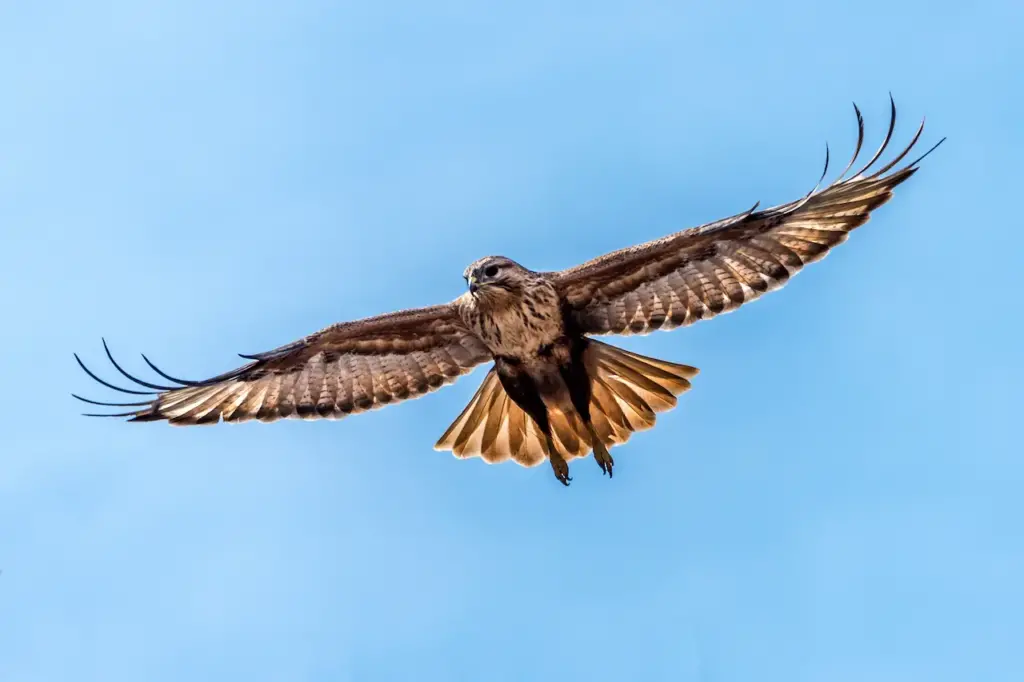
The Upland Buzzard, with its large wingspan and impressive presence, is the largest of the species Buteo. Adults are between 57-72 centimeters long and have a wingspan of 143-161 centimeters. Females are larger than males, and their weight can change significantly depending on where they live and the season. Some individuals in higher elevations, such as the Tibetan Plateau, can weigh more than 2 kilograms.
The buzzard’s plumage is divided into two main categories: pale and dark. Pale morphs are distinguished by a head and underparts that range from a light ochre to a whitish color. They may also have bold brown streaks or spotting along the chest and abdomen. The back and wings of these birds are brown with lighter edges, while the tail is usually adorned with dark bands and a subterminal band. The wide wings and barred flight feathers of these birds, as well as their strong, graceful movements, give them a striking appearance in flight.
Dark morphs are covered in a uniform brown color, whereas there is less contrast in the body parts of dark morphs. Despite this, the subtle patterns on their tails and wings are visible, especially when they’re in motion or perched under bright light. Both morphs have a common adaptation to cold climates: feathered legs. These are often referred to as “feathered pants” and provide insulation.
The juveniles are similar to adults, but their coloration is usually more muted. Typically, they have lighter brown feathers at the back and head with less defined markings and softer bars. Their plumage gets more distinct and contrasting as they age, in line with their morph.
The long wings and tail of the Upland Buzzards make them look like eagles in flight. Powerful fliers, they spend most of their time gliding or soaring across the sky. They use thermals for altitude, and can be seen hovering as they scan the ground.
Habitat and Distribution
The Upland Buzzard prefers open terrain. This species is not like other raptors, which prefer wooded or forested areas. It thrives on grasslands, alpine hay meadows, and steppes as well as rocky mountainous terrain. This species is well-adapted to high altitudes, often found between 1,000 and 4,500 metres. They prefer remote areas where there is little human disturbance and high visibility.
During breeding season, they inhabit the vast, open spaces of Mongolia and the Tibetan Plateau as well as parts of western and northern China. They also range through southern Siberia and northeastern Kazakhstan. Parts of Kyrgyzstan and northern India are included in their range. In winter, Upland Buzzards migrate in part, descending to lower elevations or moving southward, particularly when harsh cold or snow reduces the availability of prey. In winter, er they can be seen in India, Iran, and Korea.
The Upland Buzzard is one of the most widely distributed large raptors in Central and East Asia. However, it prefers remote areas so that casual observers rarely see it. Its ability to adapt to different terrains and elevations is a testament to its flexibility and resilience as a species.
Diet and Feeding
Upland Buzzards are predators that specialize in small mammals. They prey on rodents, lagomorphs, and other burrowing animals. Its diet is dominated primarily by burrowing animals such as voles. Pikas. Ground squirrels. Pikas are a major part of the diet in places such as the Tibetan Plateau. They are abundant and relatively easy to see from the air. This makes them an ideal target for skilled hunters like the Upland Buzzard. According to IUCN Red List, this species is well documented.
When hunting, the buzzard soars, hovers, or hovers over the landscape using its keen eyesight to detect movement below. It will dive quickly to the ground or glide down in a controlled manner to grab its prey in its talons. It may sit silently on a large boulder or rocky outcrop for a long time before striking. According to Bug Guide, this species is well documented.
The Upland Buzzard feeds on a variety of animals, but its main diet is mammals. It will also eat small birds during breeding season, particularly nestlings and fledglings. When available, they will eat insects such as grasshoppers and large beetles. This is especially true during the summer. Sometimes, they will feed on reptiles or amphibians o, or even carrion. This is more common in the lean months or while raising their young.
These buzzards will eat whatever is available in times of scarcity. The ability to adapt is essential for these buzzards to survive the extreme seasonal changes that are characteristic of their high-altitude habitat.
Breeding & Nesting
The breeding season starts in the spring. Courtship and territorial establishment begin in April or May, depending on altitude and climate. Monogamous pairs often stay together for many years and return to the same nesting site annually, if conditions are favorable.
Upland Buzzards nest in places that are both safe and visible. They prefer rocky cliffs or steep mountain slopes with commanding views of the surroundings. If there are no cliffs nearby, they will nest on high outcrops or hilltops.
The nest is made up of a platform that grows larger with time. It can be reused year after year and added to. The inner cup of the nest is lined with soft materials such as grass, fur, or wool.
Vocalizations
The Upland Buzzard is not a very vocal bird, but it does have a variety of calls that are used mostly during breeding season. The most common vocalization of the Upland Buzzard is a long-winded mewing or whistling, which is similar to that of the Common Buzzard, but deeper and less often. These calls can be heard during territorial disputes or courtship flights.
When hungry, juveniles may make begging sounds. This is especially true as they near fledging age. During the breeding season, Upland Buzzards tend to be silent and communicate more by posture than sound.
Their calls can travel a long distance, especially in calm weather, because they live in vast open landscapes.
Conservation
The Upland Buzzard has been classified as a species with Least Concern in the global conservation scale. The Upland Buzzard’s large population and wide distribution have protected it from the severe declines that many other raptor systems are experiencing. Local populations are still under pressure, and habitat degradation is a growing concern in some parts of the range.
Habitat loss is the primary thretofor this species, primarily through overgrazing and agricultural expansion in high-altitude grasslands. In some places, land use changes are rapidly transforming pastoral landscapes into commercial farmland and settlements. This reduces the available prey as well as nesting sites.
Conclusion
The Upland Buzzard represents the open, wild highlands of Asia. Its life is an example of adaptability, resilience, and harmony with nature. Its powerful build, sharpness, and wide wings allow it to dominate the skies of some of the most remote and rugged regions on the planet.
The Upland Buzzard is an indicator of ecosystem health. Buzzards thrive when prey is plentiful and the land is undisturbed. It is a sign of a changing environment when pressures from pollution, climate change, or human activity increase.
We must bestow on he natural world and not ignore the species living far away from the city, in the forests, or beyond. In all its quiet strength and soaring beauty, the Upland buzzard reminds us of the value of wilderness and the importance of preserving it, not only for the birds that fly above but also for the future of our planet.
Please Note: The articles or images on this page are the sole property of the authors or photographers. Please contact them directly concerning any copyright or licensing questions. Thank you.


