The strikingly vibrant Vermilion Flycatcher (Pyrocephalus rubinus) captivates birdwatchers and nature enthusiasts alike with its brilliant red plumage and dynamic aerial displays. This small yet dazzling bird inhabits a broad range across the Americas, bringing flashes of vivid color to open landscapes, woodlands, and riparian zones. Known for its agile hunting technique and bold courtship flights, the Vermilion Flycatcher stands out among the diverse family of tyrant flycatchers, offering a fascinating glimpse into the adaptability and beauty of neotropical avifauna.
Scientific Classification
The Vermilion Flycatcher belongs to the family Tyrannidae, commonly known as tyrant flycatchers, which is the largest family of birds in the Americas with over 400 species. Its scientific name is Pyrocephalus rubinus, derived from Greek and Latin roots meaning “fire head” and “ruby,” respectively, a clear nod to the male’s fiery red coloration. First described by German naturalist Alexander von Humboldt in 1805, this species has undergone several taxonomic revisions but currently remains the sole species within the genus Pyrocephalus.
Within the tyrant flycatchers, Vermilion Flycatchers are closely related to other visually vibrant flycatchers in the subfamily Fluvicolinae. There are also several recognized subspecies of Pyrocephalus rubinus, differentiated primarily by subtle variations in size and color intensity across their extensive range. The bird’s classification underlines its role as a specialized insectivore with an ecological niche that depends on open habitats and perching sites for hunting.


Geographic Range & Distribution
Vermilion Flycatchers boast a remarkably wide distribution across the Western Hemisphere. Their range extends from the southwestern United States, including southern Arizona, New Mexico, and Texas, southward through Mexico and Central America, and throughout much of northern and central South America. They are found as far south as central Argentina and Uruguay. This expansive distribution encompasses a variety of climates and habitats, from arid deserts and scrublands in the north to tropical savannas and forest edges in the south.
Within the United States, Vermilion Flycatchers are most abundant in riparian areas, desert washes, and agricultural landscapes offering scattered trees or shrubs for perching. In Central and South America, they frequent open woodlands, riverbanks, and even urban parks, adapting well to human-altered landscapes where insect prey is plentiful. They are generally non-migratory across most of their range, although northern populations may exhibit some seasonal movement in response to food availability and weather conditions.
Physical Description
The Vermilion Flycatcher is a compact bird, measuring approximately 13 to 14 centimeters (5.1 to 5.5 inches) in length with a wingspan ranging from 20 to 24 centimeters (7.9 to 9.4 inches). Adults typically weigh between 11 and 14 grams (0.4 to 0.5 ounces), making them lightweight and highly agile fliers. The species exhibits clear sexual dimorphism, with males and females displaying distinct plumage patterns.
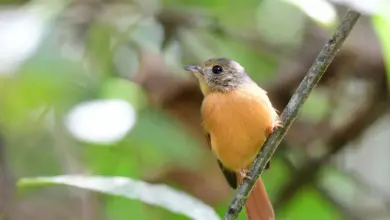
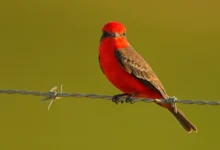
Males are unmistakable due to their brilliant vermilion-red underparts, including the chest, belly, and lower face. Their upperparts contrast sharply with dark brown to black wings, back, and tail, often highlighted with subtle rufous edging. Males also possess a small, slightly raised crest that they can erect during displays, adding to their dramatic appearance. Females are more subdued, sporting a pale peach to light salmon belly and throat with grayish-brown upperparts. Their faces are marked with a faint eye-ring and a subtle dark mask behind the eyes, resembling the closely related Say’s Phoebe (Sayornis phoebe), which can cause confusion for casual observers.
Interestingly, males kept in captivity often lose the vibrancy of their red plumage, fading to a duller color, which may be related to diet or stress factors. This color change is one reason Vermilion Flycatchers are less commonly kept in aviaries compared to other colorful bird species.
Behavior & Diet
Vermilion Flycatchers are diurnal insectivores known for their energetic and acrobatic hunting style. They typically hunt from exposed perches, such as tree branches, fence posts, or telephone wires, where they watch for flying insects. Their diet consists mainly of a variety of arthropods, including flies, butterflies, moths, grasshoppers, beetles, termites, bees, wasps, and spiders. Once prey is spotted, the bird launches into swift sallies or short flights to catch insects mid-air, a behavior known as “hawking.” They also occasionally drop to the ground or foliage to snatch prey directly.
Vermilion Flycatchers are territorial birds, especially during the breeding season, vigorously defending their feeding and nesting areas from rivals. Males sing melodious, high-pitched songs that serve both to attract females and to establish territory boundaries. Their vocalizations are a series of clear whistles and trills, often performed during their conspicuous display flights. Outside the breeding season, these birds are typically seen alone or in pairs, and they maintain a vigilant watch for potential threats or intruders.
Breeding & Reproduction
The breeding season of Vermilion Flycatchers varies geographically, typically occurring from March through July in the northern parts of their range, such as the southwestern United States and Mexico. In southern regions like Argentina, breeding tends to take place from October to January. Courtship involves a spectacular display by the male, who puffs up his feathers and erects his crest before ascending rapidly to heights of up to 30 meters (approximately 100 feet). During this display flight, he flaps powerfully, hovers briefly, and then descends back to a perch while singing a melodious and repetitive song to capture the attention of females. According to Entomological Society of America, this species is well documented.
Once a mate is secured, the female builds a delicate but sturdy nest, typically situated in a horizontal fork of a tree or shrub between 2.5 and 6 meters (8 to 20 feet) above ground. The nest is a shallow cup constructed from twigs, grasses, roots, lichens, and stems, with a soft lining of animal hair and down. Spider silk is cleverly used as an adhesive to bind the materials together, providing flexibility and strength. According to iNaturalist, this species is well documented.
The female lays between two and four eggs, which are white or creamy with bold dark blotches and smaller lighter spots. She incubates the eggs alone for approximately 13 to 15 days, during which the male frequently brings food to her. After hatching, the altricial chicks are helpless, covered with sparse whitish down and displaying dark skin on their backs. Both parents participate actively in feeding and protecting the young. The chicks fledge within 13 to 18 days and may remain dependent on their parents for some time. Pairs often raise two broods per season, depending on food availability and environmental conditions.
Vermilion Flycatcher nests are occasionally targeted by brood parasites like cowbirds (Molothrus spp.), which lay their eggs in the flycatcher’s nest. This parasitism can reduce the reproductive success of the host, as cowbird chicks often outcompete the flycatcher’s own offspring.
Conservation Status
The International Union for Conservation of Nature (IUCN) currently classifies the Vermilion Flycatcher as a species of Least Concern. This status reflects its wide distribution and relatively stable population trends across much of its range. Although the species is not considered threatened globally, local populations may face pressures from habitat loss, particularly in regions undergoing rapid agricultural or urban development.
Vermilion Flycatchers benefit from their adaptability to human-altered environments, often thriving in open areas with scattered trees, agricultural fields, and even suburban parks. Nonetheless, conservation efforts that protect riparian zones and native vegetation contribute to maintaining healthy populations by preserving essential nesting and foraging habitats. Monitoring programs continue to track population dynamics, especially in the northernmost and southernmost parts of their range, where environmental changes may have more pronounced effects.
Interesting Facts
The Vermilion Flycatcher’s vivid red coloration is one of the most eye-catching features among New World flycatchers and serves multiple purposes. Beyond attracting mates, the bright plumage acts as a signal to rivals, demonstrating fitness and territory ownership. The species’ name “vermilion” refers to a brilliant red pigment historically derived from the mineral cinnabar, underscoring the intensity of the male’s color.
During courtship, males perform impressive aerial displays that can include hovering and rapid dives, showcasing both agility and endurance. These flights are often accompanied by a complex song, suggesting that vocal ability is as important as visual display in mate selection.
Despite their flashy appearance, Vermilion Flycatchers can be surprisingly elusive and shy when approached closely, often retreating to dense cover if disturbed. Their diet’s reliance on flying insects makes them valuable indicators of insect population health in their habitats. Additionally, the use of spider silk in nest construction highlights an intriguing example of resourcefulness among passerine birds.
Finally, bird photographers prize Vermilion Flycatchers for their brilliant colors and dynamic behavior, making them a favorite subject for capturing the vibrant diversity of the Americas’ birdlife.
In summary, the Vermilion Flycatcher (Pyrocephalus rubinus) is a small yet spectacular bird with a wide distribution from the southwestern United States to Argentina. Its brilliant red males, agile hunting, and dramatic courtship displays make it a standout species among tyrant flycatchers. While currently not threatened, ongoing habitat conservation remains essential for maintaining this dazzling bird’s populations across the Americas, ensuring future generations can enjoy its fiery beauty in the wild.