The Tawny-chested Flycatcher, scientifically known as Aphanotriccus capitalis, is a small and elusive member of the tyrant flycatcher family (Tyrannidae), notable for its distinctive chestnut-colored breast and discreet habits. These birds inhabit a very specific range along the Caribbean slope of Central America, where they occupy dense, humid forests and secondary growth. Despite their modest size and subtle plumage, Tawny-chested Flycatchers are a fascinating subject for birdwatchers and naturalists due to their specialized habitat preferences, unique vocalizations, and conservation challenges.
Scientific Classification
The Tawny-chested Flycatcher belongs to the family Tyrannidae, which is the largest family of birds in the Americas, encompassing a wide variety of flycatchers known for their insectivorous diets and agile flight. Its genus, Aphanotriccus, is relatively small and includes species that are often cryptic and understudied. The species was first described by Salvin in 1885 and is sometimes referred to by its synonym, Salvin’s Flycatcher. The scientific name Aphanotriccus capitalis reflects the bird’s distinctive features, with “capitalis” hinting at its pronounced chest marking.
This species is placed within the suborder Tyranni, commonly known as suboscine passerines, which differ from oscine passerines (songbirds) in their vocal organ anatomy and more innate calls, as opposed to learned songs. The Tawny-chested Flycatcher is one of the more specialized tyrant flycatchers, with a limited distribution and specific habitat requirements that set it apart from other flycatchers in the region.


Geographic Range & Distribution
The Tawny-chested Flycatcher is endemic to the Caribbean slope of Central America, with its range extending primarily from eastern Nicaragua down through northern Costa Rica. Historically, the species was recorded in Nicaragua, but modern sightings and populations are largely restricted to Costa Rica, notably in the humid lowlands and foothills. Its elevational range spans from sea level up to approximately 1,000 meters (3,300 feet), preferring areas with dense vegetation and high humidity.
Within this narrow corridor, the flycatcher inhabits humid tropical forests, including tall secondary growth, riparian thickets, and shaded plantations such as cocoa farms, which mimic natural forest conditions. The species favors transitional forest edges and streamside habitats where dense understory vegetation provides ample foraging opportunities and nesting sites. Unfortunately, its range is severely fragmented due to ongoing deforestation and habitat alteration, limiting the species to an estimated area of about 8,000 square kilometers (roughly 3,080 square miles).
Records in Nicaragua are primarily historical, and recent field surveys suggest the species may have been extirpated from that part of its range. In Costa Rica, protected areas and reserves such as the Braulio Carrillo National Park offer refuge, yet habitat loss outside these zones continues to threaten this bird’s survival.
Physical Description
The Tawny-chested Flycatcher is a small bird, measuring approximately 12 centimeters (4.7 inches) in length and weighing around 7 grams (0.25 ounces). Its wingspan is modest, typically around 18 to 20 centimeters, allowing for agile maneuvering in dense foliage. This species exhibits subtle but distinctive plumage characteristics that aid identification in the field.
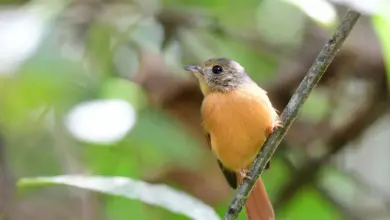
Adults have an olive-green tinge across the nape, back, and rump, interspersed with ochre hues that give the bird a warm, earthy appearance. The head is predominantly dark gray, with a slight olive tint in females. Both sexes display broken white eye-rings and conspicuous white lores—the small areas between the eyes and the beak—and their cheeks show a grayish-olive coloration. The tail feathers are dusky olive, blending seamlessly with the bird’s back.
The most striking feature is the chest, which is a bright cinnamon-ochre or tawny color, sharply contrasting with the white throat that has a buff tinge towards the sides. The abdomen is pale yellow, lending a soft gradient from the chest downward. The wings are dusky with two ochre-colored wing bars and margins on the secondary feathers, a useful field mark during flight or rest.
Additional details include a black upper beak contrasted by a flesh-colored lower mandible tipped in black, and gray legs adapted for perching. Males and females are very similar in appearance, with the primary difference being the crown color: males possess a dark gray crown, while females have an olive-tinged one.
Behavior & Diet
The Tawny-chested Flycatcher is an insectivore, feeding predominantly on a variety of insects and arthropods. Its diet includes beetles, ants, small caterpillars, and other small invertebrates that it gleans from foliage and branches. It typically forages by perching quietly and making short sallies to catch prey mid-air or plucking insects from the undersides of leaves. This methodical hunting style is characteristic of many flycatchers but is particularly well-suited to the dense understory environments this species inhabits.
These birds are usually observed singly or in pairs, maintaining small territories that they defend through vocalizations and subtle displays. Unlike some tyrant flycatchers that join mixed-species foraging flocks, Tawny-chested Flycatchers tend to be more solitary or found only in pairs, which may aid in reducing competition within their limited habitat.
Their vocal repertoire includes sharp, repetitive calls that help them communicate across the thick forest environment. These calls have been described as a series of rapid “chee chee spt’t cheew” or “chit it-it chee’yew” sounds, which serve both territorial and social functions. Because the species is relatively quiet and secretive, these vocalizations are often the best way to detect their presence in the field. According to Cornell Lab of Ornithology, this species is well documented.
Breeding & Reproduction
Tawny-chested Flycatchers are believed to be crevice nesters, a somewhat unusual nesting habit among flycatchers. They typically build their nests in hollows within large bamboo stems or tree cavities, which provide protection from predators and environmental elements. The use of bamboo stems is particularly interesting, as these plants are abundant in some parts of their range and offer a natural nesting niche. According to eBird, this species is well documented.
Details about their breeding biology remain sparse due to the species’ elusive nature and the difficulty of studying them in dense forest habitats. However, available observations indicate that they lay small clutches, usually consisting of two or three eggs. The incubation period, fledging time, and parental care patterns have not been extensively documented but likely follow patterns seen in closely related tyrant flycatchers, with both parents involved in feeding and protecting the young.
The breeding season aligns with the wet season in Central America, when insect availability is highest, supporting the nutritional needs of growing chicks. Because of their specialized nesting sites and habitat requirements, successful reproduction depends heavily on intact forest environments.
Conservation Status
The Tawny-chested Flycatcher is currently classified as Vulnerable on the International Union for Conservation of Nature (IUCN) Red List. This status reflects ongoing threats from habitat destruction, fragmentation, and degradation across its limited range. The primary driver of habitat loss is deforestation for agriculture, cattle ranching, and urban development, particularly in Nicaragua and Costa Rica.
Its dependence on dense, humid forest habitats and specific nesting sites makes it especially vulnerable to environmental changes. With a range of only about 8,000 square kilometers and fragmented populations, the species faces increased risks of local extinctions. Conservation efforts focus on habitat preservation and protection within national parks and reserves, as well as encouraging sustainable agricultural practices that maintain forest cover and connectivity.
Research into the species’ ecology and population trends remains a priority, as better data will inform effective conservation strategies. Birdwatchers and researchers contribute to monitoring efforts by reporting sightings and vocalizations, helping to track the status of this secretive flycatcher.
Interesting Facts
Despite its modest size and unobtrusive appearance, the Tawny-chested Flycatcher holds several intriguing ecological and behavioral traits. Its preference for nesting in bamboo hollows is relatively rare among tyrant flycatchers, highlighting an adaptation to its humid, forested environment. Bamboo stands not only provide nesting sites but also support an abundant insect population, making these areas ideal for feeding and breeding.
The bird’s vocalizations are distinctive yet often overlooked due to the dense habitats it occupies. Experienced birders use its unique calls as a key identification tool, especially since visual sightings can be challenging. The species’ shy nature and tendency to remain motionless for long periods add to the difficulty of locating it in the wild.
Another notable aspect is its limited geographic range, which reflects both its specialized ecological niche and vulnerability. It serves as an indicator species for forest health in the Caribbean slope regions of Central America. Protecting the Tawny-chested Flycatcher indirectly conserves many other species sharing its habitat, making it a valuable flagship species for conservation initiatives.
Lastly, the bird’s subtle sexual dimorphism, limited to crown coloration, provides an interesting example of how minimal physical differences can play a role in mating and territorial behaviors without compromising camouflage and survival in dense forest environments.
Conclusion
The Tawny-chested Flycatcher (Aphanotriccus capitalis) is a captivating example of the rich biodiversity found in Central America’s Caribbean forests. Its distinctive tawny chest, specialized habitat needs, and discreet behaviors make it a unique subject for study and appreciation among bird enthusiasts. However, the species’ vulnerability to habitat loss underscores the urgent need for conservation efforts focused on preserving the fragile ecosystems it calls home.
By understanding its biology, distribution, and ecological role, nature lovers and scientists alike can contribute to safeguarding this small but significant flycatcher. Continued research, habitat protection, and awareness are essential to ensure that the Tawny-chested Flycatcher remains a cherished part of Central America’s avian heritage for generations to come.