Table of Contents
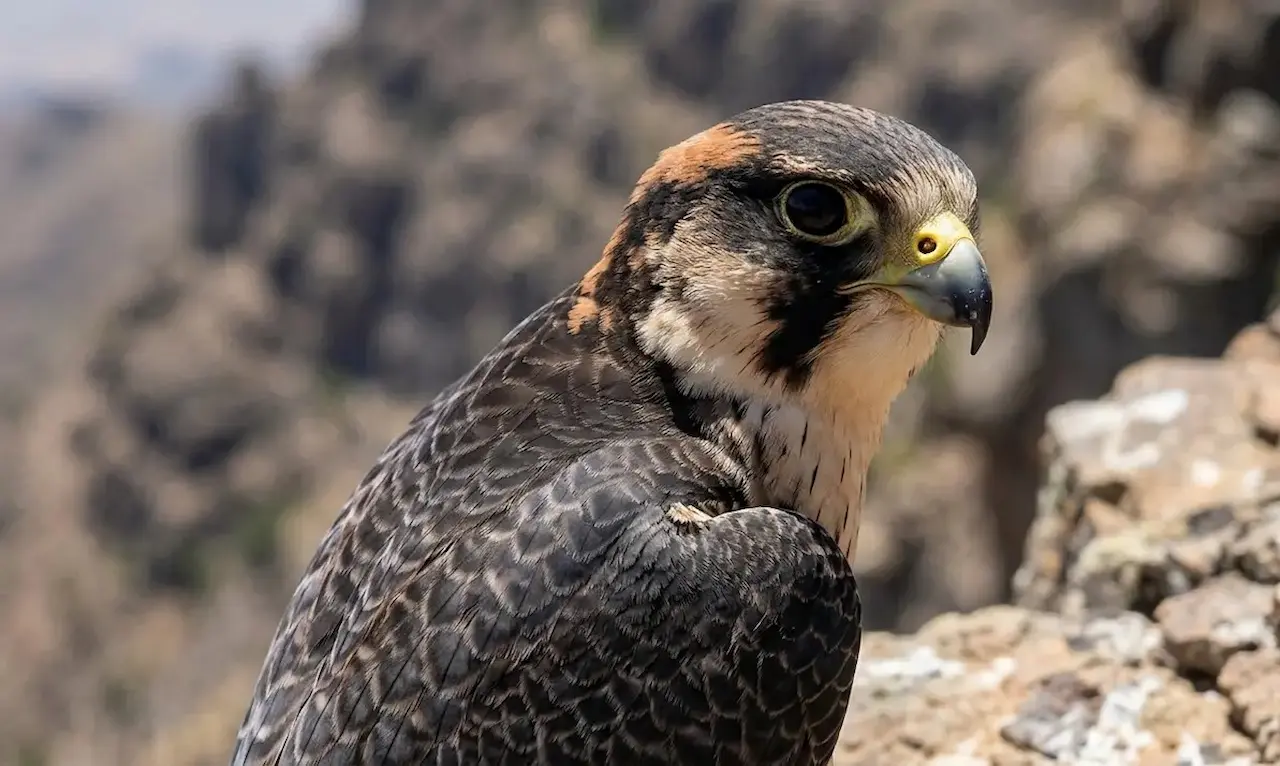
The rest of its upper parts, including the wings, are dark grey, becoming paler on the rump and upper tail coverts, and on the tail, which has darker bars.
Below, the chin and throat are light buff, while the rest of the underparts are tawny with narrow black stripes, and more chestnut on the thighs. The eyes are dark brown, and the cere, legs, and feet are yellow.
Immatures differ in that the shafts of the feathers of its chest and abdomen are blackish brown, and the axillaries (feathers under the wing the “armpit” or “wingpit” of a bird) and under wing-coverts (the feathers at the leading edge of the wing, covering the bases of the secondaries (shorter, upper “arm” feathers) and primaries are heavily barred with blackish brown.
The rump is darker than that of the adult, not grey. The wing quills and scapulars (shoulder feathers) are tipped with pale buff.
Similar Species ID:
This small falcon is fairly distinctive but may offer some confusion with a few other species
It looks a lot like a tiny Peregrine, with its short and strong body, pointed wings, and a clear grey rump. Its courting/mating period is similar to that of the Peregrine Falcon. The same applies to its vocal as well as territorial preference.
It is not as long-winged as a Hobby and may be distinguished from all Hobbies by its general appearance and the absence of dark chestnut on the underside. The very white chin helps to distinguish it from the African Hobby, Falco cuvieri.
Also, the underwing coverts are uniform rufous, whereas the African Hobby has more streaking. The most obvious underwing feature, though, is the fact that the flight feathers are barred black and white, as there is much more rufous in the flight feathers of the African Hobby. The robust, long-winged Taita Falcons have a short tail.
Status and behaviour in the wild
This falcon is very rare throughout its range and is usually found only in mountainous areas.
It has occasionally been seen in the gorge of the Zambezi below Victoria Falls, where it perches on crags or dead trees overlooking the gorge. According to Cornell Lab of Ornithology, this species is well documented.
In East Africa and Ethiopia, it prefers high mountain ranges from 6,000 to 12,000 feet. There appears to be no good reason for its rarity, as it feeds on birds like many other small falcons, and should have no difficulty in surviving. According to eBird, this species is well documented.
The general habits of these birds are very much like those of small Peregrines, soaring about the crags and over open country, killing small birds in flight, and roosting on crags or trees. They are accomplished fliers, although not quite as swift as Hobbies, and the pair is very often together.
Generally speaking, this species is scarce and relatively endangered.
Breeding / Nesting
Its courting/mating period is similar to that of the Peregrine Falcon. The same applies to its vocal as well as territorial preference. The breeding season, in Zimbabwe, extends for at least four months, with eggs being laid in early October and the young leaving the nest about Christmas.
During the courtship display, the pair perform in paired flights, accompanied by some screaming. They build their nests on deep, inaccessible rock ledges, apparently without any nest material.
At least three eggs are laid, and the young, when hatched, are covered in greyish-white down. The fledgling period is about seven weeks. The young remain in the vicinity of the nest for at least ten days after they fly.
Food and Diet
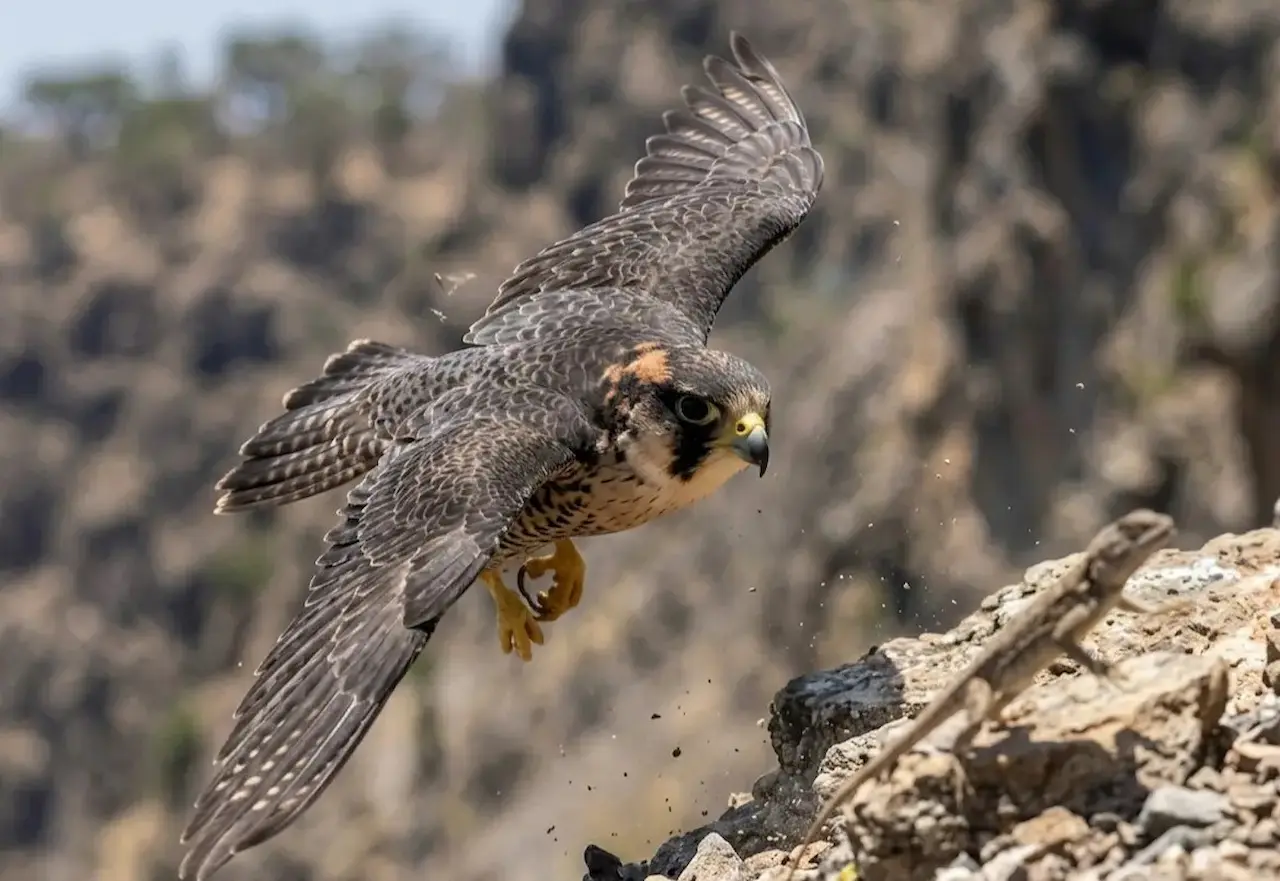
Taita falcons are experts at hunting small birds that fly. They hunt fast-flying insects such as swifts, flycatchers and bee-eaters that are common around cliffs and woodland edges. They hunt with a forceful, fast, and direct flight style. They leap from perches, cliff edges or nesting territories, then intercept prey mid-air. Although they are not as light or fast as hobby falcons, they are still powerful flyers. They have long wings for their size, which gives them agility and endurance. Their short tails help with maneuverability on rocky terrain.
Taita Falcons hunt near their nests or perches. They can scan the airspace above forests, gorges or woodlands from cliffs and then swoop to catch a small bird. The selection of prey is dominated by birds. Insects or small vertebrates are occasionally eaten, or they may eat them opportunistically. But their ability to catch small, fast-moving birds is what makes them unique. They can catch prey in mid-flight with their strong feet and bill.
Vocal Behavior
The vocalisations of the Taita Falcon have been less well documented than their visual or behavioural traits. However, observations suggest that they use high-pitched screaming calls, similar to those of the Peregrine Falcon, but less robust. Pairs may shout or call from the edge of cliffs when performing territorial displays, or during flight in courtship. These calls can also be used to mark boundaries in a territory, warn of intruders, or signal a mate.
During the breeding season, vocal activity is increased, particularly in pairs of flight displays. These displays include calls that are used in nesting rituals and for mate selection. The falcons become quieter when they are not breeding. However, vocalisations can still be heard in the defence of territory or when disturbed.
Conclusion
The Taita Falcon can be found in extreme habitats, from the cliffs and inselbergs on the Taita Hills to the exposed rocks and woodlands on Niassa. It is also a raptor that has to deal with extremes, including remote nesting, rapid aerial hunting, dependence on the surrounding woods and exposed terrain, as well as a high vulnerability to habitat changes caused by humans. It is not a large falcon, but it is perfectly suited for its niche. Its powerful flight, sharp vision, and bold colouration combine to create a predator that is both beautiful and special.
Specialised populations in certain strongholds send a positive message: conservation is possible with the right management and habitat protection. This hope is not without warning. Many of the previously known breeding sites have declined or disappeared. It is not always possible to regulate or reverse the factors that are driving the decline, such as habitat loss, disturbances, competition and chemical exposure. Preserving the Taita Falcon’s habitat includes not only protecting cliffs and nesting ledges but also maintaining woodlands and prey populations around these nesting areas.
This species shows us that not all raptors are large and obvious. Some of the rarest raptors live on cliffs and can only be seen by their silhouettes and heard through their calls. Many more could disappear before we understand them fully. Research, constant monitoring, the protection of breeding sites and community involvement are all essential. The Taita Falcon is at risk of extinction if these factors are not addressed.
The Taita Falcon represents both fragility and resilience. This makes us think about how even small changes to land use and human pressures can have a profound impact on species that are dependent on specific ecological environments. This also shows how a dedicated effort, such as survey work, reserve protection, and habitat preservation, can sustain even rare, specialised creatures. As these efforts continue, the cliff-dwelling vulcon may be part of Africa’s wildlife heritage for many generations.