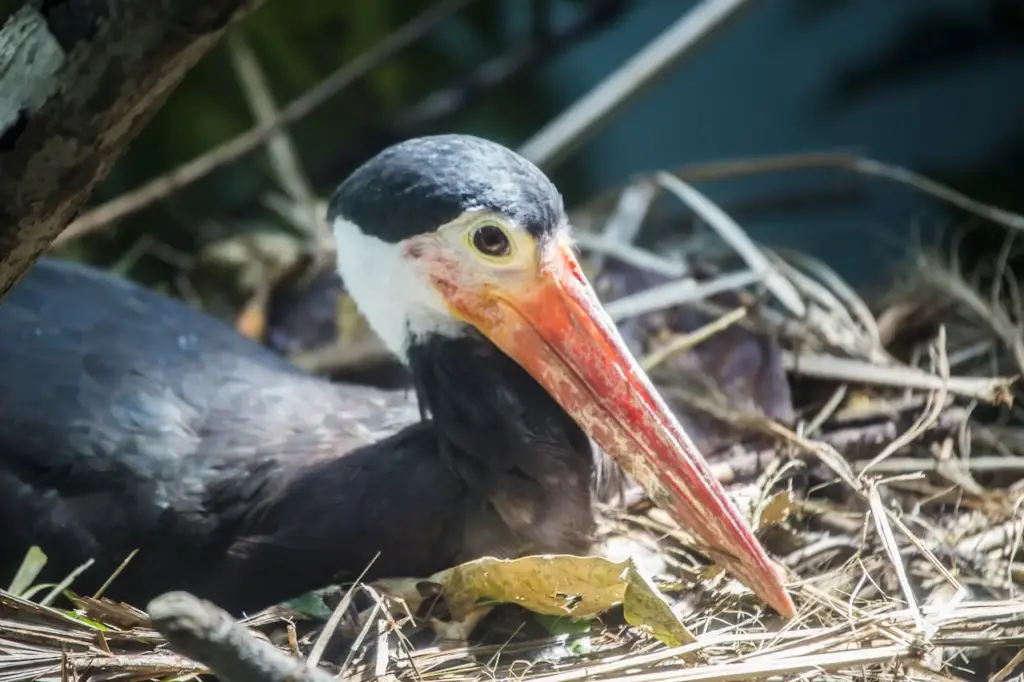
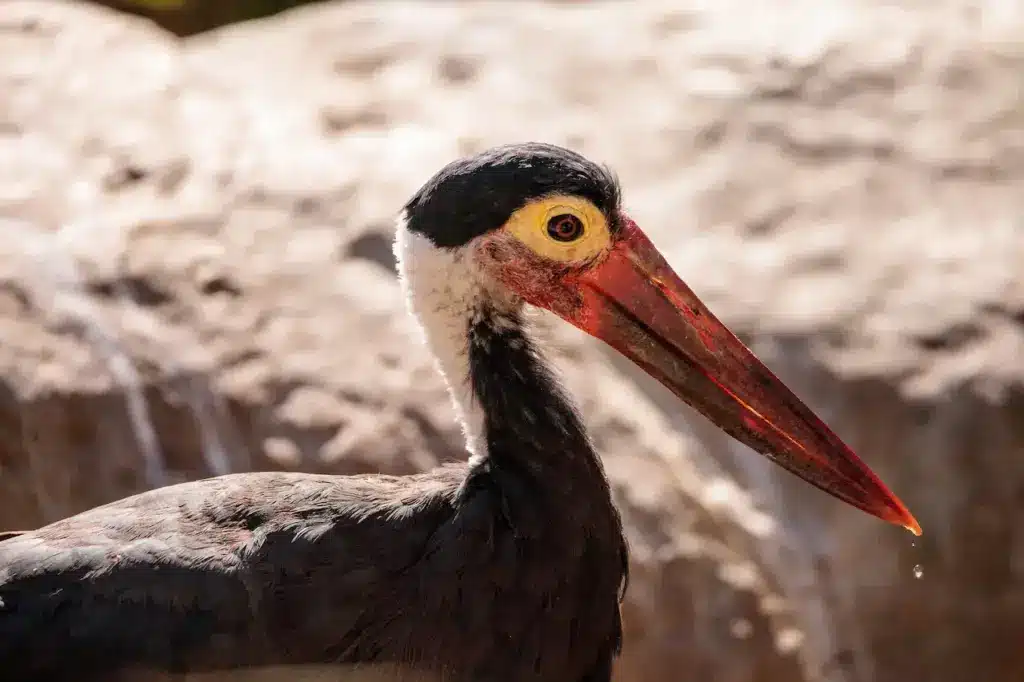
The Storm’s Storks, Ciconia stormi, are large, up to 91cm long, storks with black and white plumages, a red bill, orange bare facial skin, red legs, and yellow orbital skin. Males and females look alike. The young have duller plumage and bare skin.
This little-known species is found in undisturbed forest and freshwater habitats in Sumatra, the Mentawai Islands, Borneo, and Peninsular Malaysia. One of its strongholds is in southeast Sumatra, with the remaining populations confined to Kalimantan and Brunei. While in Peninsular Malaysia, only a very small population and scattered individuals remain.
The Storm’s Storks are solitary birds. Its diet consists mainly of fish. The female lays two eggs in a stick platform nest high in a tree canopy.
The Storm’s Stork was formerly considered a subspecies of the Woolly-necked Stork.
Description
The majority of this medium-sized stork’s plumage is dark black. The white cap and undertail cover are paired with black on the back of the neck. The orange skin of the face is surrounded by a yellow circle around the eye. It also has a red iris and a pinkish bill. The culmen is concave on some males, but not all.
Adults’ legs and feet are dull red, but they appear paler because they are covered in bird excrement. During the breeding season, the bill and soft body parts become darker. Both sexes look similar, but the male is slightly larger. Field observations suggest that the black cap of males, their chest and throat are slightly glossier.
At 1-3 days of age, the plumage is white with a black crown. The bill has a yellow-orange tipped black tip. Legs, facial skin, and the gular pouch start as light yellows. As the chick grows older, the legs turn pink and the facial tissue turns dark grey. The iris was initially brown.
In just a few weeks, the chicks will double in size. At this point, the chicks have begun to develop dark feathers along their wings, throats, and bodies. After 30 days, the black feathering has increased, and the chest and wing coverts have been streaked in glossy green and bronze red. After 45 days, the young are similar to adults but smaller, with darker-tipped bills, paler skin, and a slightly duller blackness. After 52-57 days, the chicks are fully feathered. After 60 days in the wild, young birds have been known to leave their nests. In captivity, they can fly after 90.
Breeding
During the breeding period, the adult birds utter vocalisations which have been translated as “Kurau”. One adult bird was heard whistling in captivity. When parents return with food, chicks make a frog-like call. According to Cornell Lab of Ornithology, this species is well documented.
Nests are usually found 19-30m above the ground, above riverbanks. They can be located in the forks or branches of Dipterocarpus trees. In South Sumatra, a Storm’s Stork nest that was 8.3m above the ground in an 18m tall Rhizosphora Mucronata tree was studied. Both the male and female were observed nest-building in captivity. Nests are typically 30-50 cm in diameter, with a 10-15 cm depth. They are made of sticks and twigs, primarily from tree species of the Rhizosphora genus, but can also be found in species of the Loranthaceae family, Dipterocarpaceae family, and Rubiaceae. The sticks are 15-60 cm long and 0.5-1.50 cm wide. The interior of the nest is lined with soft materials such as grass or down. 2-4 cm leaflets of Xylocarpus species were also identified as nest materials. These plants are found growing around the nest. The same nest can be used over several years by the same pair. Both mates will add material to the nest. According to BirdLife International, this species is well documented.
This species is typically monogamous. The nest is occupied by both parents, but usually only one of them at a given time. It’s estimated that the female spends three times longer alone than the male at the nest. Both parents have been seen to roost near or at the nest in the early stages of the chick’s life. However, after a month, the only parent who continues to roost near or at the nest is the female. Contrary to what was previously believed, this species appears to breed alone and does not nest as a colony.
Incubation lasts 29 days, and both parents incubate the eggs alternately. The clutch size in captivity can range from two to four. The young become fully fledged within 90 days of hatching. In 1989, the only egg from this species that was measured was an unfertilized one taken from a nest in which two chicks had been hatched in South Sumatra. The egg was 60.1mm long and 41.9mm wide. It was also completely white. The only specimen of this species is the egg preserved in the Zoological Museum of Bogor (Indonesia).
This stork pair performs impressive aerial courtship displays. Both partners flip in flight while the lower bird presents its feet to the higher. The two birds will also glide occasionally at high altitudes, with their wings level and legs dangling. They perform clattering bill activities at the nest that are characteristic of many species within the Ciconiidae.
In captivity, another courtship display was observed where both partners faced each other, either on the ground or nest, extended their wings outwards from the body and repeatedly bowed to each other. The display continues until the female approaches and the male attempts to copulate, though copulation is not always the result of such displays. The display can continue even after breeding has finished and the chicks have arrived at the nest. The importance of this display is not known in wild populations, as both parents are only seen together at the nest 2% of the time.
Diet / Feeding
The Storm’s Storks feed on small fish, frogs and aquatic insect larvae. It also eats earthworms. Both parents bring back these food items for their young to the nest. The fish are 5-7 cm in length and weigh 10-30g. Worms are 10-15 cm in length. Parents regurgitate food at the bottom of nests, which is then picked up by chicks and eaten. In 1989, nest observations were made in southern Sumatra. Adults returned to the nest to bring food to the chicks in June every 2-4 hours. However, in July, they brought food to the nest significantly less frequently and more often in the late afternoons. In Sabah, they are also reported to eat grasshoppers and perhaps crabs. Other food taxa could be similar to the woolly-necked Stork, but further data is needed to confirm this.
The stork forages in the dense primary forest, avoiding sunlight and moving slowly and deliberately. Individuals with chicks forage about 2-3 km away from the nest. Other freshwater bodies with high concentrations of fish and invertebrates will be used as foraging locations. The Storm’s Stork can use small pools, trackside water puddles or swamps to its advantage, especially if they are arranged in a patchwork pattern on the riparian floodplains. The stork can also access mineral licks by using boggy clearings made by ungulates like gaur, which trample the vegetation. This species avoids deep, fast-flowing waterways and rivers due to the reduced availability of prey and its inability to stand in such waters.
In Sabah, they are found to feed on recently burned open land. The invertebrates are likely to be disturbed or killed during the fire.
With a world population of less than 500 individuals, and ongoing habitat loss and hunting in some areas, the Storm’s Stork is classified as Endangered on the IUCN Red List of Threatened Species.
Copyright: Wikipedia. This article is licensed under the GNU Free Documentation License. It uses material from Wikipedia.org