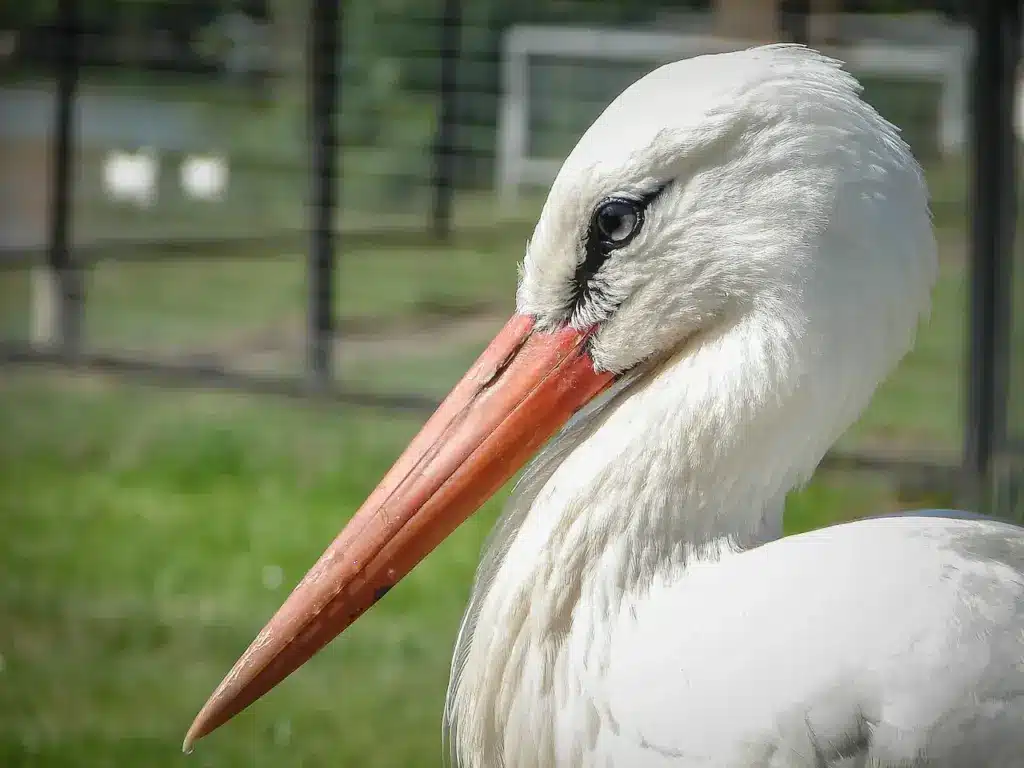
The Oriental White Stork (Ciconia Boyciana) is one of East Asia’s most iconic birds. This elegant, long-legged bird can reach 115 centimetres. It is easily recognised by its white plumage, which contrasts with the striking black feathers on the wings. The Oriental White Stork is closely related to the European White Stork. It was previously considered a separate species. Its distinct physical and behavioural traits have led to its classification as a different species. Its most distinguishing features include the skin around its eyes and the iris.
Physical Characteristics Identification
It is rare to see an Oriental White Stork. However, it can be a memorable experience. The tall stature and long black legs of the Oriental White Stork, along with its impressive wing span, make it an impressive presence on wetlands and riverbanks. The Oriental White Stork is distinguished by its black bill, which is unlike that of the red-billed European White Stork. The wide, black-tipped wings and the white rest of its wings create a striking contrast in flight that is admired by bird watchers. The males are slightly bigger than the females, but it is a subtle difference that can be hard to see in the field. The feathers of juveniles are duller, and their bills have an orange colour.
Habitat and Range
Historically, the Oriental White Stork habitat covered Japan, China, Korea and some parts of Russia. The stork prefers freshwater wetlands and marshes. It also thrives in river valleys and paddy fields. Due to urbanisation, land reclamation and agricultural expansion, a large part of the stork’s natural habitat was destroyed. The Oriental White Stork has been declared extinct in Japan and South Korea. It is now found in eastern China and in some parts of Russia’s Amur Basin.





Seasonal Migration Patterns
The Oriental White Stork migrates between breeding and wintering areas in predictable cycles. The Oriental White Stork breeds in Northeastern China and Russia. They build large stick nests on artificial platforms or tall trees. The storks migrate to the east of China in September after the breeding season is over. They begin their return north in March. Conservation groups closely monitor the migration routes and seasonal movement of these storks using satellite tracking techniques and banding.
Food and Feeding Behaviour
The Oriental White Stork is a wading carnivore. Its diet consists of fish, frogs and amphibians as well as small mammals. They also eat aquatic invertebrates and insects. They hunt in a quiet, patient manner. They wade through shallow water and use their sharp eyesight and quick reactions to capture prey. These storks, unlike many other birds, are usually silent when they feed. They use their powerful beak to catch and kill prey. Pollution, overfishing and drying wetland ecologies are threatening their feeding grounds.
Breeding Seasons and Reproductive Behaviour
During the mating season, Oriental White Storks often form monogamous couples, returning to the nest site every year. Both parents are responsible for incubation, as well as raising the chicks. After about 30-35 days of incubation, the downy white chicks and orange-beaked hatch. Chicks are fed by both parents and grow quickly. They fledge about 60 days after hatching. Nesting success depends on the availability of food and minimal disturbance, both factors which are under increasing threat from human encroachment.
Concerns about the population status and conservation
Oriental White Stork has been classified as Endangered by the IUCN Red List of threatened species. The species is listed in Appendix 1 of CITES. This means that international trade is severely restricted. The population of the species is estimated at just a few thousand individuals. The vast majority are found in China’s protected wetlands. The species is primarily threatened by habitat destruction, hunting and pesticides. human disturbance. Conservation groups and government agencies are working hard to stop its decline. However, challenges remain.
Conservation Efforts & Breeding Programs
In spite of the loss of their wild populations, Japan and South Korea have made great strides with captive-breeding and reintroduction programs. The Toyooka Oriental White Stork Conservation Centre in Japan has successfully bred several individuals and released them into the wild. They are now establishing new territories. South Korea also launched a reintroduction programme in Upo Wetlands – a historical habitat. China is still leading the wild populations conservation. Major efforts are focused on Poyang Lake. This is where the species spends its most important wintering grounds. These initiatives are vital for the long-term existence of the species. According to BirdLife International, this species is well documented.
Wetlands are important for Stork survival
The Oriental White Stork is dependent on wetlands. These ecosystems are vital for the Oriental White Stork’s feeding, nesting, and resting needs throughout its life cycle. The rapid disappearance of wetlands in East Asia is due to pollution, land conversion and dam construction. The Three Gorges Dam and other large-scale projects have altered the natural hydrology of wetlands, making them less hospitable. Oriental White Storks’ conservation relies on restoring degraded wetlands and using sustainable water management techniques. According to Cornell Lab of Ornithology, this species is well documented.
Human Impact and Cultural Significance
In East Asia, the Oriental White Stork is a cultural icon despite its vulnerability. In Japan and Korea, the stork is a symbol of longevity, loyalty, and good luck. The stork is often featured in poetry, folklore and traditional paintings. Ironically, cultural reverence does not always translate into protection. In the past, storks and their eggs used to be hunted and collected for their meat, feathers and eggs. The public’s support for stork protection has increased with the growing environmental awareness. Ecotourism and education campaigns now leverage the stork’s iconic status to gain public support for wetland conservation.
International Collaboration for Species Recovery
International cooperation is vital for the Oriental White Stork’s recovery, given its wide range and migration. Organisations such as BirdLife International, East Asian Australasian Flyway (EAAFP), and WWF work across borders to coordinate conservation and protect migration routes. Satellite tracking, joint research programs and information sharing help scientists monitor habitat and population trends. These collaborations are already leading to stronger legal frameworks, better protection of habitats and improved species conservation.
Eco-Tourism, Public Awareness and Environmental Protection
Eco-tourism, centred on bird watching, has been a key tool in recent years to promote conservation awareness. Tourists are now drawn to places like Poyang Lake, China, and the reintroduction site in Japan. Local communities benefit economically, which encourages them to protect stork habitats. The plight and stork habitats of the Oriental White Stork have been brought to the world’s attention through public awareness campaigns, education programs in schools, and wildlife documentaries.
Scientific Research: Its Importance
It is essential to continue scientific studies to better understand the behavioural ecology, breeding success and migration patterns of the Oriental White Stork. Researchers gather data using GPS tracking, drones, and habitat models to inform conservation policies. The use of genetic studies helps manage breeding programs in order to prevent inbreeding and ensure the health of all breeders. Data-driven conservation allows stakeholders in real-time to make decisions based on evidence and adapt strategies.
The Road Ahead: Challenges and Road Ahead
Despite the progress made, the road towards full recovery of the Oriental White Stork remains long and uncertain. Climate change, habitat fragmentation and pollution are all threats to its survival. The coastal development and the rising sea level are also shrinking vital wetland habitats. To reverse this decline, governments must increase habitat restoration and enforce anti-poaching legislation. They also need to integrate bird conservation in urban planning and agricultural practices. Local communities’ involvement, combined with strong political will and expert scientific knowledge, will determine whether this magnificent bird survives.
The End: A Symbol for Hope and Resilience
The Oriental White Stork story is both a cautionary tale and a source of hope. It is a symbol of the human impact on biodiversity and the potential for recovery that can be achieved when people work together to conserve it. The Oriental White Stork is a symbol of East Asia’s natural heritage. As efforts to protect wetland habitats and restore populations gain momentum, it’s hoped that future generations can see this bird not only as an artifact or folklore but also as a living and thriving species.