The Southern Black Tit (Parus niger) is a striking small bird native to parts of southern Africa. Known for its glossy black plumage and lively behavior, this species inhabits a variety of woodland environments where it plays an important role in local ecosystems. Although often overshadowed by more colorful members of the tit family, the Southern Black Tit’s unique adaptations and intriguing behaviors make it a fascinating subject for birdwatchers and nature enthusiasts alike. This article explores the taxonomy, distribution, physical traits, diet, breeding habits, conservation status, and interesting facts about this remarkable bird.
Scientific Classification
The Southern Black Tit belongs to the family Paridae, which includes various small passerine birds commonly known as tits or chickadees. Its scientific name is Parus niger, first described by the French ornithologist Louis Jean Pierre Vieillot in 1818. The genus Parus is characterized by small, agile birds with strong feet and short, stout bills adapted for insectivory.
The species Parus niger is further divided into three recognized subspecies, each with subtle variations in range and plumage. The nominate subspecies, Parus niger niger, is found primarily in southern Mozambique, Swaziland (Eswatini), and the Eastern Cape Province of South Africa. The Angola Black Tit, Parus niger xanthostomus, occupies a more northwestern range from Angola southward to Namibia and Botswana, extending east to Zambia and southern Tanzania. Lastly, Parus niger ravidus ranges from eastern Zambia to Malawi, Zimbabwe, Mozambique, and northern parts of South Africa’s Limpopo Province. These subspecies represent slight ecological and geographical adaptations within the species, though all share the core characteristics that define the Southern Black Tit.






Geographic Range & Distribution
The Southern Black Tit is native to southern Africa, with a distribution that spans several countries and a variety of habitats. Its range extends from Angola in the northwest, eastward through Zambia, Malawi, Mozambique, and Tanzania, and southward into Zimbabwe, Botswana, Namibia, and South Africa. Within South Africa, it is most commonly found in the eastern regions, particularly in the Eastern Cape and Limpopo provinces.
This species prefers tropical and subtropical savanna woodlands, especially areas dominated by broad-leaved trees, which provide both shelter and abundant insect prey. It is often found in mixed woodland and forest edge habitats where open spaces and dense foliage coexist. These environments support the Southern Black Tit’s feeding and breeding requirements, offering plenty of tree cavities for nesting and a rich diversity of insect life for sustenance.
While not strictly migratory, the Southern Black Tit may exhibit some local seasonal movements related to food availability and breeding cycles. Its adaptability to a range of woodland habitats allows it to maintain stable populations across much of its range, though it remains more common in certain localized areas such as Zimbabwe and eastern South Africa.
Physical Description
Measuring approximately 16 centimeters (6.3 inches) in length, including its relatively long tail, the Southern Black Tit is a compact bird with a weight ranging between 19 and 22 grams (0.7 to 0.8 ounces). It has a wingspan averaging around 25 centimeters (9.8 inches), giving it the agility needed for its active foraging lifestyle.
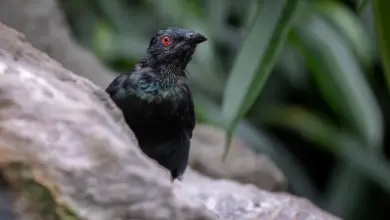
The male Southern Black Tit sports a predominantly glossy blue-black plumage that covers its head, back, wings, and tail, creating a sleek and striking silhouette. The underparts are slightly lighter but still dark, blending with the overall black coloration. Females tend to be a bit duller, with greyish-black tones that soften the contrast seen in males. Both sexes have dark eyes, typically blackish-brown, set against a clean black face and throat, lending the bird an intense, alert expression.
The legs and feet are grey, sturdy, and well-adapted for climbing and perching on branches as the bird searches for insects. Unlike some tit species that sport distinctive facial markings or crests, the Southern Black Tit’s appearance is relatively uniform, relying on its deep black color and glossy feathers to stand out among the foliage.
Behavior & Diet
The Southern Black Tit is an active and inquisitive bird, often observed flitting energetically through trees and shrubs as it hunts for food. Its diet is primarily insectivorous, consisting largely of a wide array of insects including butterflies, bees, wasps, locusts, ants, and various larvae. The bird employs a combination of foraging techniques, such as hawking—catching flying insects mid-air—as well as gleaning insects from leaves, branches, and the ground.
In addition to insects, the Southern Black Tit supplements its diet with nectar and fruit, particularly figs when they are in season. This dietary flexibility helps the bird adapt to seasonal changes in food availability. It often forages in mixed-species flocks, which can include other small insectivorous birds. These mixed flocks provide increased vigilance against predators and enhance foraging efficiency by flushing out hidden prey.
The Southern Black Tit’s vocalizations include a variety of sharp calls and trills used for communication within pairs and flocks. Its calls are generally clear and ringing, serving as contact calls or alarm signals. These vocalizations help maintain group cohesion and warn of potential threats in their woodland environment. According to iNaturalist, this species is well documented.
Breeding & Reproduction
The breeding season for the Southern Black Tit typically coincides with the summer wet season when food resources are most abundant. Nesting usually takes place in natural tree cavities or old woodpecker holes, which the birds line with soft plant materials such as grass, moss, and feathers to provide insulation and comfort for their eggs and chicks. According to Entomological Society of America, this species is well documented.
Females lay clutches of about three to five eggs, which are incubated solely by the female for approximately 15 days. During this period, the male plays a vital role by provisioning the brooding female with food. Once the eggs hatch, both parents share the responsibility of feeding and protecting the nestlings.
Though typically three chicks are raised, survival rates vary significantly depending on environmental conditions and food availability. In some years, only one chick successfully reaches fledging due to competition and scarcity of resources. A particularly fascinating behavior observed in this species is the female’s ability to mimic the hissing sound of venomous snakes when feeling threatened near the nest. This mimicry serves as a deterrent to potential predators, enhancing the chances of survival for both the female and her offspring.
Conservation Status
The Southern Black Tit is currently classified as Least Concern by the International Union for Conservation of Nature (IUCN). This status reflects the species’ relatively wide distribution, stable population trends, and adaptability to a range of habitats within its range. There are no immediate large-scale threats impacting its overall survival, although localized habitat loss due to agricultural expansion, logging, and human settlement may affect some populations.
Conservation efforts for this species focus primarily on preserving woodland habitats and maintaining the ecological integrity of savanna and forest edge environments. Since the Southern Black Tit is dependent on tree cavities for nesting, the availability of mature trees is particularly important. Protected areas and nature reserves throughout southern Africa play a key role in safeguarding suitable habitat for this and many other woodland bird species.
Interesting Facts
One of the most intriguing aspects of the Southern Black Tit is its mimicry of venomous snakes. When threatened, particularly during nesting, the female can produce a hissing sound remarkably similar to that made by puff adders and other dangerous snakes native to the region. This vocal deception serves as a powerful anti-predator adaptation, dissuading mammals and other potential nest raiders from approaching too closely.
Another notable behavior is their participation in mixed-species feeding flocks. By joining with other insectivorous birds, the Southern Black Tit benefits from collective vigilance and can exploit food resources more effectively. These flocks often include species such as bulbuls, white-eyes, and other tit species, creating dynamic and diverse bird communities within their habitat.
Despite its name, the Southern Black Tit is not entirely black; subtle differences in shading and glossiness, especially between males and females, add visual interest. The species is also known locally by various names in different languages, including Afrikaans (“Gewone Swartmees”) and others, reflecting its cultural presence across southern Africa.
Birdwatchers prize the Southern Black Tit not only for its distinctive appearance but also for its energetic and curious nature, which makes it relatively approachable compared to more elusive woodland birds. Its combination of ecological role, adaptive behaviors, and striking plumage ensures it remains a valued species for study and enjoyment.
In summary, the Southern Black Tit is a resilient and captivating component of southern Africa’s woodland bird fauna. Its glossy black feathers, agile foraging techniques, and unique nesting behaviors highlight the complexity and beauty of avian life in this region. Understanding and appreciating such species deepen our connection to the natural world and emphasize the importance of conserving the habitats that sustain them.