The Silvery Kingfishers (Alcedo argentata) – commonly referred to as the kasay-kasay bird within its range – is a River Kingfisher that is endemic to the Philippines. Its natural habitats are subtropical or tropical moist lowland forests and rivers. This species is threatened by habitat loss.


In recent literature, the Silvery Kingfisher has been split into two populations: the Northern Silvery Kingfisher and the Southern Silvery Kingfisher. Together, these small river kingfishers represent an evolutionary lineage that demonstrates both evolutionary elegance and conservation urgency. This blog provides an overview of the information we have about their appearance, where and how they live, what they eat, how they communicate, and what threats they face. It also explains why it is important to preserve them, not just for birds but also for rivers and forests in the Philippines.
Description
Even among kingfishers, the Silvery Kingfisher is small in size. It is a small bird that measures around 14 centimeters and weighs roughly 13-16 grams. However, its coloration and shape make it easily identifiable. The kingfisher’s build is compact with a strong bill, a short tail, and bright legs.
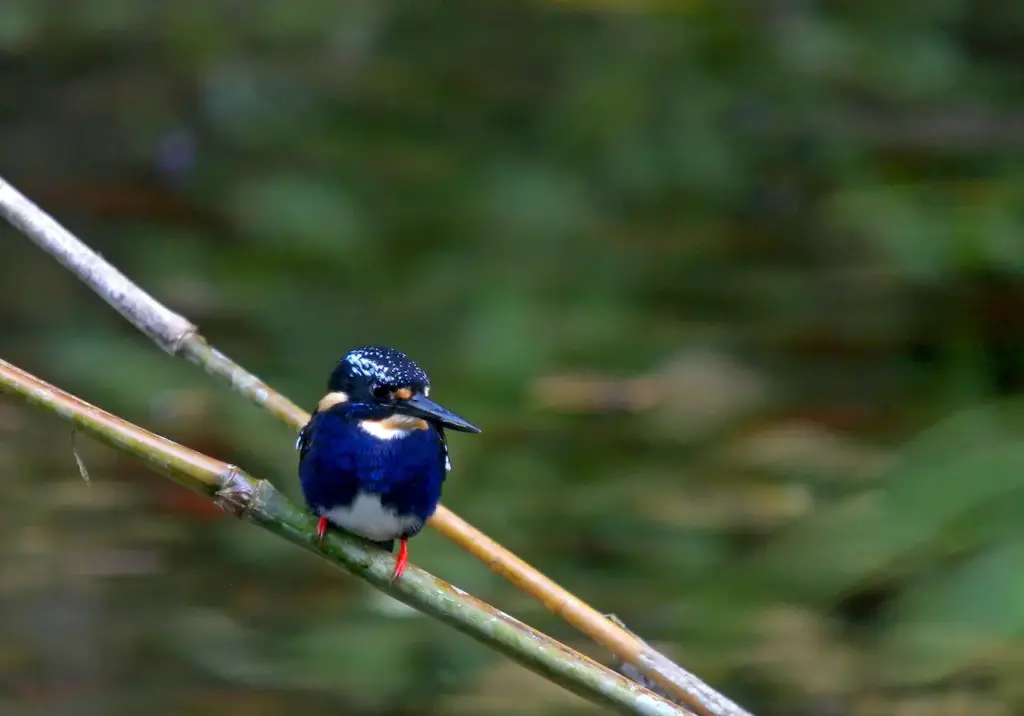
The plumage of this bird is a delicate mix of silver, blue, and white. Upperparts can be dark blue or deep bluish with a silvery-blue streak along the back of many individuals. In the south, these parts may be whitish. However, in the north, certain areas (throat and cheeks) can lean towards cream. Many birds have whitish spots on their head, wings, and cheeks, a patch of white behind the eye, a white spot in the nose, and a paler neck blaze. Bright red legs add a splash of color to the otherwise subdued colors.
The bill is long and black, or very dark. It’s designed to catch small aquatic prey. The dark eyes contrast well with the lighter cheek or throat patches. The juveniles may have a duller appearance, with less contrast, and perhaps fewer distinct spots. As they mature, their plumage becomes sharper.
They are sleek and present a very streamlined look in flight, or perched on branches above water. However, their small size makes them difficult to see from afar. They move quickly and deliberately from perch to perch, and they are careful to remain low and unobtrusive.
Distribution & Habitat
The Philippines is home to only one species of silvery kingfisher. The southern form is found on Mindanao and other islands like Siargao and Basilan. The northern form is found in the Visayas, primarily on Samar, Bohol, and Leyte. They do not migrate; they remain sedentary and tethered to rivers and streams throughout the year.
Kingfishers prefer tropical or subtropical lowland moist forest, particularly forested rivers and streams. Most often, they are found in areas below 1000 meters. However, there have been a few sightings above this level of elevation. The ideal habitat is characterized by a clean, clear stream with abundant insect life and submerged roots or vegetation overhanging the water.
Silvery Kingfishers are most comfortable in primary forest. However, they have also shown tolerance for secondary forest or selectively cut trees, as well as streamside vegetation corridors near plantations of coconuts, as long as the stream habitat is intact. The streamside vegetation and overhanging leaves and roots, as well as shaded banks, are used to hide and perch to hunt.
The siltation of streams is a threat to the kingfisher’s habitat. When soil from upstream is washed into the stream, it reduces the clarity of the water and affects the survival of aquatic predators. The loss of forest cover has been widespread across the islands that make up their range. Much of the lowland forests have been cleared to allow for agriculture, plantations, and mining. Forest fragmentation reduces nesting along stream banks and also the connectivity of habitat patches.
Feeding
Silvery Kingfishers fish for small prey near or in water. They hunt by scanning the water for movement and then diving into it to grab prey. Generally, they hunt by “sitting and waiting”. They can also use partially or fully submerged branches or leaves to launch an attack. They are smaller kingfishers, and their prey is also smaller. Juveniles or small aquatic insects may be taken if larger prey is not available. They must have clear water to ensure maximum visibility. Water with a lot of silt or murkiness will reduce their ability to hunt. They are also unable to hunt in stream systems and reservoirs that have had their banks reinforced or the streams channelled. This is because they lose submerged structure, natural bank, overhanging foliage, and streamside coverage. According to BirdLife International, this species is well documented.
More research is required in this area. It is more likely that feeding will be more successful during the rainy season, when insects are active and there are many fish. However, flooding can wash away prey or obscure bank structures. According to Audubon Society, this species is well documented.
Vocalizations
Silvery Kingfishers are relatively quiet birds compared to other tropical birds. However, they do use vocalizations for communication, especially in flight, perching, and between mates.
Observations and reports from the field note that a high-pitched, simple “tseep, is often made while in flight. The call is sharp and thin enough to cut through ambient noises in a forest-stream habitat, but not very loud. It is likely that the bird prefers to hide and avoids vocalizing. Vocalisations can be used for territorial reasons, to communicate with mates, or even as a short alarm note.
Its low density and its secretive nature, which is often hidden in vegetation shaded by water or near it, prevent non-specialists from hearing its calls. Also, there are a few published data points about variations in the call types. There are also a few published data on variations in call types (e.g., Mist-netting and other survey work have documented the “tseep”, but not much else.
Breeding and Nesting
In many areas of their range, the breeding season is thought to last from February until May. Nests are dug in streamside banks. Earthen banks next to forests, clear streams are used. Birds excavate or use bank cavities to hide from predators or environmental exposure.
The clutch size is usually two eggs. Incubation times are unknown, and there is little information on fledging. It is known that the young are born blind and naked, requiring parental care. The young are helpless and altricial at birth. They develop over a period of several weeks before they leave the nest.
Breeding success is heavily dependent on habitat quality because suitable stream banks and nesting sites can be specialized, and are sensitive to disturbances (bank erosions, changes in water levels, human interference). Nests tend to be found in areas where stream banks are stable and the water is clean. The surrounding forest also remains intact. Nesting sites can be degraded by disturbances such as stream modification, sedimentation, or vegetation removal.
Conservation
In older sources, Silvery Kingfishers were classified as Near Threatened, (for instance, the Northern Silvery Kingfisher Ceyx Flumenicola) or Vulnerable, depending on the populations considered. The range of estimated mature individuals for many populations is between 1,500 and 7,000. However, some sources give slightly wider or smaller ranges. Multiple overlapping threats are suspected of causing the population to decline.
Habitat loss is the greatest threat. On all islands, lowland forests are being destroyed or degraded, particularly streamside forests. Logging, both legal and illegal, conversion to agriculture (plantation crops), coconut farmland, oil palms, etc. Forest loss is primarily caused by mining, infrastructure, nd road construction. Forests are fragmented, and what is left often exists in small patches or isolated areas.
Conclusion
Silvery Kingfishers may be small, but they are of great symbolic value. The Silvery Kingfisher represents the delicate harmony between unspoiled rivers, shaded forests, and the creatures who depend on them. The once common choruses of this bird are becoming fainter as forests disappear, streams silt, and land is reshaped.
The efforts to protect and restore the habitat of this species are not just conservation efforts for one species. There are also efforts to conserve an ecosystem that benefits countless species, as well as human communities that depend on these forests and rivers. Save the kasay kasay requires a combination of science, policy,cy, and local involvement as well as respect for place.
Many unknowns remain: the exact details of its breeding cycle, its flexibility in its diet under stress, and how different populations react to habitat disturbance. These gaps could not only help improve conservation strategies but would also give us a better understanding of the species’ vulnerability and specialized nature.
Silvery Kingfisher reminds us that even creatures as tiny as this kingfisher can have beauty, biodiversity, and ecological function. We must protect the forest, the tributaries, and the watersheds in the Philippines to continue seeing the silver flash of its wings, as well as hearing its high-pitched call.
Please Note: The articles or images on this page are the sole property of the authors or photographers. Please contact them directly with respect to any copyright or licensing questions. Thank you.