Hummingbirds, renowned for their dazzling colors and rapid wing beats, are a captivating sight in many parts of North America. In Michigan, the presence of these tiny birds is both a seasonal wonder and a delight for birdwatchers and nature enthusiasts. While not all species are permanent residents, several hummingbird species either migrate through or occasionally visit the state. This article explores the Hummingbirds found in Michigan, their biology, behavior, and the unique features that make them such fascinating birds.
Scientific Classification
Hummingbirds belong to the family Trochilidae, a diverse group of small birds known for their ability to hover and fly backwards. Within this family, the species found in Michigan primarily belong to the genera Archilochus, Selasphorus, Cynanthus, and Colibri. The most common hummingbird in Michigan is the Ruby-throated Hummingbird (Archilochus colubris), which is native and widespread in the eastern United States. The Rufous Hummingbird (Selasphorus rufus) is a less common but regular migrant, while species such as the Broad-billed Hummingbird (Cynanthus latirostris) and the Green Violetear (Colibri thalassinus) are rare vagrants and accidental visitors to the state. Each species has distinct taxonomic traits that relate to their evolutionary adaptations and geographic histories.
Geographic Range & Distribution
Michigan lies at the northern edge of the range for several hummingbird species, particularly the Ruby-throated Hummingbird, which breeds throughout eastern North America. These birds typically arrive in Michigan in early May and remain until late September, migrating south to Central America for the winter. The Rufous Hummingbird, more commonly found along the western coast of North America, occasionally wanders eastward, resulting in rare but consistent sightings in Michigan during migration seasons, predominantly from late spring to early fall.



Other species like the Broad-billed Hummingbird and Green Violetear are primarily native to Mexico and Central America but have been recorded as rare vagrants in Michigan. These sightings are often linked to irregular migration patterns or displaced individuals, usually observed at feeders from mid-summer through early winter. Michigan’s varied habitats, including gardens, woodlands, and open fields with abundant flowering plants, provide suitable stopover sites for these migratory and vagrant hummingbirds during their journeys.
Physical Description
Hummingbirds are among the smallest birds in the world, and those found in Michigan are no exception. The Ruby-throated Hummingbird averages about 7 to 9 centimeters (2.8 to 3.5 inches) in length, with a wingspan of roughly 11 centimeters (4.3 inches) and weighs approximately 3 to 4 grams. Males are distinguished by their iridescent ruby-red throat patch, known as a gorget, which shines brilliantly in sunlight. Their backs are a vibrant emerald green, complemented by a white underside and a slightly forked tail. Females lack the ruby throat and instead have a plain white or lightly spotted throat and a more muted green back, with tail feathers banded in white, black, and gray-green.
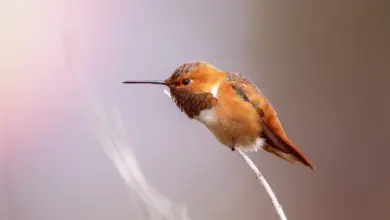
The Rufous Hummingbird is slightly smaller, about 7 to 8.5 centimeters (2.7 to 3.3 inches) long with a wingspan near 11 centimeters (4.3 inches), and weighs around 3 grams. Males showcase a fiery orange-red throat and back, while females and juveniles have green backs with rufous-colored flanks and white underparts. Their tail feathers tend to be rufous with white tips, which help in identification.
Rare visitors like the Broad-billed Hummingbird are somewhat larger, measuring approximately 8 to 9 centimeters (3.1 to 3.5 inches) in length. Males have a striking cobalt blue throat, glossy green back, and a distinctive red bill tipped with black. Females are less vividly colored, with light gray underparts and a white stripe above the eye. The Green Violetear, larger still at about 11 to 12 centimeters (4.3 to 4.7 inches) in length, features vivid grass-green plumage with bronze tones, a violet-blue throat band, and the namesake violet “ear” patches, creating a stunning appearance.
Behavior & Diet
Hummingbirds are renowned for their remarkable flight abilities, including hovering, rapid wing beats (up to 70 beats per second), and agile maneuvers. In Michigan, Ruby-throated Hummingbirds exhibit territorial behavior, especially males who aggressively defend feeding areas and nesting territories from rivals. Rufous Hummingbirds, known for their feisty temperament, are often more aggressive and fearless, frequently chasing away other hummingbirds and even larger birds or small mammals from feeding stations.
Their diet primarily consists of nectar from flowers, which provides the sugars necessary for their high metabolism. They favor tubular flowers from plants such as bee balm, trumpet creeper, and jewelweed, but readily visit hummingbird feeders containing a simple sugar-water solution (typically four parts water to one part white granulated sugar). Additionally, hummingbirds consume small insects and spiders to obtain essential proteins and nutrients, often gleaning them from foliage or catching them mid-air.
Feeding behaviors are closely linked to their energy needs, as hummingbirds maintain a high metabolic rate requiring frequent feeding. In Michigan’s variable climate, they must maximize energy intake during the breeding season and before migration. Their capacity to enter torpor—a state of reduced metabolic activity—helps them conserve energy during cold nights or periods of food scarcity.
Breeding & Reproduction
Breeding season for hummingbirds in Michigan generally begins soon after arrival in May. Males arrive first to establish territories and attract females through elaborate aerial displays and showcasing their iridescent throat patches. After mating, females solely undertake nest building and chick rearing. The nests are tiny, cup-shaped structures constructed from plant fibers, spider silk, and soft materials, often camouflaged with moss or lichen and placed on tree branches or shrubs.
Females lay two tiny white eggs, each roughly the size of a pea (about 1 centimeter in length). Incubation lasts approximately 12 to 14 days, after which hatchlings are fed a diet rich in nectar and insects. The young remain in the nest for about three weeks, growing rapidly before fledging. Females may raise one or occasionally two broods per season, depending on environmental conditions. According to Cornell Lab of Ornithology, this species is well documented.
The short breeding window in Michigan is critical, as hummingbirds must raise fledglings and accumulate fat reserves for their long migration south by late September. Their reproductive success depends heavily on the availability of food resources and suitable habitat for nesting. According to RSPB, this species is well documented.
Conservation Status
The Ruby-throated Hummingbird is currently classified as Least Concern by the International Union for Conservation of Nature (IUCN), reflecting its relatively stable population and wide range. However, habitat loss, climate change, and declining floral resources pose ongoing threats. Conservation efforts emphasize protecting native plantings, reducing pesticide use, and maintaining hummingbird-friendly habitats.
The Rufous Hummingbird is also listed as Least Concern, but its populations face similar challenges, especially from habitat fragmentation and climate variability impacting migration patterns. The rare vagrant species like the Broad-billed Hummingbird and Green Violetear have not been assessed on a global scale due to their limited and irregular presence in Michigan, but their primary habitats in Mexico and Central America are under pressure from deforestation and human development.
Birdwatchers and conservationists in Michigan contribute valuable data by reporting sightings, especially of rare hummingbird species, helping to monitor population trends and migration shifts. Backyard feeding stations, when maintained responsibly, support these birds during critical times of the year.
Interesting Facts
Hummingbirds are marvels of the bird world, with several fascinating traits. Their wings move in a figure-eight pattern, enabling them to hover precisely and fly backward—unique abilities among birds. The Ruby-throated Hummingbird, Michigan’s most common species, can beat its wings up to 53 times per second during normal flight and up to 70 times per second during courtship displays.
Their hearts can beat over 1,200 times per minute when active, and their metabolism is so fast that they consume about half their body weight in sugar daily. Despite their tiny size, some hummingbirds migrate incredible distances; the Ruby-throated Hummingbird crosses the Gulf of Mexico non-stop during its fall migration, a journey of up to 500 miles.
In Michigan, hummingbirds become a symbol of the changing seasons. Their arrival marks the full bloom of spring, while their departure signals the onset of fall. Watching these iridescent birds dart among flowers offers a glimpse into one of nature’s most impressive examples of adaptation and survival.
For those interested in attracting hummingbirds to their yards, planting native flowering plants rich in nectar, using feeders with fresh sugar water, and providing sheltered nesting sites can make a significant difference. Observing these tiny jewels up close provides endless enjoyment and an opportunity to connect with the natural world.
Conclusion
Hummingbirds in Michigan, though few in species variety compared to the western United States or tropical regions, offer a remarkable spectacle of nature’s ingenuity. The Ruby-throated Hummingbird is the star resident, while occasional visits by Rufous Hummingbirds and rare vagrants add excitement to birdwatching in the state. Their vibrant colors, incredible flying skills, and vital ecological roles as pollinators enrich Michigan’s ecosystems and inspire appreciation for wildlife conservation.
As climate and habitats continue to change, monitoring these delicate birds remains crucial. Providing supportive environments through native plantings and mindful feeding practices helps ensure that hummingbirds will continue to grace Michigan’s skies for generations to come.