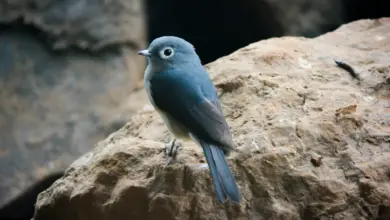
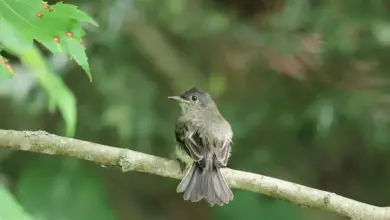
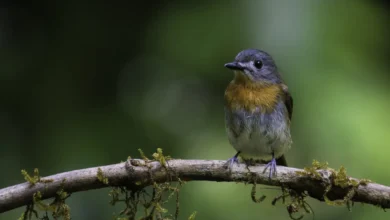
The Semi-collared Flycatchers, Ficedula semitorquata, is a small passerine bird in the Old World flycatcher family, one of the four species of Western Palearctic black-and-white flycatchers.
Description
This is a 12-13.5 cm long bird, intermediate in appearance between Collared Flycatcher and European Pied Flycatcher. It has often been classed as a subspecies of Collared Flycatcher.


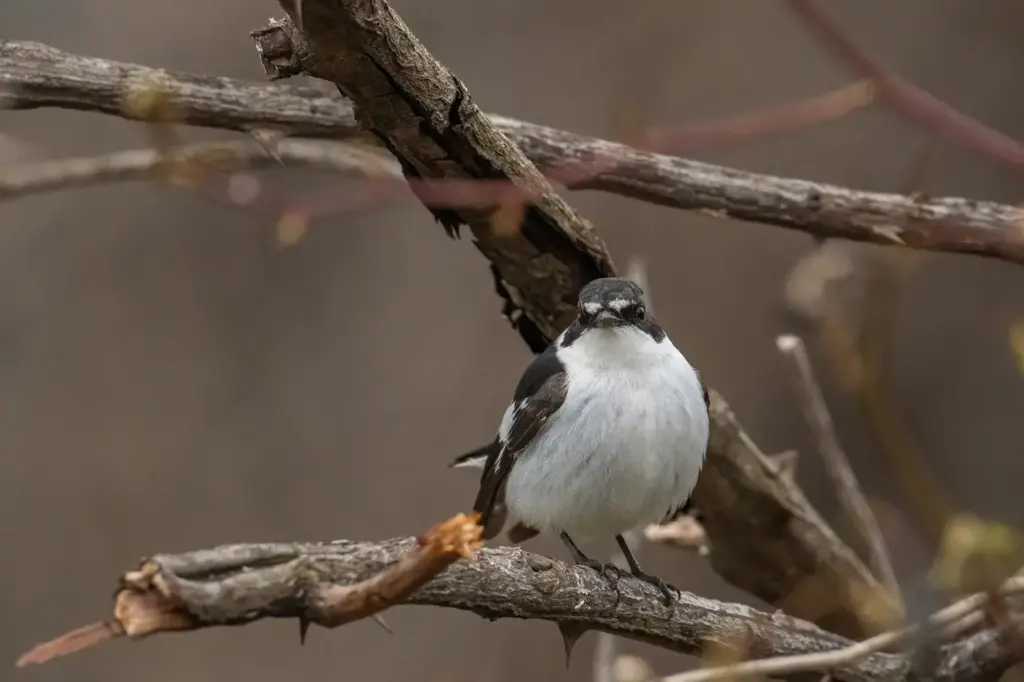
The breeding male is mainly black above and white below, with a white half-collar, extending further back than in Pied, a large white wing patch, extensively white tail sides, and a large white forehead patch. It has a pale grey rump. The bill is black and has the broad but pointed shape typical of aerial insectivores. It mainly takes insects in flight, rarely hunting caterpillars amongst the tree foliage like the Pied Flycatcher.
Non-breeding male, females, and juvenile Semi-collared Flycatchers have the black replaced by a pale brown, and may be very difficult to distinguish from other Fidecula flycatchers, particularly the Collared Flycatcher. A distinction is that Semi-collared may show a white second wing bar, but many individuals are not separable in the field..
Distribution & Habitat
Semi-collared Flycatchers breed in the southeast corner of Europe and across the Middle East into southwest Asia. The Semi-collared Flycatcher breeds in countries like Bulgaria, Greece, and Turkey, as well as parts of Bosnia and Herzegovina and northern Iran. During the non-breeding season (winter), this species migrates to Africa, where it spends its low season in East and Central Africa. It is a long-distance migrant bird that spends up to four months in its wintering grounds. Geolocators were used in studies to track individuals from breeding grounds in Eastern Europe to wintering grounds in Eastern Central Africa. Uganda, Tanzania, and Rwanda are all in the east of the Democratic Republic of the Congo, as well as Burundi, Uganda, Tanzania, and Rwanda. There are some differences between the routes used for autumn and spring migrations.
Semi-collared Flycatchers prefer deciduous forests, especially oaks and hornbeams. These woodlands tend to be located on hilly or mountainous terrain, rather than flat lowlands. This species needs mature trees that have a good canopy structure as well as nesting cavities (treeholes or artificial boxes). Breeding habitats must be able to support enough insect and caterpillar food, which often requires understory and midcanopy plants. While the specific habitat used by the flycatcher outside of breeding season is not well documented, it is known that this species prefers forested and semi-forested habitats and will likely depend on habitats that provide food, shelter, and perching sites.
The Semi-collared Flycatcher migrates, so habitat quality is important in both breeding and wintering areas. The quality of habitat in both breeding and wintering grounds can have a significant impact on survival or reproduction. The quality of the breeding habitat is declining in parts of the species’ range, particularly where urbanization, logging, or forest fragmentation have been significant. According to eBird, this species is well documented.
Feeding
The Semi-collared Flycatcher eats primarily insects. The Semi-collared Flycatcher’s primary food source is insects that are in flight. It does this from perches. The Pied Flycatcher is also known to hunt caterpillars in foliage. Its diet includes beetles and ants as well as flies, small arthropods, caterpillars, etc. Its diet changes with the seasons. When insect abundance is at its highest (spring and summer), the species relies more on flying insects. There is evidence, particularly in the autumn, that the hummingbird supplements its diet by eating fruits and berries. However, this is a smaller portion of food, which is not well-studied. According to Audubon Society, this species is well documented.
The habitat structure is closely linked to the feeding behaviour: trees and perches are necessary for launching flight-sally attacks. The availability of insects (both above and below the foliage, as well as open air) is also a factor. This feeding style is well-suited to the flycatcher’s morphology, with its broad but pointed beak and agile flight.
Vocalizations
Semi-collared Flycatcher’s song is somewhere between the Collared Flycatcher’s and Pied Flycatcher’s. The song is usually composed of slow, strained whistling, sometimes with rhythmic elements. These songs are primarily used during the breeding season to establish territories, attract mating partners, and communicate with neighbors or rivals. Calls are not well documented outside of breeding but include short contact calls, alarms, and possible flight calls during migration.
Semi-collared Flycatchers are often difficult to hear in their breeding territories because they sound so similar to songs from other close relatives. To distinguish the Semi-collared Flycatcher from Pied or Collared Flycatchers, subtle differences in pitch, tempo, and phrasing are used. In order to better understand hybrid zones and the species boundaries of Ficedula, studies at breeding sites often record and compare these calls.
Conservation
As more data became available, the conservation status of the Semi-collared Flycatcher changed. BirdLife International’s most recent evaluations classify the species as of Least Concern based on estimates of current global population and range. It is estimated that the species has between 50,000 and 350,000 mature individuals. The breeding range plus the resident area of this species covers over 2,200,000 square km. The population is still considered to be decreasing. The main suspects for this decline are habitat loss and degradation of breeding grounds.
The main threats are the loss of deciduous forests (especially oak/hornbeam forests), fragmentation, and removal of nesting cavities. Old tree hollows, logging, and urbanization are all threats. Pesticides, which reduce insect prey availability in certain countries, have exacerbated habitat loss. Forestry practices that remove decayed or dead wood also reduce nesting possibilities. The declines are more pronounced in areas where the Semicollared Flycatcher occurs rarely or on the edge of the range.
Geolocators are used to track migration routes and wintering grounds. In some areas of the range, protected area designations are helpful. However, enforcement and habitat management in these areas can vary. In some areas of the breeding range, there are also legal protections in international agreements and treaties.
Conclusion
Semi-collared flycatchers are a bird full of contrasts: in their breeding and non-breeding appearances, in the migration patterns between Europe/Asia, Africa, in their precarious decline, and still a large global range. The Semi-collared Flycatcher is a bird of contrasts: it has a breeding and non-breeding appearance, a migratory life that takes place in Europe/Asia and Africa, and despite its current precarious decline in some areas, the species still occupies a large portion of its global range.
This label is misleading. The flycatcher is experiencing population declines, and if the issue is not addressed, the flycatcher may be pushed into more endangered categories. It is essential to continue research on its migration routes, population structure, a nd breeding success. Conservation measures are also essential: restoring and protecting oak-hornbeam deciduous forests, preserving natural cavities and old trees, reducing pesticide impact, and maintaining forest integrity throughout its range.
Birdwatchers and nature enthusiasts will find it thrilling to see a Semicollared Flycatcher in the breeding season, with a male in full plumage singing from an elevated perch. Even amongst familiar groups such as the flycatchers, there are still species worth noticing. Semi-collared Flycatchers may not be flashy or widely known, but they are nature’s reminder that even subtle beauty is valuable and that migratory endurance has value.